














Legacy modernization
Modernization, sustained: AI-driven operations in action


For decades, wealth management has operated on a predictable cadence: a dedicated advisor, a quarterly review and the assumption that markets, opportunities and client needs move slowly enough to wait for the next scheduled meeting. In reality, they don’t.
This is the story of Marcus, a typical high-net-worth wealth customer who discovered that reality the hard way, and how a new-age wealth management firm’s agentic architecture turned continuous attentiveness into its strongest competitive advantage.
Marcus is the client every wealth management firm wants: a successful entrepreneur with a rapidly expanding balance sheet. For years, he trusted Heritage Wealth, where his dedicated advisor understood his long-term goals and risk tolerance. Their quarterly sit-downs were thorough and reassuring. However, outside those ninety minutes every three months, any proactive interaction was virtually non-existent.
This particular low-touch arrangement, however, fell apart during an exceptionally profitable business month. Flush with an unexpected cash windfall, Marcus called his advisor to deploy the capital immediately. Overburdened with manual administrative work across his broader client book, the advisor's earliest available appointment was nearly four weeks away.
Three weeks into that wait, while playing golf, a friend mentioned an investment opportunity that aligned perfectly with Marcus’s growth profile. By the time Marcus’s meeting with Heritage finally occurred, the opportunity had re-priced. He missed it entirely.
Marcus was left with two palpable frustrations: the idle money left on the table, and the realization that no one at Heritage Wealth was actively watching his portfolio, or his life between the quarterly meetings.
Marcus’s friend who captured that investment opportunity is a customer with Apex Wealth: a relatively new entrant in the wealth management space that had recently rebuilt its client experience around agentic AI. Instead of relying on static dashboards or waiting for scheduled check-ins, Apex deploys a network of AI agents that operate continuously in the background. These agents monitor markets, portfolios and significant life events, such as unexpected cash inflows, market shocks or emerging opportunities that warrant timely action.
When an event occurs, Apex's agents do not merely issue generic alerts. They reason through the context: analyzing what the shift means for the client’s specific goals, risk tolerance and tax positioning, and then formulating a concrete recommendation for portfolio rebalancing. Both client and advisor are notified simultaneously with a pre-validated execution plan.
Frustrated with Heritage’s operational latency and passive portfolio oversight, Marcus gradually transferred his entire portfolio to Apex over the next quarter. Soon after joining Apex, Marcus notices something subtle. He does not necessarily speak to his advisor more often. But the interactions that do occur are more relevant, more timely and better prepared. The firm seems to know not just when something matters, but why it matters to him.
This is how an ordinary Tuesday now unfolds for Marcus as an Apex wealth customer:
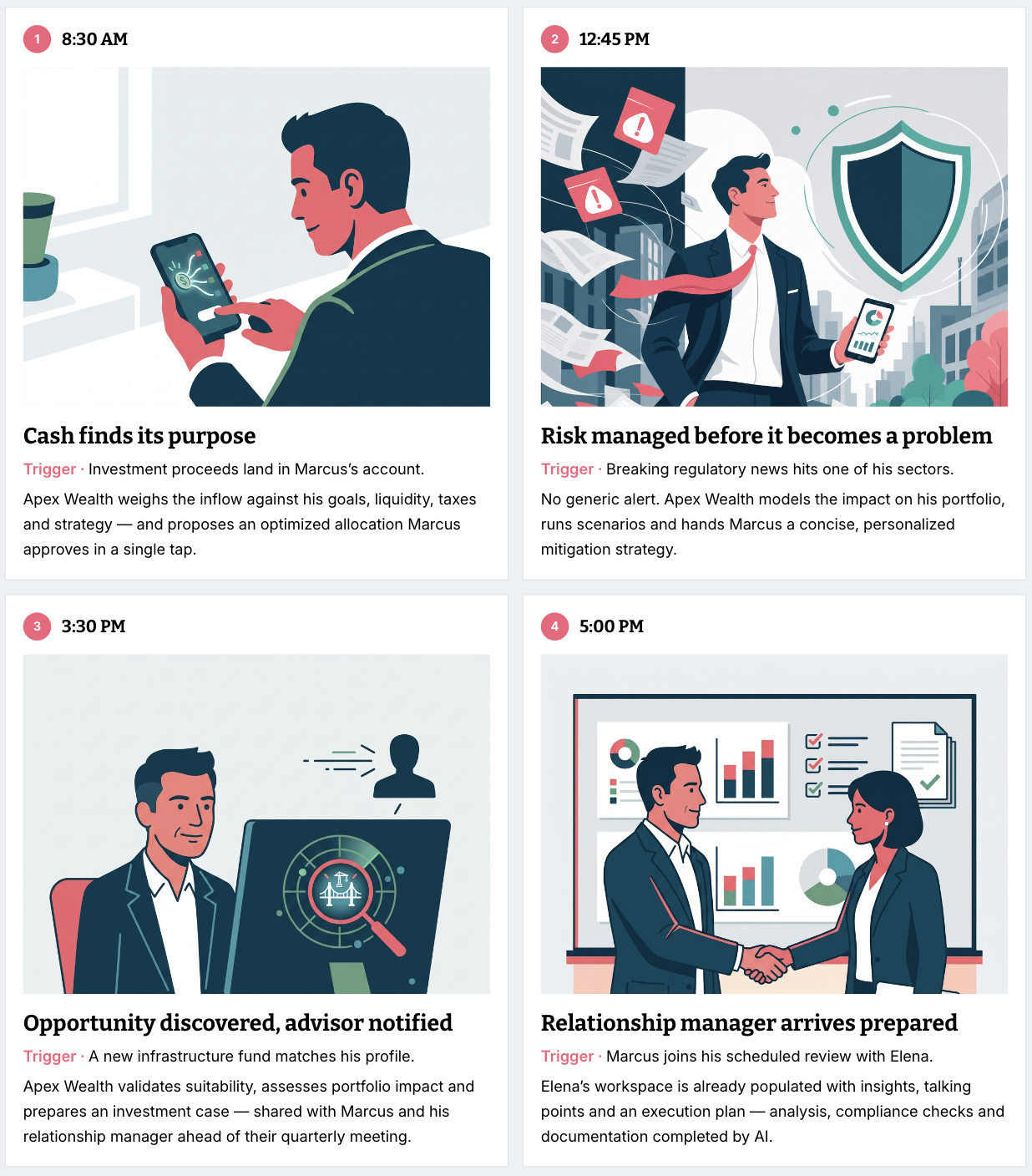
These days, instead of reviewing reports, Marcus spends focussed time discussing strategy, validating the recommendation through the RM’s expertise and agreeing on the next steps. Marcus gives a verbal confirmation, and Apex automatically initiates the downstream execution workflow.
From Marcus’s perspective, the entire interaction with his wealth management platform feels intuitive, effortless and most important of all, near real-time. However, to deliver this experience, Apex needed to rebuild their wealth management system to employ AI agents that would proactively help clients like Marcus achieve their financial goals at pace and scale. They realized very early that simply throwing AI at their inflexible legacy environment with locked-in data was just too costly and failed to produce the desired results when they tried to scale their POCs in production.
They needed deliberate modernization aimed at incrementally rearchitecting their legacy monolithic systems into domain aligned, modular, decoupled and composable services. They started with domain modelling and business capability mapping alongside user experience design and service journey mapping. Their key objective was to make their transition to an agentic wealth management system an additive change, both for their technology and their organization.
They were intentional in their build vs buy choices and used domain driven patterns like bounded buy to integrate both in-house and off-the-shelf services. The resulting architecture provided them with domain-aligned APIs. With the underlying data also split along domain ownership boundaries, their APIs provided open yet secure access to data that agents need to construct context for their queries to LLMs.
Opening up their architecture also allowed Apex Wealth to automate many of their manual processes around portfolio optimization, investments and advice, originally supported by an unsustainable collection of spreadsheets that were a substantial risk to the business.
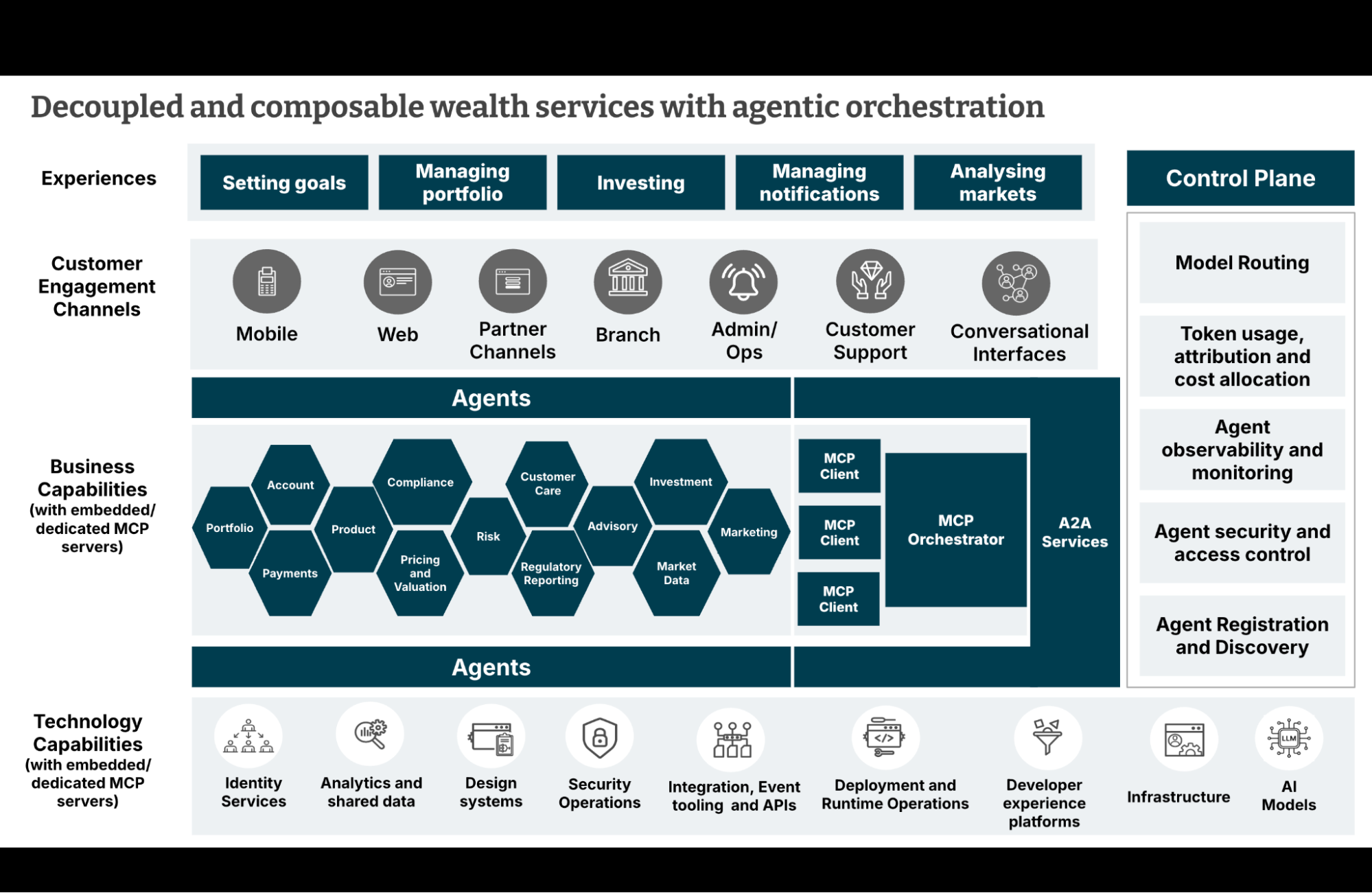
One important component of any agentic system is the agentic control plane and its value in an agentic wealth management system cannot be overstated. Without the agentic control plane, it will be near impossible to govern the system to minimize risks, achieve compliance and understand the costs.
The insights that the control plane provides also help optimize agentic behavior for higher ROI. Token usage assessment and their attribution to respective workflows allows cost allocation to these workflows. This in turn enables ROI calculations when paired with granular revenue data. This also helps build and optimize unit economics of AI which act as the leading indicator to the ROI. Unit economics specifically enables teams to diagnose and optimize prompt and context verbosity and reduce AI usage where just tools and resources are sufficient.
Transitioning to an agentic architecture for their wealth platform was not just a technical change for Apex Wealth but also a socio technical change for both their technology and business teams. Because clients can now get notified on market data, performance of their portfolio, relevant news events and product changes, along with what it means to their financial goals, the role of advisors and analysts transitions to using their freed up capacity on maximizing opportunities and minimizing risks for both their clients and the firm. They now need to define the guardrails and constraints that can be implemented in the system to stop an agentic system from introducing risk. They may have more interactions with their clients but their technology now better supports and prepares them for these very focused and targeted conversations.
Technology teams have to transition to a platform and a product operating model. The common shared business and technical capabilities are assimilated into platforms that are built and maintained as products with intentional long term investment. Portfolios of agentic workflows are also treated as long running products, investments in which are predicated to the ROI of individual and collective workflows in a portfolio. This makes investments into technology intentional and aligned with the commercial and business goals of the firm so that they can deliver optimum value to their clients economically and safely with speed and confidence.
Marcus's story isn't an isolated one. Morningstar found that 62% of investors who fired their advisor cited the cause to be poor quality of service, advisor relationship or communication, compared with just 11% who left because of poor returns. Clients don't just leave over performance; they leave when they stop feeling valued. That's what happened with Marcus: nobody was paying attention when it mattered.
The challenge is structural. Most firms struggle to deliver continuous, personalized attention to every client at scale. And this gap is expected to widen further with the great wealth transfer where, over the next two decades, about $84 trillion is expected to move to a new generation that expects digital, personalized and always-on service as standard. Adding more advisors won't scale. Agentic AI can augment human capacity: continuously sensing what matters, turning signals into context and preparing the right action.
The question is no longer if a wealth management firm will pursue agentic transformation, but when. Delaying it will increase competitive pressures. Rushing into it headlong risks prioritizing investments in capabilities and workflows that provide limited returns.
Thoughtworks has helped businesses build their AI and agentic transformation strategies which have enabled them to make value led investments in their future agentic systems. The evolutionary nature of these systems enables adaptation to changing business requirements with comparatively lower costs. Executing such an agentic strategy allows firms to achieve an early and incrementally increasing ROI, building the confidence of the business and the customers alike.
Disclaimer: The names, firms, scenarios and events described in this article are entirely fictional and are used for illustrative purposes only, with the sole intention of depicting the potential applications and implications of agentic AI in wealth management. They do not refer to any specific organization or an individual.