















The clock is ticking for the UK’s financial institutions to implement profound changes to the securities settlement timeline, moving from T+2 to T+1. If that sounds like a simple change, the reality is anything but. If you think you have yet to reach the last responsible moment to start preparing for this critical regulatory and operational shift, think again!
Here, we walk you through the risks and challenges, recommendations to help mitigate them, and the key technical considerations needed to manage this change effectively.
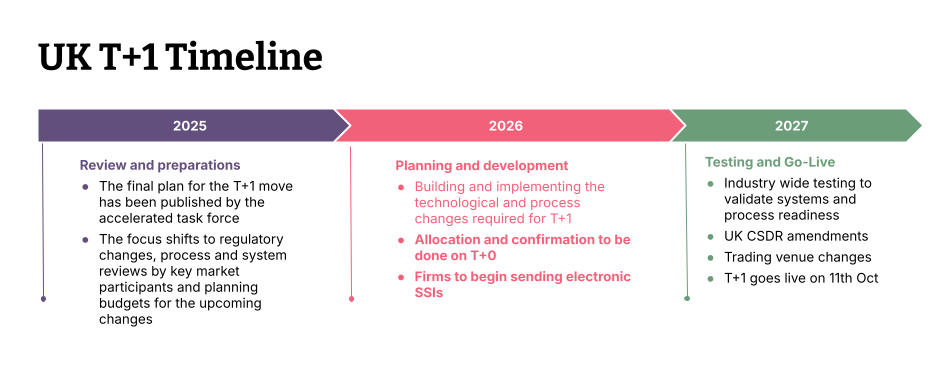
The Accelerated Settlement Taskforce, set up by the UK government, has set an October 11, 2027 deadline for the UK’s financial services markets to move to T+1 settlement. While the EU and Switzerland have similar deadlines, the FCA has also specified intermediate milestones to support the industry’s transition.
The intention of this proposed regulation is to:
Reduce settlement and counterparty risk. With the London Stock Exchange processing nearly 800,000 daily trades valued at over £5 billion, unsettled trades represent a major source of systemic risk that T+1 helps mitigate.
Increase market efficiency.
Improve liquidity.
Align with the T+1 movement across Europe.
Align with global markets. The US recently moved to T+1, while China, India and many other markets already operate on a T+1 settlement timeline.
However, this is not going to be easy. As we saw with the US move to T+1, institutions face significant operational hurdles, such as the requirement to send standard settlement instructions on T+0, the need to compress FX processing windows, and the complexity of managing misalignment with markets still operating on T+2 (more on this in the next section).
What makes this even more difficult is that post-trade processes in the UK grapple with persistent challenges around legacy systems and manual interventions. Overcoming these will require comprehensive planning across multiple stakeholders, extensive technology upgrades, and significant adjustments to how things are currently done.
Some key challenges that make a move to T+1 significantly harder:
Trade enrichment: In many instances, the data necessary for enrichment simply isn't available when needed, forcing manual interventions that cause inevitable settlement delays.
Trade failures: Sudden spikes in volume during volatile periods have historically led to trade failures. Under T+1, the window to recover from these failures virtually disappears.
Legacy systems: Inconsistent automation plagues both in-house technology and B2B settlement services. Since T+0 matching is critical for T+1 success, these legacy blockers prevent the complete, robust automation required and need to be addressed as a priority.
Data standardization: The UK lacks a unified format for SSIs (Standing Settlement Instructions). Currently, the absence of a standard, automated way to store and share this data leads to inconsistencies and inaccuracies. This introduces significant risk and is often the primary culprit behind trade failures.
Lessons from the US move to T+1
The UK can learn a great deal from the US transition to T+1. Key lessons include the importance of rigorous planning, a strong focus on automation and technology upgrades, effective communication and client education, and the need to streamline upstream processes across the trade lifecycle.
Not all approaches will translate directly to the UK market, but they provide a strong foundation for planning and executing a smooth transition.
Key lessons from the US move to T+1 in 2024
Early and comprehensive planning: Engaging all key market participants is essential for success. The US transition was strongly supported by the DTCC, demonstrating the importance of working closely with the CSD.
FX execution challenges: Aligning FX within the compressed timeframe is critical to avoid settlement failures; pre-funding or earlier execution may be required for cross-border transactions.
Standing settlement instructions: Sending SSIs on T+0 is fundamental. Given the UK’s challenges around standardized SSIs, this is an area that will need significant automation.
Trade allocation and confirmation: These must occur on T+0. The US demonstrated that T+0 allocation is achievable, but automation of post-trade processes is key to reducing operational pressure. Resolving clearing breaks by T+0 is critical; the UK’s challenges with trade enrichment will need to be addressed.
Technology upgrades: Many firms needed to upgrade legacy systems for faster processing and increased automation. Robust, integrated platforms, effective data management and real-time information access are essential.
Cross-border hurdles: Time zone differences (particularly for Asia-Pacific firms) increased FX complexity and funding costs. Misalignment with T+2 markets created settlement mismatches, while ADRs and dual-listed securities introduced additional complexity. Strong international coordination and FX management strategies are required.
Securities lending impact: T+1 compressed recall timelines for on-loan securities, increasing settlement failure risk. Adjusting operating practices, ensuring timely collateral receipt and strengthening communication are key for lenders and borrowers.
ETF processing: ETFs faced potential disruption due to underlying securities settling on different cycles (T+1 vs T+2).
Operations: Many firms increased operational headcount during the transition to support trade processing and settlement. The UK should expect similar short-term pressure.
Technical considerations for faster settlements
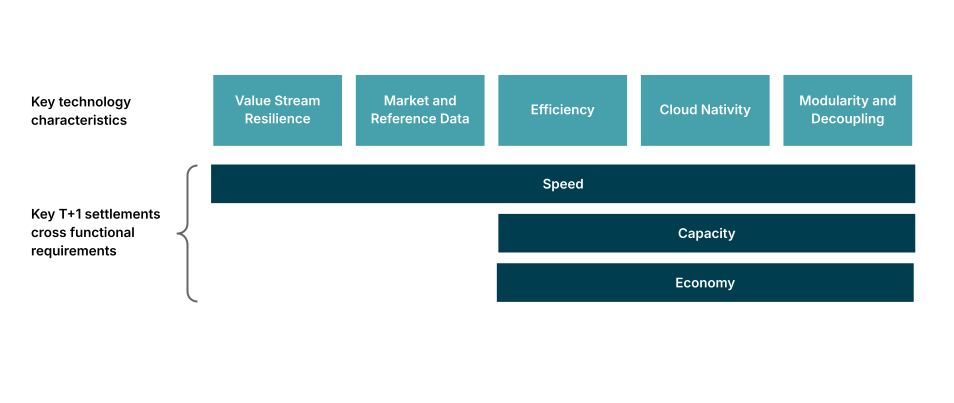
The primary considerations for faster settlements are processing speed and scalable processing capacity. Together, these reduce response times while enabling firms to scale economically as transaction volumes fluctuate throughout the day.
This creates a significant challenge for firms still relying on monolithic or tightly coupled systems hosted in on-premise data centers. On-demand horizontal scaling in these environments is often limited and costly, as tightly coupled architectures typically require significant overprovisioning to handle peak loads.
For middle and back-office technology, this implies the need to:
Decouple systems and services to enable granular horizontal scaling that matches varying transaction volumes.
Optimize compute, storage and communication resources to achieve high processing speeds with maximum efficiency.
Leverage the public cloud for on-demand capacity and storage, avoiding the costs associated with maintaining idle on-premise infrastructure.
Ensure the resilience of the processing value stream to minimize data errors and processing failures.
Guarantee timely access to accurate, complete market and reference data for enrichment, including efficient methods to normalize and validate diverse SSI formats.

Modularizing and decoupling systems
Horizontally scaling monolithic or coarse-grained services is expensive. Scale-out costs are high because every instance requires significant resources. You are forced to scale the entire monolith, even if the bottleneck is caused by the load on just one specific capability.
Modularizing a monolith into granular, domain-aligned and decoupled services can significantly reduce these costs. With this approach, only the services actually experiencing a processing bottleneck need to be scaled, providing both capacity and performance exactly where it is needed. Because each modular service consumes a fraction of the resources a monolith would, the cost to scale is drastically lower.
Domain-driven design (DDD) enhances this decoupling by encapsulating domain-specific implementations within their respective microservices. As a result, changes rarely ripple through the entire system. This reduces the cost and time required for updates, enabling teams to keep systems evergreen and relevant to the business.
Achieving performance through efficiency
Optimizing computation, storage and communication helps achieve higher performance at reduced costs. This requires regularly profiling services to identify and remediate processing hotspots.
Using data structures and messaging formats that optimize storage, retrieval and communication contributes to reduced latency and eliminates the need for expensive caches, keeping the overall architecture simple. Optimized services have a smaller computational footprint, which also lowers scale-out costs.
Public cloud hosting
The primary benefit of the public cloud for T+1 processing is on-demand elastic capacity. On-premises infrastructure often forces firms to over-provision to meet stringent peak requirements, resulting in wasted investment in idle capacity and higher maintenance overheads.
Moving to the cloud offers a significant opportunity to reduce these costs. Through elastic scalability and consumption-based pricing, firms can leverage optimized, decoupled services that scale granularly, paying only for what they use.
Additionally, the cloud unlocks extensive automation in provisioning, deployment and cost tracking. While the raw unit cost of cloud resources can be higher, the combination of automation and efficiency leads to superior unit economics, lowering the actual cost per business operation.
Processing value stream resilience
Instabilities in the processing value stream pose significant risks to T+1 goals. Primary among these are data validation failures and system faults.
Ensuring trade settlement data quality closer to the source is essential for maintaining processing throughput. This minimizes the downstream overhead of diagnosing failures caused by invalid, incomplete or incorrect data. Achieving this requires partnering with counterparties to demonstrate the commercial value of validating and correcting data early.
Settlement systems must also handle diverse industry formats and schema versions, particularly for data like SSIs. Consequently, robust validation and transformation to a normalized format are critical parts of the value stream. Ensuring these processes are resilient and performant is key to the success of faster settlements in general, and T+1 in particular.
Finally, the importance of service resilience across the value stream cannot be overstated. This is largely achieved through a strong focus on software quality. An architecture and engineering platform that provides early warnings of deteriorating system health (and enables rapid recovery from failures) is vital to preventing disruptions in the processing pipeline.
Market and reference data credibility
Settlement processes require enriching trade and settlement messages with market and reference data. The timely availability of valid, accurate and complete data is essential to prevent processing delays.
This data is generally sourced from third parties via data feeds or file downloads. Since it is utilized across the firm, a dedicated team typically manages sourcing and internal distribution through mechanisms such as APIs, files or data streams. The reliability and performance of these internal sources are critical to the timely processing of settlements.
Systems with strict performance requirements often cache market and reference data to guarantee its availability. However, caching strategies should be carefully considered, as they increase the cost and complexity of the settlement value stream.
The time to act is now
On average, market participants pay €850 million annually in cash penalties for failed trades. Failing to meet T+1 settlement timelines could push these penalties beyond €1 billion.
In contrast, timely investment in streamlining your trade processing value stream, through targeted modernization and optimization of your technology stack, could cost less than €100 million, delivering a compelling ROI.
These focused investments will yield systems and operating models, across both business and engineering, that help you achieve higher performance, scalable capacity and economic efficiency. By acting before the October 2027 deadline, you not only ensure T+1 compliance but also minimize costs and unlock new opportunities for business growth.