














Data strategy
Semantic drift and semantic integrity: Stewarding meaning in the age of AI


The financial services industry is caught between the impressive, accelerating capabilities of generative AI and the need for trust. What makes this moment uniquely dangerous isn't the technology itself but a property of general-purpose technologies that history has repeatedly underestimated: they create the illusion of expertise in whoever wields them.
This collision creates a tension: financial institutions build something they believe is brilliant, but struggle to pause and examine whether the solution actually adds value, or, worse, compromises decades of hard-won trust. This isn't just about AI's technical risks. It's about how general-purpose technologies seduce us into confusing fluency with mastery, and building with understanding.
Before the dopamine of accelerated delivery fades, financial services leaders must answer three simple questions:
What, exactly, are you building?
Is it genuinely valuable?
Would you stake your institution's reputation on it , not in a demo, but in a downturn?
In this blog post we’ll look at how to ensure AI enthusiasm strengthens your organization rather than undermining your focus on what matters.
The consequences of integrating AI agents into financial services can be understood as a decomposition of three distinct layers:
The engagement layer. This is where customer interaction takes place; it's now migrating to embedded finance and autonomous agents.
The intelligence layer. This is where analytics, personalization, security and other data-oriented facets of financial services happen.
The system of record (SoR). This is the regulated ledger or the chartered balance sheet; it's the sovereign-backed anchor of financial trust.
The first two layers are becoming increasingly commoditized. However, when thinking about trust and maintaining the institutional legacy that customers look to as the foundations of their relationship with a bank or financial services company, it's the third layer that demands attention. It's the non-negotiable moat.
One way of navigating this is to see AI not as a driver of innovation, but rather as an operational enabler that will strengthen the foundations of the institution. An illustration of this shift can be seen in JPMorgan Chase's reclassification of AI spending from 'discretionary innovation' to 'core infrastructure' in early 2026, a move that places AI investment explicitly alongside data centres, payment systems and core risk controls, not alongside product roadmaps or customer experience initiatives.
The bank's most prominent AI deployment, the LLM Suite, available to more than 60,000 employees, is intended for internal productivity: summarising regulatory documents, drafting internal communications, automating administrative tasks that previously consumed significant analyst time. The investment is not aimed at the engagement layer. It is aimed at making JPMorgan's existing operational capability cheaper, faster and more reliable to execute, hardening what already works, not assembling something new.
This distinction matters because it runs directly against the instinct that general-purpose AI tools tend to produce. When building feels this accessible, the gravitational pull is always toward the engagement layer, the visible, the demonstrable, the things that generate excitement in a boardroom. The System of Records (SoR) layer is unglamorous, heavily constrained and resistant to the rapid iteration that makes AI development feel rewarding. It does not produce demos. It produces resilience. And for an institution whose customers have placed decades of trust in its ledger integrity, resilience is the product, whether or not the builder's instinct recognises it as such.
The lesson, then, isn't to build more AI applications; it's to treat AI as infrastructure for the layer you cannot afford to lose, and to be honest about which layer that actually is.
That's often easier said than done. The very tools that make AI accessible also make it feel intuitive, and leaders who have recently discovered the satisfaction of building are rarely inclined to pause and evaluate dispassionately what they have assembled. Add to that the practical reality that infrastructure investments are understood to be significantly larger than other forms of spending, and that work in this area carries a degree of perceived increased risk, and the conditions for careful strategic judgment become difficult to sustain. In other words, saying we need a mindset shift is all well and good: what's hard is actually making that happen.
To do this, organizations need a framework to guide and enable decision making and, ultimately, to ensure that enthusiasm doesn’t get in the way of considered and strategic judgment. We propose the EEP Framework, designed to help leaders evaluate initiatives across three dimensions: economics, engineering and psychology.
Effective AI investments sit at the intersection of all three. They’re invariably situated at the point where financial returns, technical feasibility and human trust converge.
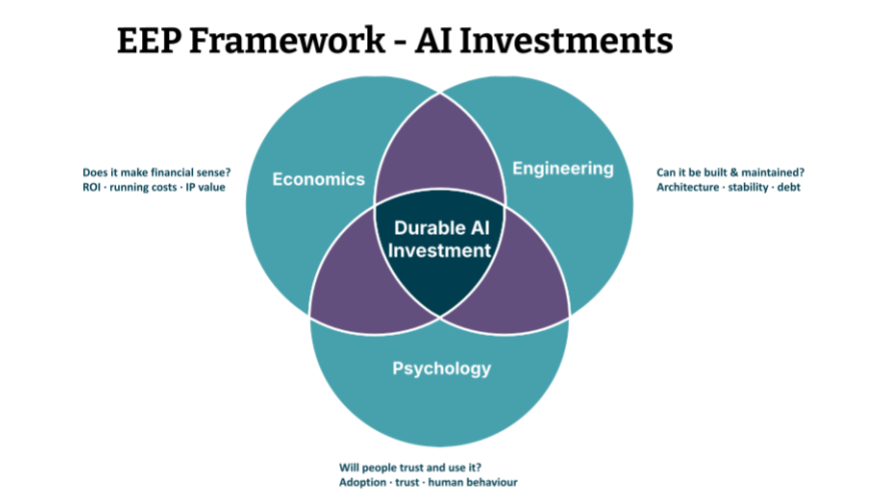
Let’s take a look at each of these elements separately before exploring how, taken together, they can guide good decision making around AI.
Anyone who’s been working with AI inside their organization in the first half of 2026 will be aware that costs are increasing. The shift from flat-rate costs to consumption costs are proving a significant headache for many organizations — in financial services and beyond.
To complicate the picture, the build-versus-buy calculation has also been shifting. According to Menlo Ventures' 2025 State of Generative AI in the Enterprise report, 76% of enterprise AI use cases are now purchased rather than built internally — that’s a significant flip from the 47% build ratio of the prior year.
One of the reasons for this is that buying solutions will get you to production and deliver value much faster. Internal builds are challenging in any industry, but in banking and finance, the regulatory scrutiny is such that the overheads of development and integration extend even further. A bank that builds a custom credit adjudication system is not merely deploying a new model. It is establishing a permanent engineering capability, with all the maintenance, retraining, regulatory re-validation, and bias-testing obligations that entails indefinitely.
There is, though, a tension that needs to be acknowledged. Buying gets you to production faster, but passes institutional knowledge to the vendor. And while building in-house allows you to retain that knowledge, it does require a degree of engineering discipline if it’s to be sustained. This is a strategic choice, the answer to which rests upon existing financial and technical context and strategic goals for the years to come.
The most defensible posture for banking institutions is selective ownership: build and own the proprietary orchestration logic, the evaluation metrics and the credit policy specifications encoded as institutional artefacts and outsource the executable infrastructure, DevOps scaling, security compliance, and long-term regression testing to specialised partners under rigorous service level agreements.
This preserves the intellectual property that encodes genuine institutional knowledge, while insulating the institution from the full software product lifecycle of a capability that is transforming faster than any single organization can track internally.
AI systems aren’t stable artefacts. They drift as customer behavior changes, as macroeconomic conditions shift, and as the underlying foundation models on which they depend are updated. Organizational changes, which drive shifts in functional boundaries and language can also undermine AI effectiveness and reliability. The engineering and architectural discipline required to manage change is distinct from the one that built the system.
It’s worth considering, though, transaction foundation models (TFM); they change this picture in one important respect.
Rather than each domain agent independently managing its own intelligence, a TFM sits above existing AI and ML models as a centralized intelligence layer. It consolidates institutional knowledge, regulatory interpretation, credit policy, product definitions and customer transaction context into governed embeddings that domain-specific agents consume.
This provides AI agents working across a complex system a shared, consistent representation of what the institution knows. The TFM becomes, in effect, the institution's evolving memory: the place where credit cycle experience, regulatory change and customer behaviour shifts are encoded and maintained centrally, ensuring that what agents decide is traceable back to governed institutional sources rather than probabilistic approximation.In this sense, the TFM is not merely an architectural choice. It is the institution's answer to the assembly problem at scale: the difference between a system that has been built and one that has been understood.
Not all AI investment decisions are equal, and the key variable is not product complexity but information asymmetry between institution and customer.
At one end of the spectrum sit payments, basic transaction accounts and commodity credit products. The customer understands what they’re buying and outcomes are immediate and visible. At the other end sits insurance, retirement planning, investment advisory and complex structured lending. The customer may not fully understand what they are purchasing, and outcomes are long-term, not immediate.
This is important in the context of AI adoption and investment because it should shape where initiatives happen. It is where leaders need to think about how AI does and does not enable and strengthen trust, and where the instinct to build and automate must be tested against a more uncomfortable question: does this initiative serve the customer's confidence in the institution, or does it serve the institution's enthusiasm for the technology?
For instance, in product areas that are relatively easy to understand, AI may be able to augment human advisory capabilities, giving advisers deeper insight and better risk models — while preserving the relationship and accountability that constitute the proposition. But the reflex of most AI initiatives is to minimise friction everywhere. In financial services, that reflex is not always correct. In high-asymmetry contexts, friction is often the mechanism through which trust is expressed and accountability is felt. Automating in contexts that demand trust could be destructive. One way to think about this is to think of the inverse of AI: retain friction where it strengthens trust, seek to remove it where it fails to add it.
It’s worth noting that while younger customers report being among the most satisfied with their banks, they're also the most likely to leave,and this is precisely where misapplied AI creates its most immediate commercial risk. This demographic don't view their bank as a lifelong relationship, but instead as a service they can pick and choose. A single poor AI experience, particularly in a context where a human interaction would have preserved confidence, can prompt an immediate switch in ways that most financial services organizations are not yet calibrated to anticipate or absorb. The asymmetry cuts both ways: the same generation that is most tolerant of AI in low-stakes interactions is least forgiving when it intrudes on moments that matter.
To avoid these traps, financial services leaders need to take a different approach:
Treat boring infrastructure as the primary engineering challenge. The institutions most at risk aren't those that have ignored AI, but those that have embraced it enthusiastically at the engagement layer while the foundations beneath it remain unexamined. Enthusiasm isn't a substitute for load-bearing architecture. The real opportunity lies in the invisible infrastructure: multi-tenant data isolation, durable execution runtimes that let long-running credit processes pause for human approval without losing state and automated validation harnesses that clear probabilistic outputs before they influence regulated decisions.
Invest in defining and documenting domain contexts and semantics. AI systems must be anchored to clearly defined domains. Without this, agents operating across product lines will generate highly confident, contextually wrong outputs. They'll make credit decisions using marketing assumptions or route compliance queries through risk logic designed for an entirely different definition of the same customer. Cross-domain communication must pass through translation layers that resolve conflicting business definitions before data crosses those boundaries.
Treat trust as an architectural decision, not a compliance afterthought. The biggest mistake overenthusiastic builders make is addressing regulatory and trust requirements after building the system. A four-layer trust architecture, including data provenance, model explainability grounded in credit policy, sandboxed agent execution and real-time outcome monitoring, must be designed into the system from day one.
Apply the EEP framework before committing capital. Every proposed AI investment should clear three critical lenses before receiving resources:
Economics: Does the case account for the full cost of ownership, not just the initial build?
Engineering: Does the plan enforce bounded contexts and include a model drift management strategy?
Psychology: Does the calibration match the level of information asymmetry in your product category?
If you can't answer yes to all three, you have a pilot, not a strategy.
Generative AI makes building banking technology faster and cheaper than ever. But it also makes it easy to mistake a prototype for a production system, confuse falling build costs with rising competence and treat a parity problem as a differentiation opportunity.
While it's tempting to treat the engagement layer as your growth engine, differentiation over the next decade won't be determined by who has the best app. It'll be decided by who can build systems that make all three layers of financial services work in concert. True value and trust are built across every customer interaction, not just the ones designed for a favorable demo.
Before committing capital to AI, banking leaders must answer three essential questions:
Are the foundations beneath your engagement layer ready, in terms of technology, data quality and organizational capability?
Which approach, build or buy, will help you deliver on your institutional goals? The right answer is the one that strengthens your identity instead of diluting it.
In the product categories where you're deploying AI, does the customer's understanding of what they're buying warrant full automation, or does it demand that a human remains accountable for the outcome?
The institutions that answer these questions honestly, before committing capital and before a builder's enthusiasm makes the decision for them, will be the ones still trusted to answer them a decade from now.
Disclaimer: The statements and opinions expressed in this article are those of the author(s) and do not necessarily reflect the positions of Thoughtworks.