














White paper
Composable architecture and governed AI for public services



Universities are being asked to deliver simpler, more personalized experiences while preparing for an AI-enabled future. But decades of investment in SIS, LMS, ERP, research and departmental systems have created a complex technology estate that can't simply be replaced.
The answer isn't another wholesale transformation. It's modernization from within.
Thoughtworks helps universities turn existing systems, data and institutional knowledge into reusable capabilities that can power AI agents and more adaptive, personalized experiences.
The AI Imperative
AI in higher education is moving beyond isolated pilots. Institutions need the infrastructure, governance and reusable technology capabilities to deploy AI agents and other AI-enabled services securely and responsibly across teaching, research and campus operations.

Students, faculty, researchers and administrators expect simpler, more personalized digital experiences.

Critical data, workflows and institutional knowledge remain trapped across legacy systems and organizational silos.

Disconnected tools and custom point-solutions lack the enterprise orchestration, observability, and shared governance needed to expand across campus.
The Agentic University is Thoughtworks' approach to AI and technology modernization in higher education. It brings together AI infrastructure, connected institutional knowledge and governed AI agents to transform campus operations without replacing core technology investments.
Our four-layer architecture connects existing systems and data with governed AI capabilities, creating a scalable foundation for more adaptive experiences across students, faculty, administrators and researchers.
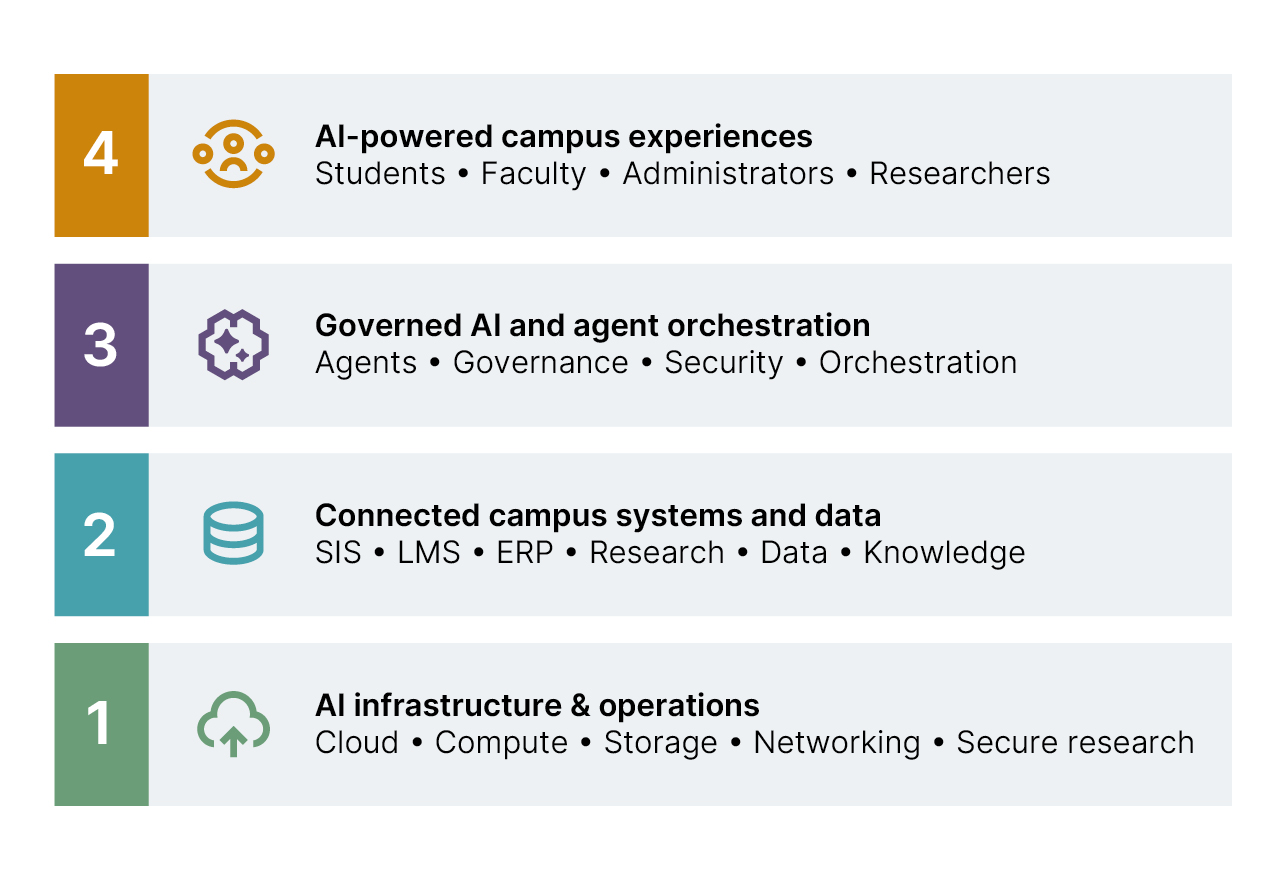
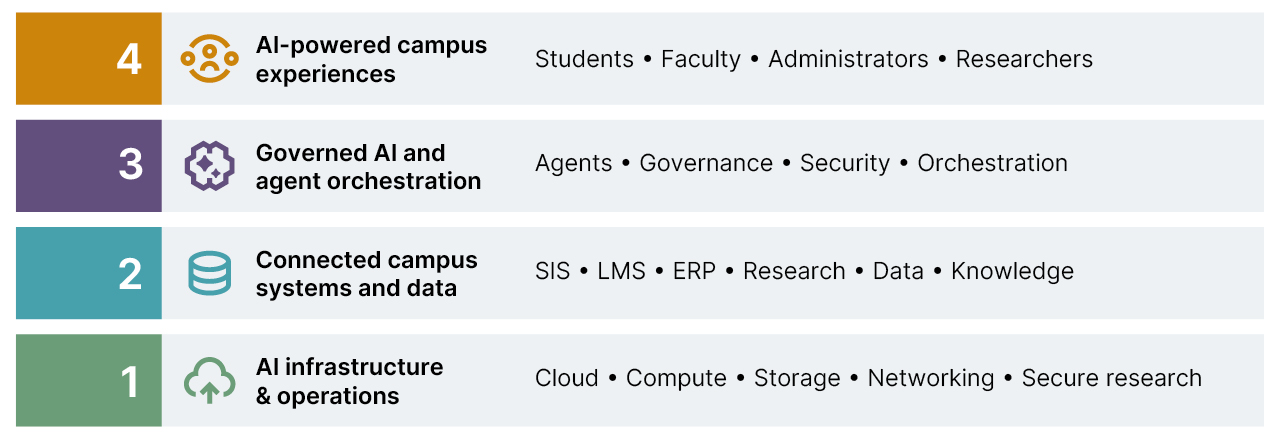
Build the secure, scalable infrastructure needed to support AI across teaching, research and university operations, with the governance and cost controls to operate responsibly at campus scale.
Turn legacy SIS, LMS, ERP and other university systems into reusable capabilities, trusted data products and accessible institutional knowledge, making existing systems easier to connect, reuse and evolve.
Give AI agents secure access to trusted university systems, data and capabilities so they can understand context and orchestrate actions across workflows, with the governance and oversight needed to operate responsibly.
Bring these capabilities into the tools and workflows people already use, creating more connected, adaptive experiences for students, faculty, administrators and researchers.
Students get more tailored support across admissions, financial aid, advising, course selection, academic progress and career readiness. Instead of navigating disconnected university systems, they can access guided, AI-enabled experiences that bring together the right information and actions in context.
Faculty gain AI-enabled support for teaching and research through capabilities such as teaching assistants, contextual content support and research copilots. The goal is to reduce administrative burden and free up more time for mentorship, teaching and research.
Administrative teams can use AI agents to automate and assist with workflows across retention, enrollment, financial aid, communications and resource planning, while using connected, governed data to identify patterns and support better decisions. Because these experiences are built on reusable capabilities, they are easier to evolve and more consistent across the institution.
Researchers can access better support for grant discovery, proposal drafting, experiment design and AI-enabled research workflows. Secure enclaves, high-throughput infrastructure and reusable research capabilities help move from idea to execution faster.
Modernize from within. Connect fragmented systems, data and institutional knowledge to create more adaptive, AI-enabled experiences across higher education without replacing the core systems your university already depends on.

