















AI-first is a given — now it’s about results
Recent research shows that 88% of organizations are already using AI, yet only about one-third have scaled it across the enterprise. And just 5 to 6% are achieving meaningful financial impact.
At the same time, the opportunity is clear. Leading organizations are delivering double-digit improvements in efficiency and productivity through AI-enabled transformation, yet fewer than 40% report any meaningful enterprise-level impact on earnings.
The gap is no longer about adoption — it is about execution.
AI-first banking is decision-centric banking
Traditional banks optimize products. AI-first banks optimize decisions.
The shift is fundamental. Instead of organizing around channels, products, or applications, AI-first banks design around decisions and journeys — the points where intelligence directly shapes outcomes.
In this model, intelligence is embedded into every material decision. Customer journeys adapt in real time. Employees are augmented with intelligence, not replaced by it. Risk and compliance are engineered into how decisions are designed and executed, not applied after the fact.
This is not achieved through isolated AI initiatives. It requires coordinated execution across four critical dimensions, with AI/works™, Thoughtworks’ Agentic Development Platform, providing the backbone that connects strategy to delivery at scale.
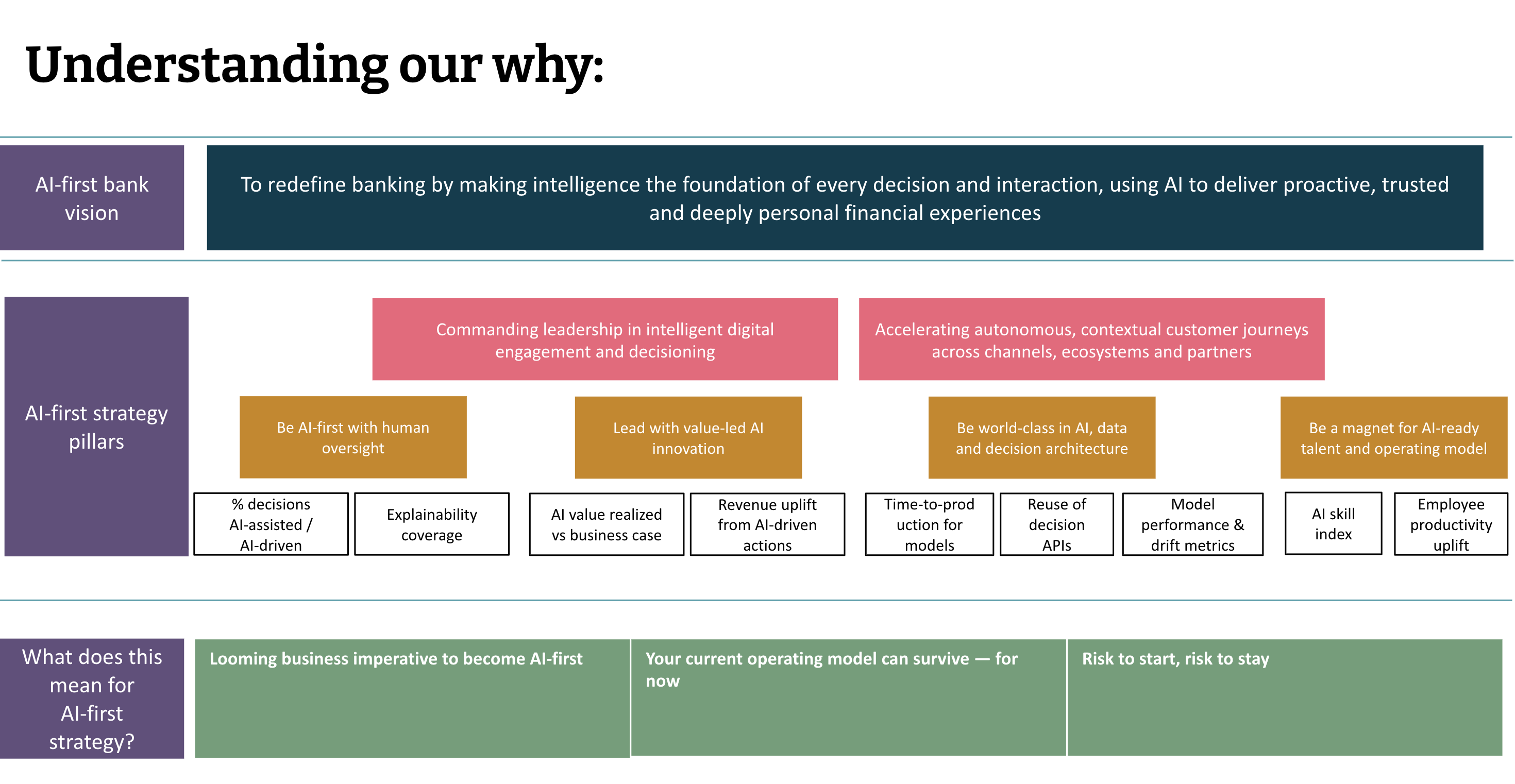
1. Lead with value-led AI innovation
AI-first banks do not start with where AI is easiest to deploy. They start with where better decisions materially change outcomes.
The focus is on high-leverage domains - credit, fraud, servicing, collections, and relationship management where improved decisioning directly impacts growth, cost efficiency, and risk.
AI/works™ enables this shift by exposing where critical decisions actually reside within legacy systems, translating them into outcome-driven specifications, and accelerating delivery of AI-enabled journeys tied to measurable value.
The result is a decisive move away from pilot-led experimentation towards scaled, outcome-driven execution.
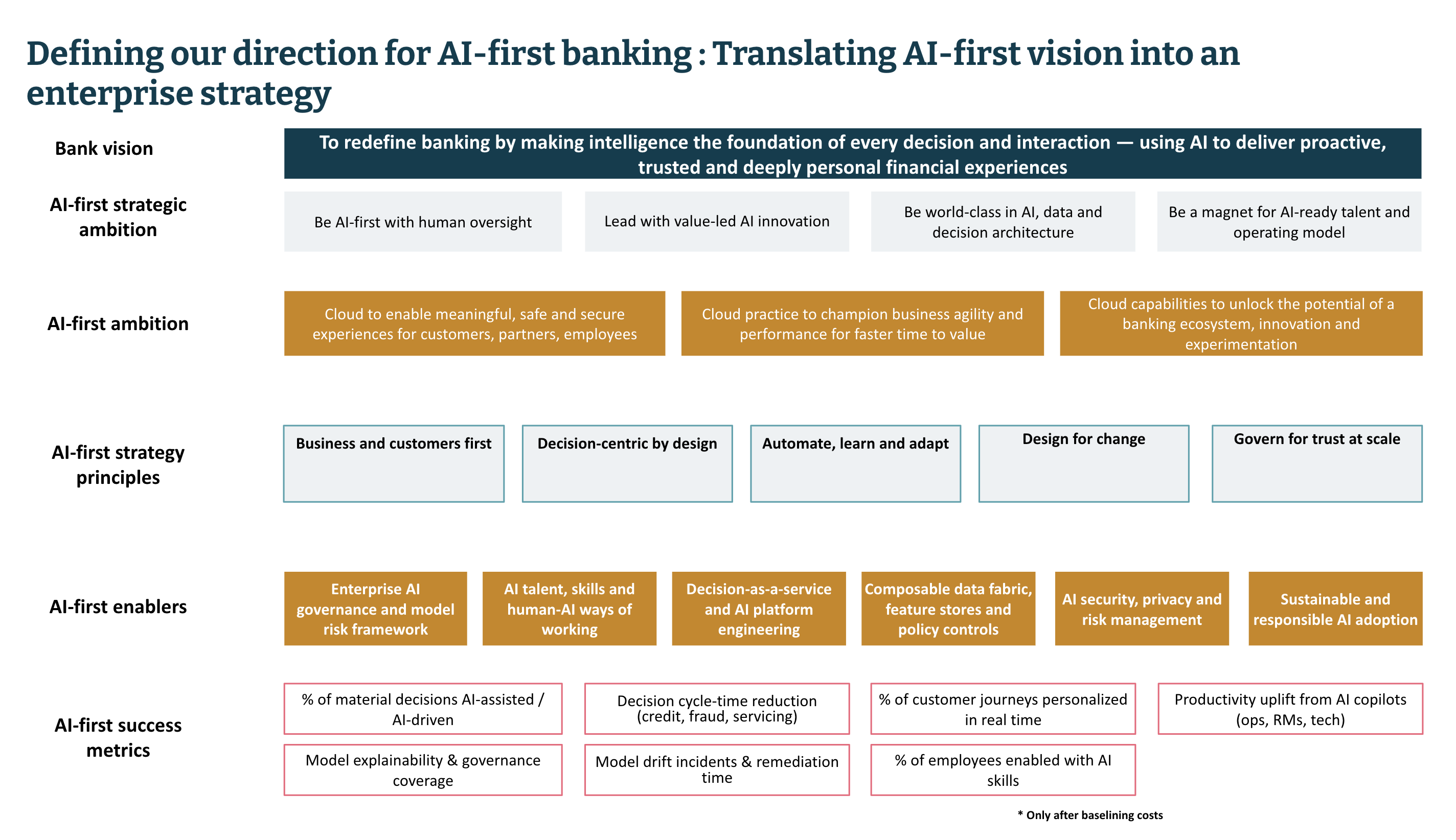
2. Scale AI with built-in trust and accountability
AI-first does not mean removing humans from decision-making. It means making accountability explicit.
For UK banks, this is non-negotiable. FCA expectations around explainability, consumer duty and fair outcomes require that AI-driven decisions are transparent, auditable and controlled.
Leading banks are designing systems where the boundary between AI-driven and AI-assisted decisions is clear, where governance is embedded directly into workflows, and where explainability is built in by default.
AI/works™ operationalizes this by making decision logic visible, encoding regulatory expectations into system design and enforcing human-in-the-loop controls at runtime.
Trust, in this model, becomes a scalable capability — not a constraint.
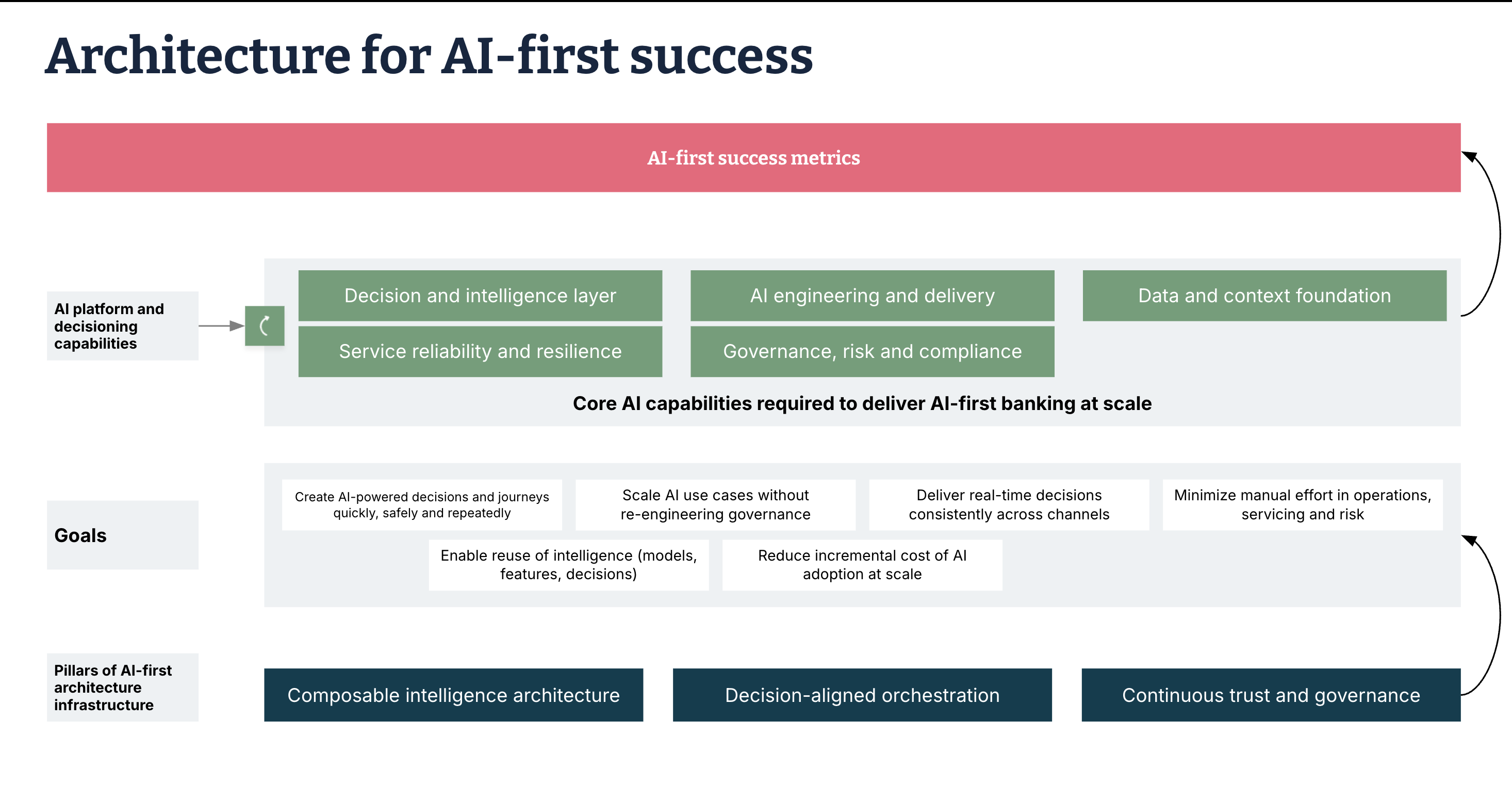
3. Build a decision-centric AI and data architecture
AI at scale requires more than models. It requires an architecture built for continuous decisioning.
This means moving towards composable intelligence — where decision components can be reused across journeys — and ensuring governance is continuous across the AI lifecycle.
For many banks, this requires breaking free from legacy systems that were never designed for real-time, decision-centric operations.
AI/works™ enables this transition by decomposing legacy estates into modular, decision-aligned blueprints, defining a living specification layer through SuperSpec™, and driving consistent, production-grade delivery through automated, agentic workflows.
The outcome is an architecture where intelligence scales across the enterprise, rather than remaining trapped within silos.
4. Scale through talent and operating model transformation
AI capability cannot remain concentrated within a center of excellence. It must be embedded across the organization.
This requires operating models built around platform teams, journey-aligned squads and standardised delivery practices that balance speed with control.
Today, many banks remain constrained by knowledge locked within legacy systems and a small number of experts. This limits both execution speed and scalability.
AI/works™ addresses this by making system logic explicit, standardising how teams design AI-enabled systems, and automating delivery patterns that drive consistency and accelerate learning.
The result is an organization where AI capability is distributed, repeatable and scalable.
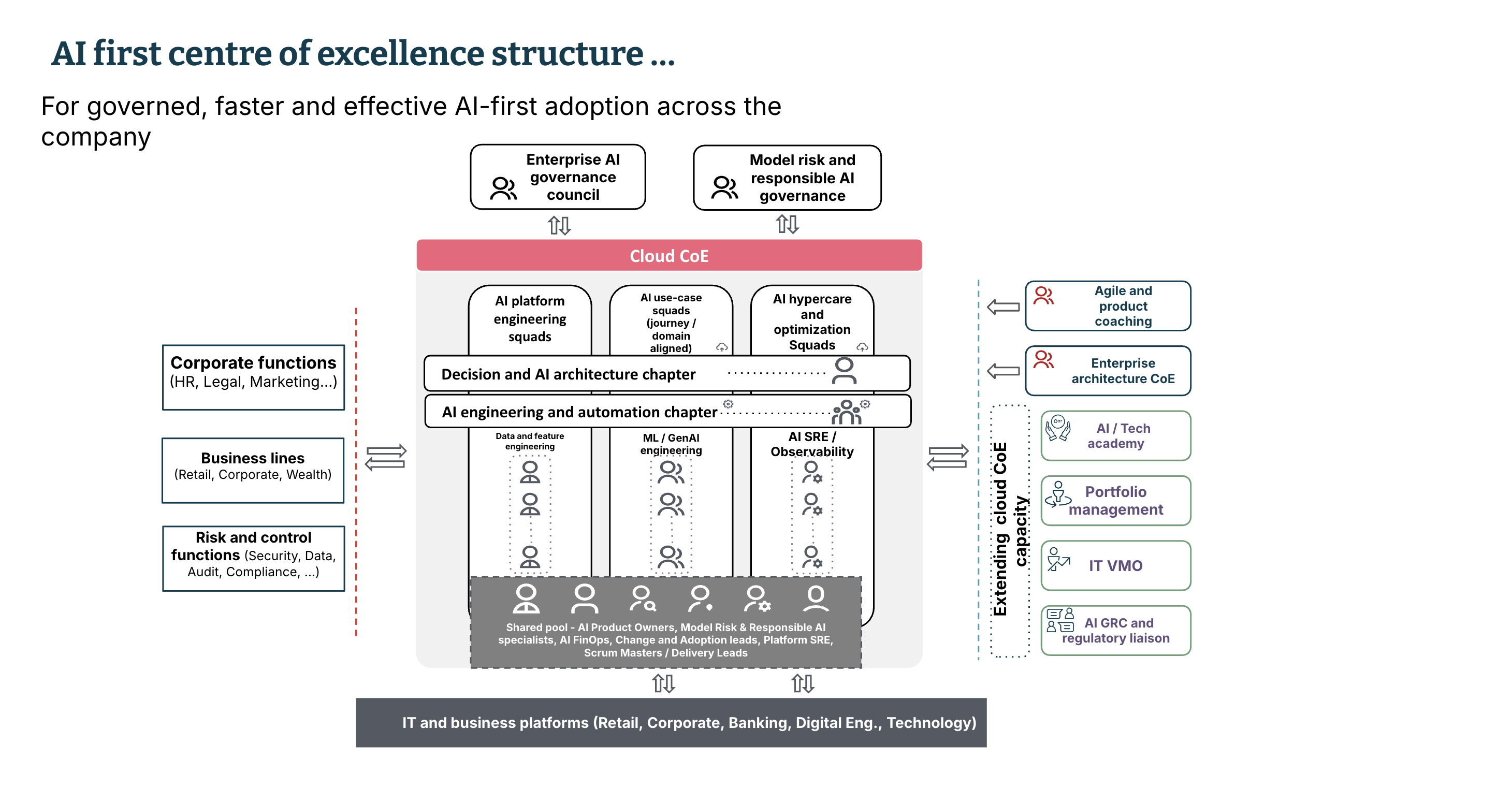
Industrializing intelligence through decisions
The unifying principle across all four dimensions is clear: AI-first banking succeeds when decisions are treated as a managed, enterprise capability.
This means connecting strategy to executable specifications, linking legacy systems to modern intelligence, embedding governance into delivery and balancing human accountability with AI autonomy.
AI/works™ provides the integration layer that brings these elements together — enabling banks to move from experimentation to industrialised intelligence.
Conclusion
AI-first banking is no longer about ambition. It is about execution.
The banks that lead will be those that can industrialise intelligence across decisions, journeys and operations — while maintaining trust, explainability and regulatory confidence by design.
Thoughtworks brings a decision-centric approach to strategy. AI/works™ provides the execution engine to rewrite legacy complexity, reimagine compliant-by-default delivery, and rewire banks for speed at scale.
The question for banking leaders is simple:
Can your organization move from AI pilots to enterprise AI performance before competitive and regulatory pressures make that transition unavoidable?