














Generative AI
The future of software development: AI speed, human judgment


The shift toward an AI agent-based software development life cycle (SDLC) is currently a major trend in software development organizations. While much of the attention is on the technology, tooling and architecture, it’s crucial to consider how this new SDLC integrates with the organization. Specifically, how this transformation will impact organizational structures, people, governance and culture.
AI tools are currently enhancing developers' work, already boosting productivity and quality. However, a major shift is imminent: AI's role is moving beyond simple tooling to fundamentally rewire development organizations. By substantially taking over workload from humans, AI will enable organizations to effectively manage the growing complexity of modern software systems and more broadly the value that we create with technology.
The SDLC is evolving toward a hybrid workforce model where autonomous AI agents aren’t just tools, but — together with humans — essential contributors to the software organization. Success in this new paradigm hinges on the robustness of our agentic architecture that is best deployed by a sophisticated agentic platform, like AI/works™.
But how will this new SDLC affect the organization? We can examine this through three key areas:
Agents as team members: Agents are developing from passive tools to active team members. They will engage in natural conversations, exchange bidirectional feedback just as a human colleague would, and co-solve problems. Agents will cover specialized expertise that does not need to be provided by the human team anymore. Additionally, agents will offload cognitive activities from humans allowing them to extend their focus more on customer value.
Non-deterministic engineering: Like humans, agents make mistakes (hallucinate) and operate within "cognitive" limits (context windows). Humans have long mastered the art of building reliable systems from fallible human logic using sophisticated processes and methods like iterating, pairing, reviewing, testing and so forth. To succeed, agents must be embedded into these similar robust development lifecycles with boundaries by advancing governance.
Shared memory: While agents mimic human collaboration, they possess a distinct advantage: the ability to ingest and recall knowledge at scale. They can work with a shared memory layer, instantly connecting insights from across the organization that would otherwise remain siloed. By complementing human intuition with this knowledge network, agents become the connective tissue of the enterprise.
Consequently, this technological shift also demands a parallel evolution in our operating model based on four strategic elements:
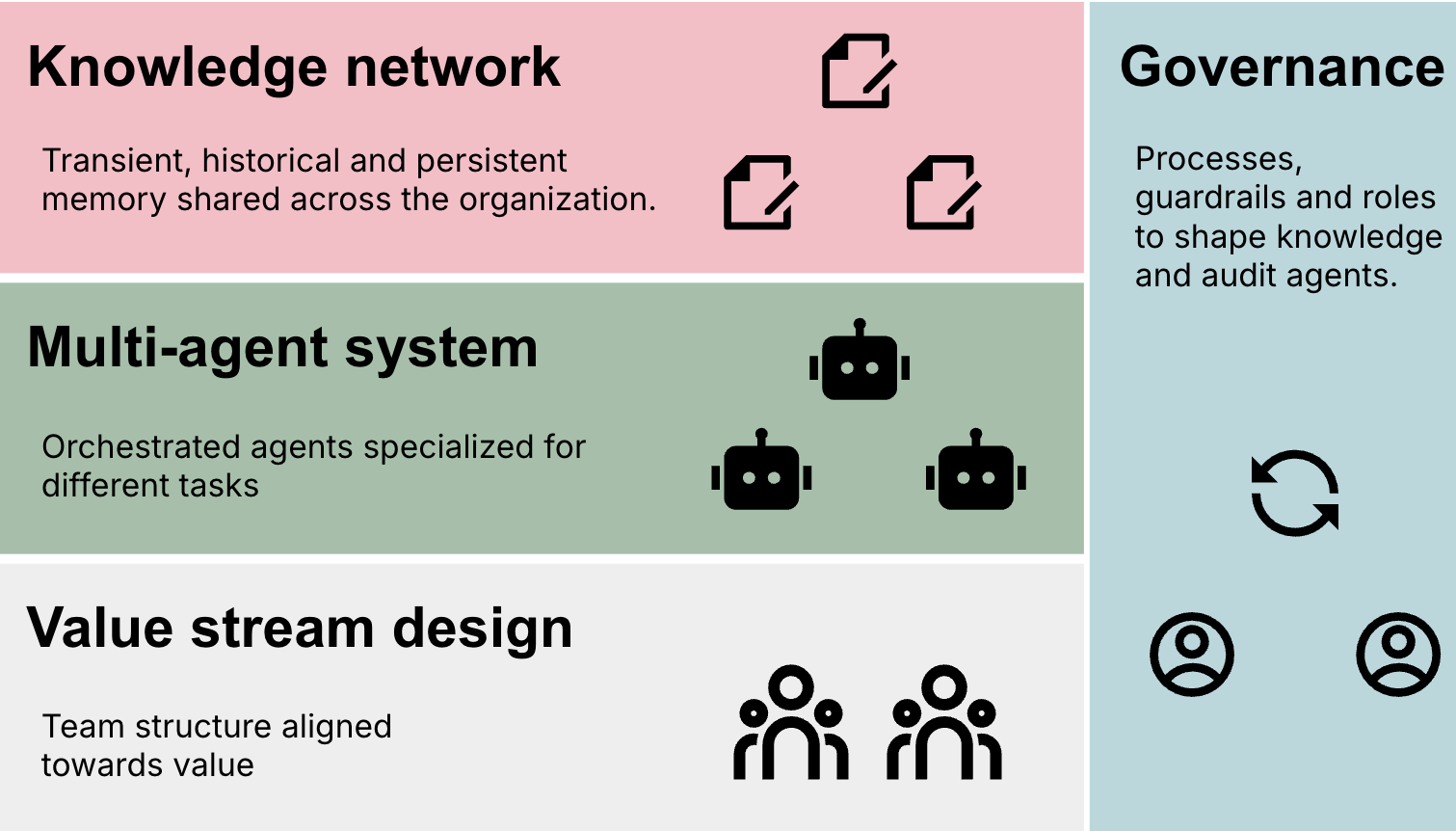
To fully harness the potential of this agentic operating model, we must comprehensively reshape team structures, learn new skills and promote culture change, alongside the new technology.
The following sections will dip a little deeper into this transformation.
The shift to an agentic SDLC represents a significant transformation for engineering talent. With AI largely taking over coding tasks, the developer job profile must evolve, requiring a substantial upskilling of current staff.
In the journey, the roles within the engineering team evolve:
Experienced engineers will move into roles focused on architecture, orchestration and governance.
New roles will emerge to develop and maintain the agentic platform, such as knowledge architects, agentic architects or agent reliability engineers.
In general, the focus of team capabilities is shifting from coding to code review, prioritization and auditing. It demands a better understanding of the business context to correctly feed the knowledge network and evaluate agent output.
Product owners, business analysts and UX designers will continue to be essential due to their strong insights and empathy with users and the broader business context. We will also see a consolidation of specialized roles, such as front-end developer or database engineer, into more generalized, full-stack engineering positions.
This change also necessitates a complete rethinking of the growth trajectory for junior developers, as the tasks traditionally used for their development will now be handled by AI. This means new methods for talent development will need to be established. For junior staff to gain necessary experience, pairing is mandatory and mob programming becomes a feasible upskilling avenue. Agents can also facilitate on-the-job training by operating in a learner or pairing mode with junior colleagues.
Mid-level engineers have dual career paths: progressing toward a governance or architect role or specializing as expert agent developers. It’s crucial to have individuals or strategic partners who take ownership of the agents and the underlying architecture, since it becomes a major asset of the development organisation.
Capabilities are shifted from direct value delivery to developing the agentic platform and from writing code to managing and overseeing agents. This requires a talent strategy to guide these capabilities shifts and supports people with upskilling.
The change towards the agentic SDLC will lead to smaller development teams with reduced developer capacity, as AI agents take on more coding tasks. Beyond generating code faster, they ease the exploration of unknown code and automate elements of the solution design. Therefore, these smaller teams will deliver value more quickly and can handle a broader cognitive load, allowing them to extend their focus. This enables teams to work more end-to-end, and helps them on their journey towards stream-aligned teams, consistent with the principles of Team Topologies, e.g. teams can be decoupled via agentic self-service interfaces helping them to work more autonomously.
Consequently, the structure of delivery organizations will change. While platform or component teams will still be necessary to grow and maintain reusable assets, these teams will be more decoupled from the stream-aligned teams. They will establish knowledge and code assets and set up agents to serve as interfaces for other teams, allowing them to operate with greater autonomy and more product-orientation (platform as a product thinking). Stream-aligned teams will therefore work more autonomously, resolving dependencies with the self-service capabilities of agents. This reduces the time they wait for answers and allows them to stay in flow.
The decoupling of teams is supported by the scalability of agents and the knowledge network that acts as a backbone for the organization. While this will decrease cycle time by ease of integration and the shift toward composability, it bears the risks of cultural fragmentation. Holding up the whole-product-focus and investing in overall strategic alignment across teams become a more crucial task.
To facilitate rapid decision-making demanded by fast-pace agents and the resolution of complex issues, teams will be co-located, sit together and provide necessary clarification for the AI quickly. This leads to mob programming with small teams sitting together working with the agentic platform. This could mean we see an increase in calls to return to offices.
Governance is an important strategic element in the transformation. AI agents introduce complexity to operational structures, necessitating enhanced governance and steering to prevent organizational chaos, especially given the speed of AI development and the volume of generated code. In more predictable areas, the role of humans is evolving from "human-in-the-loop" to "human-on-the-loop" to meet these new challenges. Humans will look after the agentic workflow performance and reliability rather than reviewing every single change.
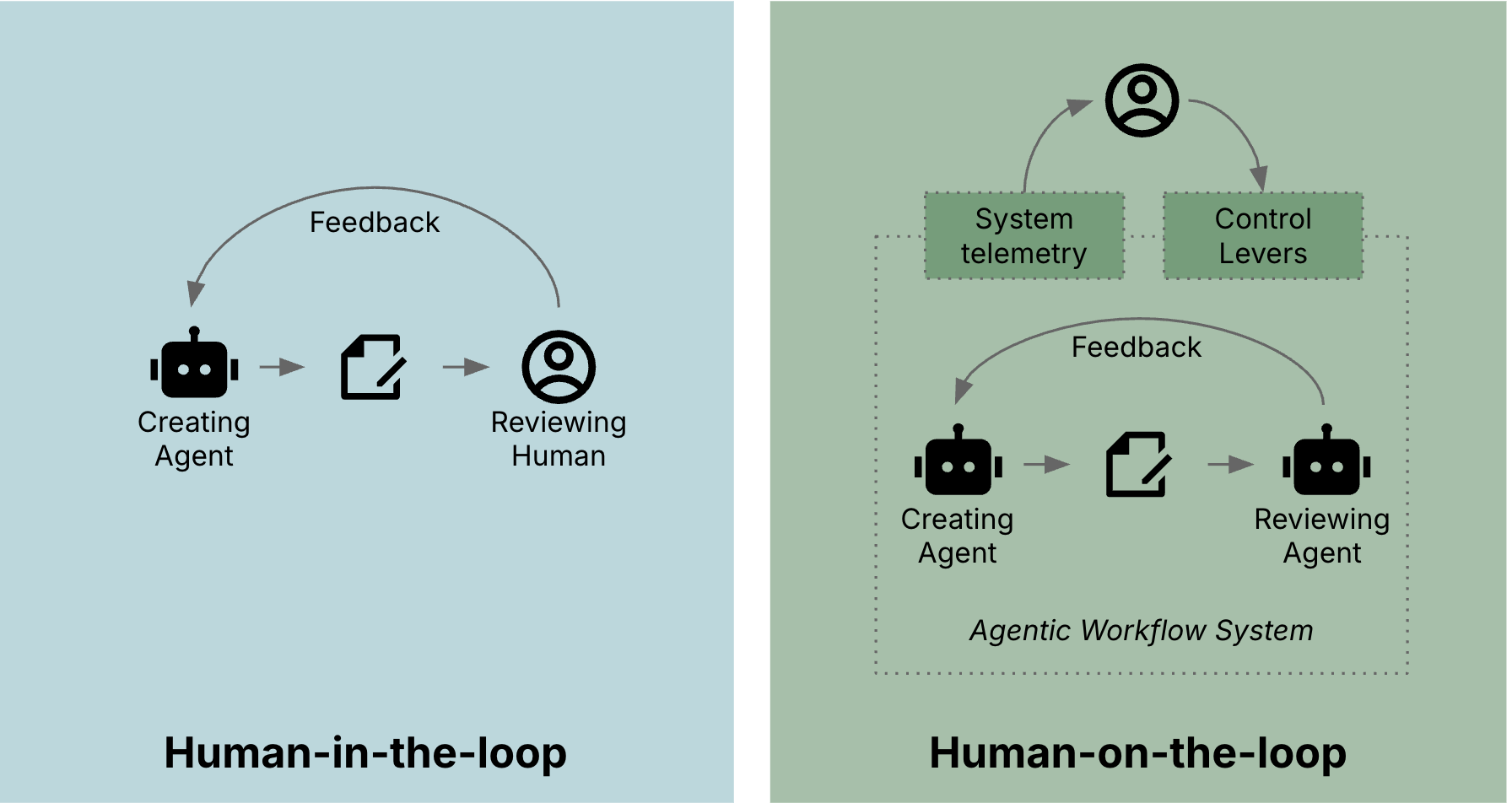
The non-determinism of LLMs, on which AI agents are built, necessitates foundational governance. This is best implemented through policy-as-code rules. A core risk emerges when AI not only handles individual tasks but also orchestrates the entire workflow: the established process, which serves as a harness for ensuring quality, could be at risk. Automated non-AI rules must ensure that minimum guardrails are met, balancing the flexibility of an agent-orchestrated workflow with the reliability needed.
A critical component of the agentic architecture involves specialized AI agents dedicated to validation and compliance. They are set up with a quality assurance goal and aim to challenge the work of other agents.
For effective governance and continuous improvement, agents must generate audit records logging their performance and success. Clear accountability for the results of agents lies with the human team and hence they must be able to monitor and make corrective actions.
A central trust register could be maintained for all agents. This register would provide access to the most reliable agents or transparently indicate the level of risk associated with deploying one.
Reliability is monitored through metrics such as the agent task completion rate. These metrics are essential for detecting and acting on behavioral drift, which must be actively managed.
AI FinOps is another critical component given the substantial costs of running LLM-powered agents. The organization will need a robust model to accurately track these costs and inform decision-making, particularly concerning the return on investment and potential workforce implications.
The shift to an agentic SDLC is fundamentally a cultural transformation. This is, unfortunately, an area that’s often overlooked in earlier change initiatives. There’s a danger this new transformation will suffer the same fate.
This transformation rests on a foundation of strong software engineering excellence. The integration of agents requires embedding them into the team's culture, establishing a feedback loop where humans and agents give and receive input, which will inevitably modify human behavior. To accommodate the necessary pace, faster decision-making is required, making close cross-functional collaboration and mob programming essential practices. Engineers will see their roles evolve from creators to governors, a transition that may prove challenging for some individuals.
The shift to an agentic software development lifecycle (SDLC) necessitates a change in engineering mindset and team culture.
Professional value moves from syntax mastery to problem definition. The ideal developer transforms from the "hero developer" to the "system thinker". Engineers' primary responsibility evolves from being the main code authors to becoming the architects and auditors of the system.
Based on the changes to the operating model described above and the nature of AI agents, team culture is affected in the following ways:
Healthy skepticism must be cultivated: teams need to trust agents sufficiently while remaining critical with their outputs.
Silos must be reduced in favor of collaborative practices like mob programming and swarming.
Leaders need to cultivate a culture where errors are embraced, treating unsuccessful AI experiments as valuable learning opportunities.
Although culture change cannot be prescribed, anticipating the target picture helps to design the SDLC, so it’s not contradicting.
The transition to an Agentic SDLC is not merely a technological upgrade but a holistic organizational journey that touches every facet of an organization: architecture, talent, team structure, governance, and culture. Success therein depends on an integrated strategy that addresses all these dimensions in parallel - that’s applied system thinking.
By embedding autonomous AI agents as essential contributors, organizations can manage increasing complexity and achieve unprecedented speed. This requires a proactive talent transformation, evolving engineers from coders to architects and auditors, supported by a critical capability building strategy. Concurrently, team topologies must adapt toward smaller, more focused stream-aligned teams. To prevent chaos from non-deterministic agents, robust governance is mandatory. Most critically, the shift demands a profound culture change.
The Agentic SDLC is the future of software development. Organizations that embrace this integrated approach - adapting their people, processes, and culture alongside their technology - will be best positioned to harness the full potential of this transformation.