














Architecture
Are non-functional requirements the missing guardrail for AI-generated code?


A product manager spends three weeks deep in a feature. Grooming after grooming. Stakeholder calls where the requirements shift just enough to matter. Edge cases nobody saw coming until the third round of testing. By the end, they can tell you why a particular field is optional instead of mandatory, which stakeholder pushed for that change and what breaks downstream if you get it wrong.
And it isn't just the PM. Every role carries part of the picture: the tech lead remembers why an integration pattern was chosen, QA knows the edge cases, the architect understands upstream constraints and business stakeholders understand the trade-offs that shaped the feature.
Development finishes. QA signs off. Everything passes in staging. Then the feature waits.
It waits because the next release window is six weeks out. It waits because another team has not finished their piece. It waits because production deployments in large enterprises get treated like surgery, not routine.
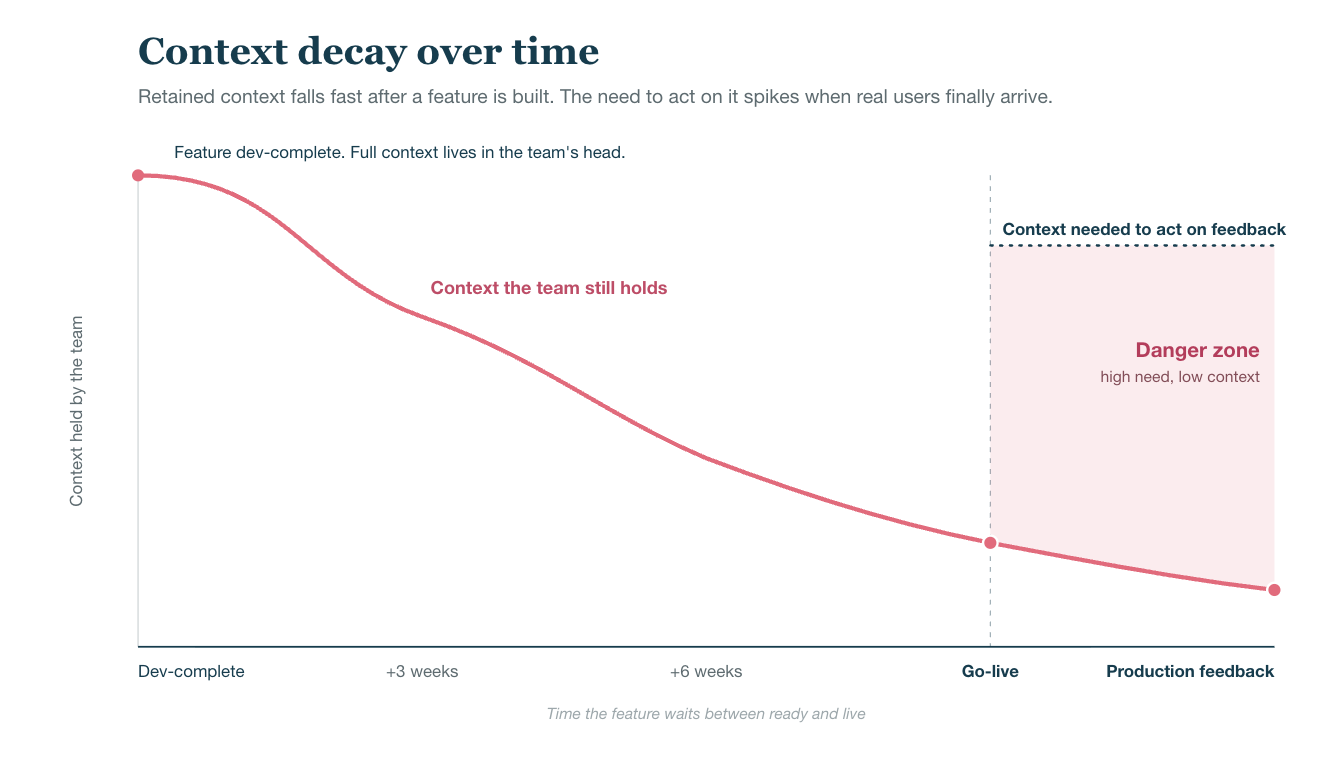
By then, everyone has moved on. New sprint, new grooming sessions, a completely different feature filling their head. Nobody is thinking about this feature anymore, and it has not seen a single real user. That is exactly when it becomes dangerous.
People frame stale features as a technical risk. Code diverges, merge conflicts pile up, regression gets heavier the longer something sits. Engineers know that pain, and teams have learned how to manage those technical costs.
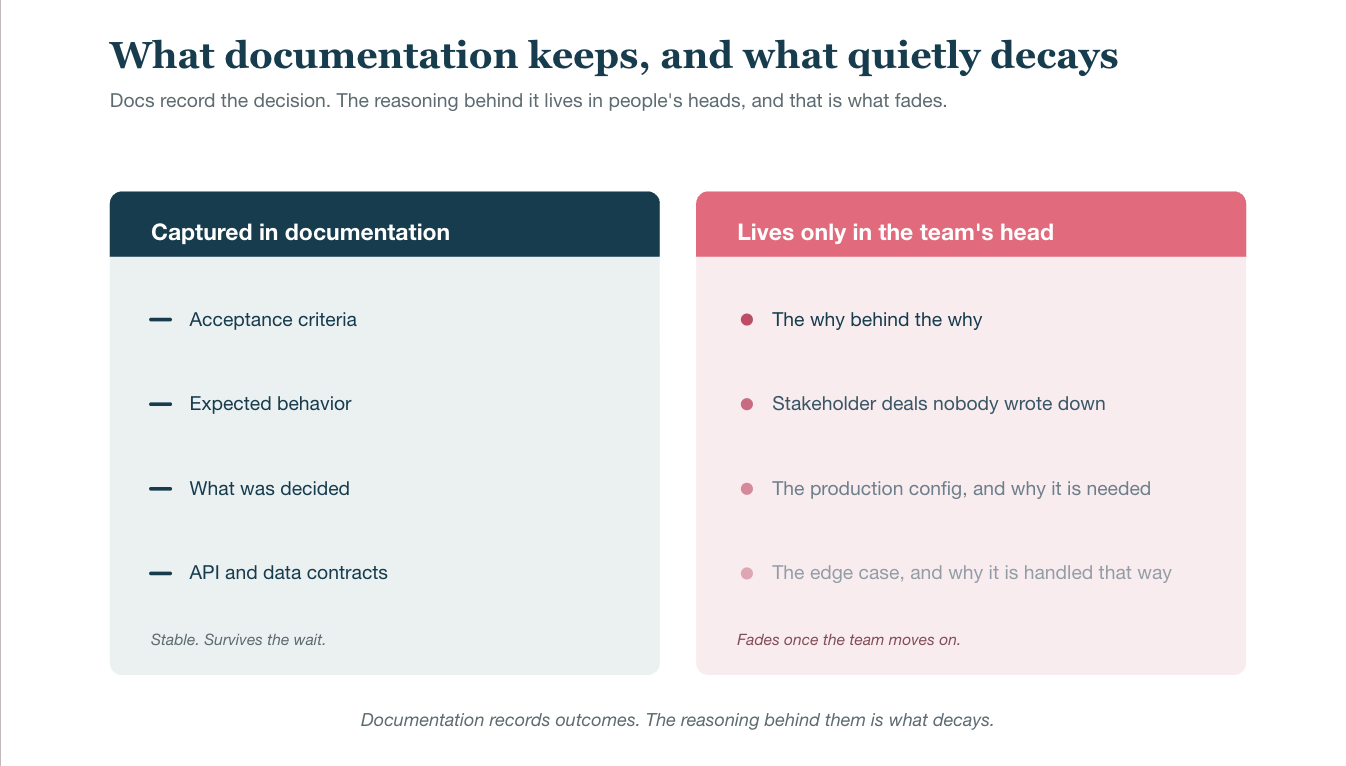
The cost nobody talks about is cognitive. Knowledge management researchers have a name for what the team builds during those weeks: tacit knowledge, the kind Michael Polanyi summed up as 'we know more than we can tell.' It goes well beyond any Jira ticket or Confluence page. It includes the trade-offs, assumptions, rejected alternatives and informal agreements that shaped the feature but rarely make it into formal documentation.
All of that starts fading the moment people switch context. Three weeks later it's hazy. Six weeks later much of it has gone. Psychologists describe this through Ebbinghaus's forgetting curve: without reinforcement, memory naturally decays.
I saw this on an enterprise program where a feature cleared UAT, sat waiting for release and finally reached go-live months later. When business stakeholders questioned earlier decisions, nobody could fully explain them. The team ended up reconstructing its own reasoning from Jira comments, Slack threads and half-updated documents.
I call this context decay: the gradual loss of organizational memory between making a decision and acting on it. Delayed releases accelerate it, but so do team changes, reorganizations and vendor transitions.
The result isn't just slower deployments. Teams revisit settled decisions, introduce unnecessary changes, delay releases further and spend time rediscovering knowledge they already had.

The obvious answer is better documentation. Write down every decision. Keep a living document.
Good documentation matters. Architecture decision records, decision logs and operational runbooks all preserve important knowledge. Teams that don't use them should. But documentation records decisions; it rarely preserves the reasoning, assumptions and future questions that emerge once software reaches production.
What they miss is the why behind the why: the reasoning behind the decision. The alternatives that were rejected, the assumptions the team made and the questions that only production can answer.
Even the best documentation can't replace timely feedback. That's why the real solution isn't documenting more, it's shortening the gap between building a feature and learning from real users.

Someone is already thinking: this is just basic Agile. Ship incrementally. Short feedback loops. They're right. Working software in production over comprehensive documentation has been a core idea for over two decades.
But almost nobody runs textbook Agile in an enterprise, and fairly so. A fintech moving millions in transactions a day has real reasons for careful releases. A healthcare platform facing regulatory audits cannot push to prod on a whim. Those constraints are often genuine.
Still, it's worth being honest about which delays are unavoidable and which are just inherited processes nobody has questioned. There is a difference between "we deploy monthly because production changes carry regulatory weight" and "we deploy monthly because that is what the calendar says."
The real benefit of shorter release cycles isn't lower deployment risk. It's faster feedback. You can write the most thorough test cases, run every regression suite, do three stakeholder walkthroughs and still miss things, because lower environments do not behave like production. Production often exposes behaviors that never appeared in testing because the users, data and operating conditions are different.
Release the feature to a small slice of users. When feedback arrives while the team's context is still fresh, decisions are faster and better informed than if the same issue surfaces months later.
A quarterly release cycle asks the team to hold context for 90 days. No amount of well-written Confluence fixes a 90-day gap between 'ready' and 'live.'
If release dates can't move, protect the context instead. Write a short go-live note while the feature is fresh. Keep lightweight decision logs and ADRs up to date. Run a deployment rehearsal before the team moves on. AI meeting assistants can now draft decision records automatically, making context capture far less burdensome than it once was. You can build an AI knowledge fabric and transform generic AI models into highly specialized, hyper-efficient digital teammates. Most importantly, don't let critical knowledge live in one person's head.
None of this is glamorous. It's not a framework; it's the discipline of admitting that if deployment will be delayed, you have to actively protect against the context loss that comes with it. The default is to assume you will remember, but you won't. Build like you know that.
Disclaimer: The statements and opinions expressed in this article are those of the author(s) and do not necessarily reflect the positions of Thoughtworks.