














Legacy modernization
Legacy modernization in insurance: Why insurers should act now


Commercial marine underwriting relies on specialized expert judgment. Yet the average marine underwriter spends more than 40% of their day on administrative tasks — manually gathering vessel histories, checking sanctions lists and extracting data from incomplete broker emails. For a team of 15 underwriters, this friction wastes 9,000 hours of capacity every year.
We outline how human-led AI assistants can eliminate this administrative burden. By automatically assembling risk context, identifying data gaps and surfacing historical records before you even open a file, insurers can drastically speed up broker response times and improve pricing precision. This approach optimizes the workflow for complex lead lines while paving the way for streamlined automation in follow markets, returning thousands of hours to core underwriting.
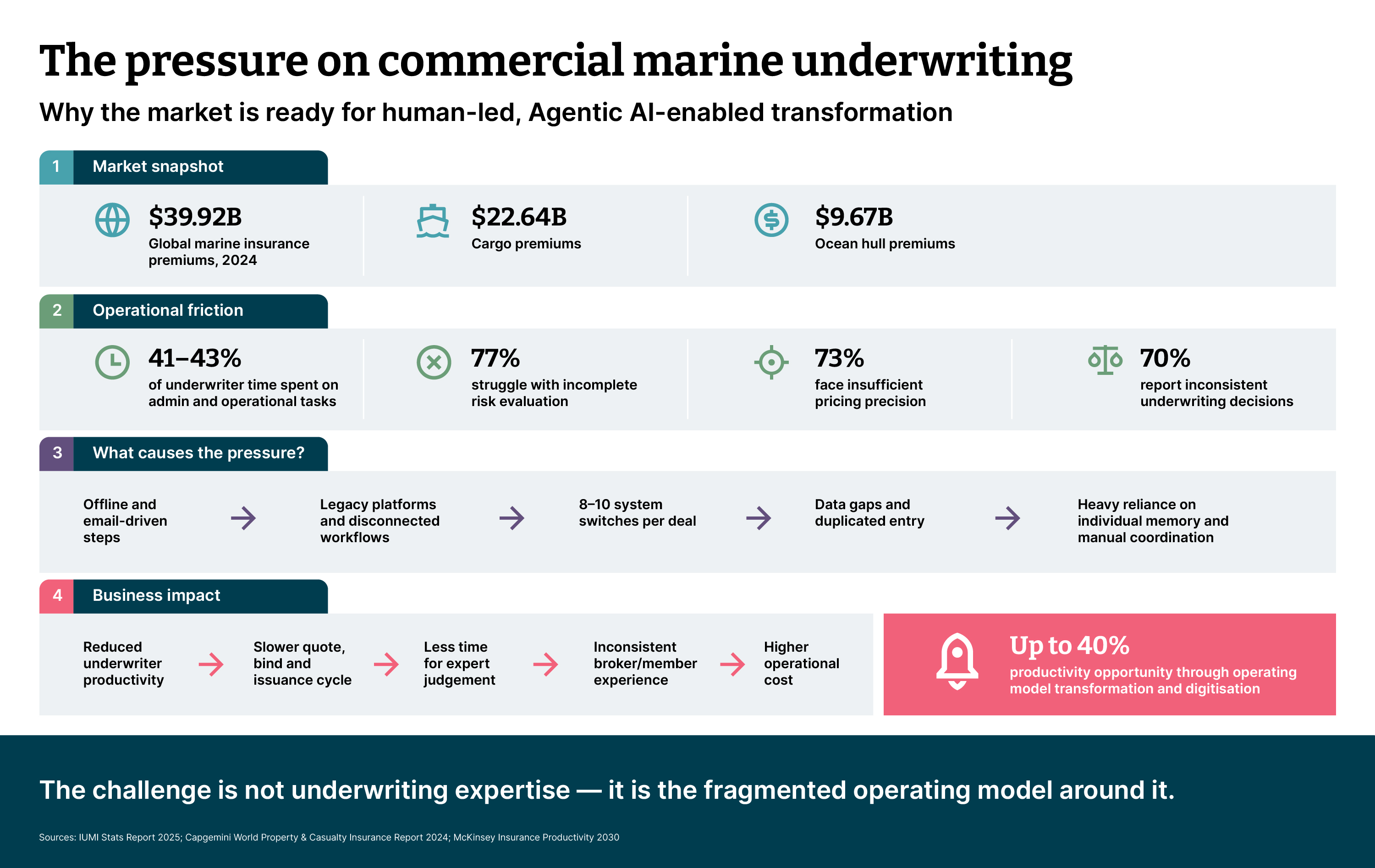
Agentic AI offers a new way to think about underwriting. The technology is so transformative that we must reimagine the workflow — specifically how human expertise integrates with agentic capabilities.
The submission-to-quote journey is just one example of how agentic AI compounds value. The same approach applies to other tasks like renewals, mid-term adjustments, claims triage and policy issuance — anywhere pattern recognition, reasoning and information synthesis dominate the work.
Imagine opening a new submission where the case is already prepared:
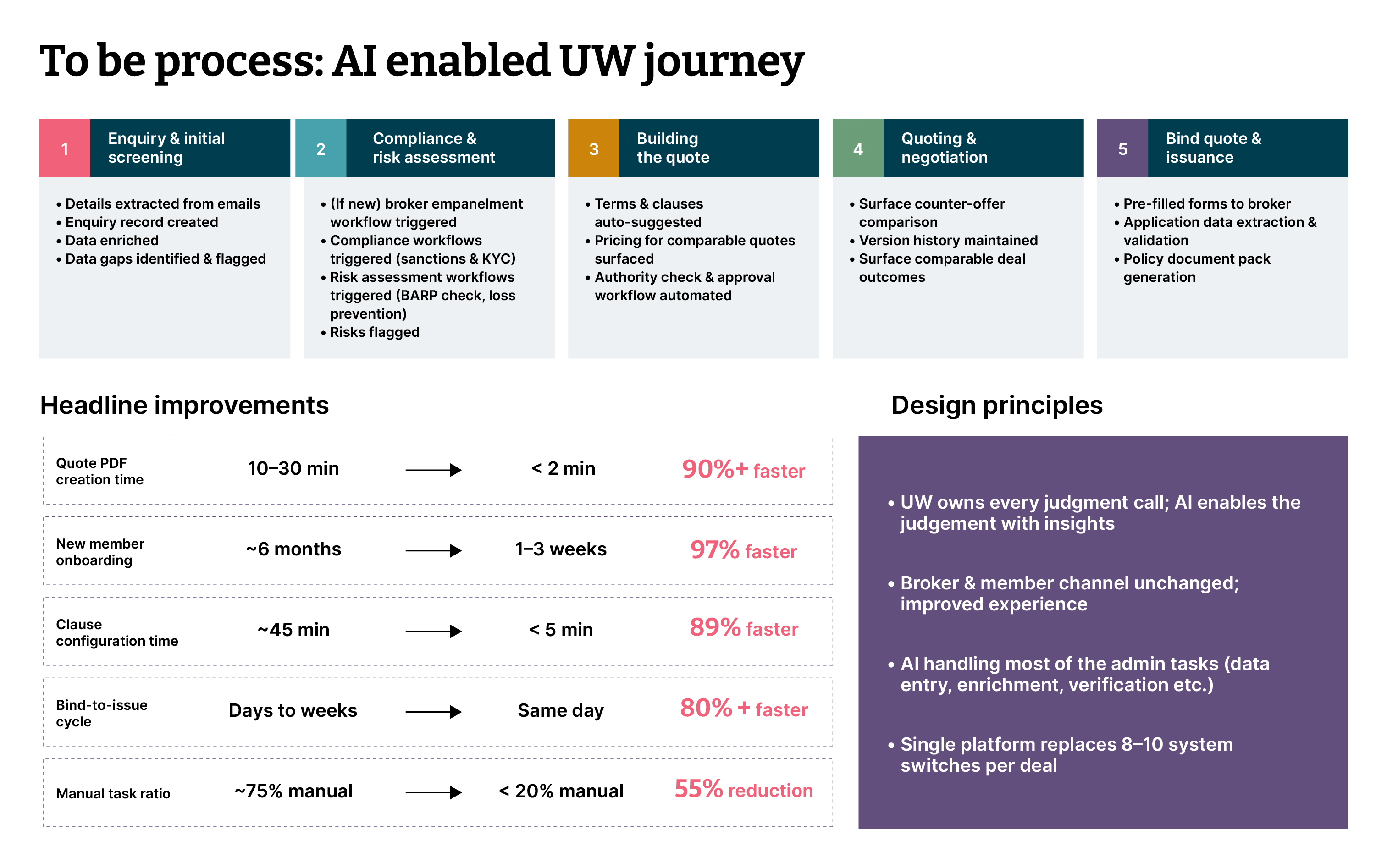
Key data is extracted.
Gaps are flagged.
Vessel history is pulled.
Sanctions checks are complete.
Comparable quotes are surfaced.
Clause options are ready.
Now, you can focus on applying your judgment to a well-prepared brief.
This doesn't remove familiarization from your job; it changes what it looks like. Instead of spending the first hour assembling a brief by hand, you review it: confirming the AI's facts, probing the flagged gaps and forming a view of the risk based on a complete picture. You build familiarity through structured review and challenge, not manual data-gathering.
A critical part of this workflow is presenting information so you can easily review and challenge the risk. Realizing this requires people, processes and technology to move together: empowering underwriters, redesigning the journey and ensuring the architecture is governed, integrated and scalable.
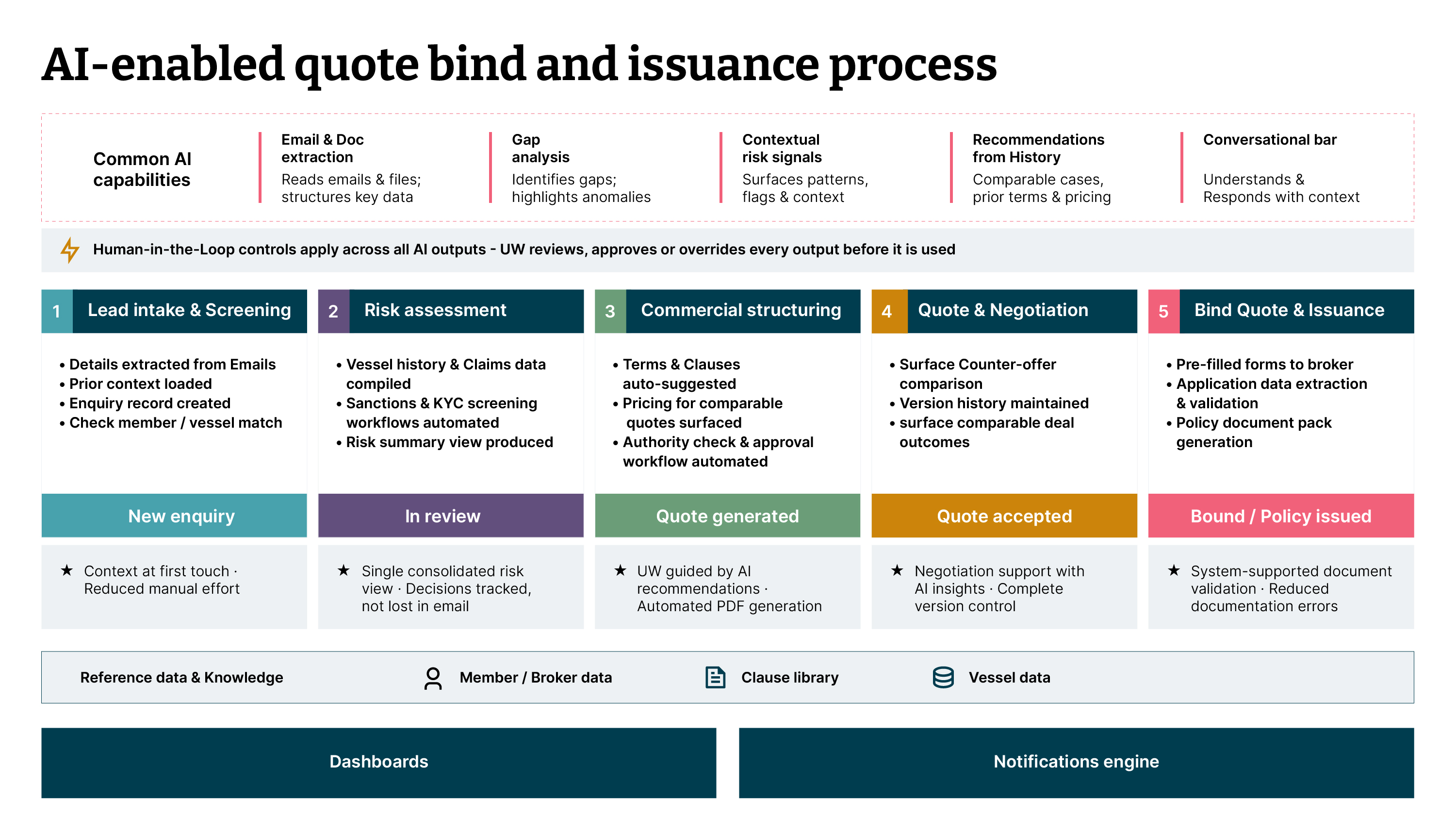
With every insurer exploring AI, the PRISM framework separates purposeful investment from expensive experimentation. It gives underwriting leaders a clear, repeatable method to identify exactly where agentic AI compounds value, ensuring effort lands where it matters most.
The PRISM framework provides a practical lens:
P — Pattern dependence: Does the task require recognizing patterns across claims, submissions, clauses, vessels or negotiations?
R — Reasoning effort: Does it require comparison, judgment or trade-off analysis?
I — Information complexity: Does it involve unstructured inputs like emails, PDFs, spreadsheets or broker submissions?
S — Source spread: How many systems, documents or datasets must you combine?
M — Memory requirement: Does it depend on prior cases, comparable quotes, historical decisions or broker and member context?
The strongest candidates score highly across multiple dimensions — like inquiry intake, gap detection, risk summaries, comparable quote retrieval, clause recommendation, negotiation support and policy validation.
A simple investment lens helps guide your strategy:
High-PRISM, high-frequency work is ideal for agentic AI.
High-PRISM, low-frequency work is better suited for an augmented workflow where AI assists but a human drives the process.
Low-PRISM work should stick to standard rules automation, API integration or simpler processes.
Mature adoption starts with knowing where AI belongs — and where it doesn't. This scoring system maps tasks directly to your investment decisions, ensuring you avoid unnecessary agentic investments on simpler, low-PRISM tasks.
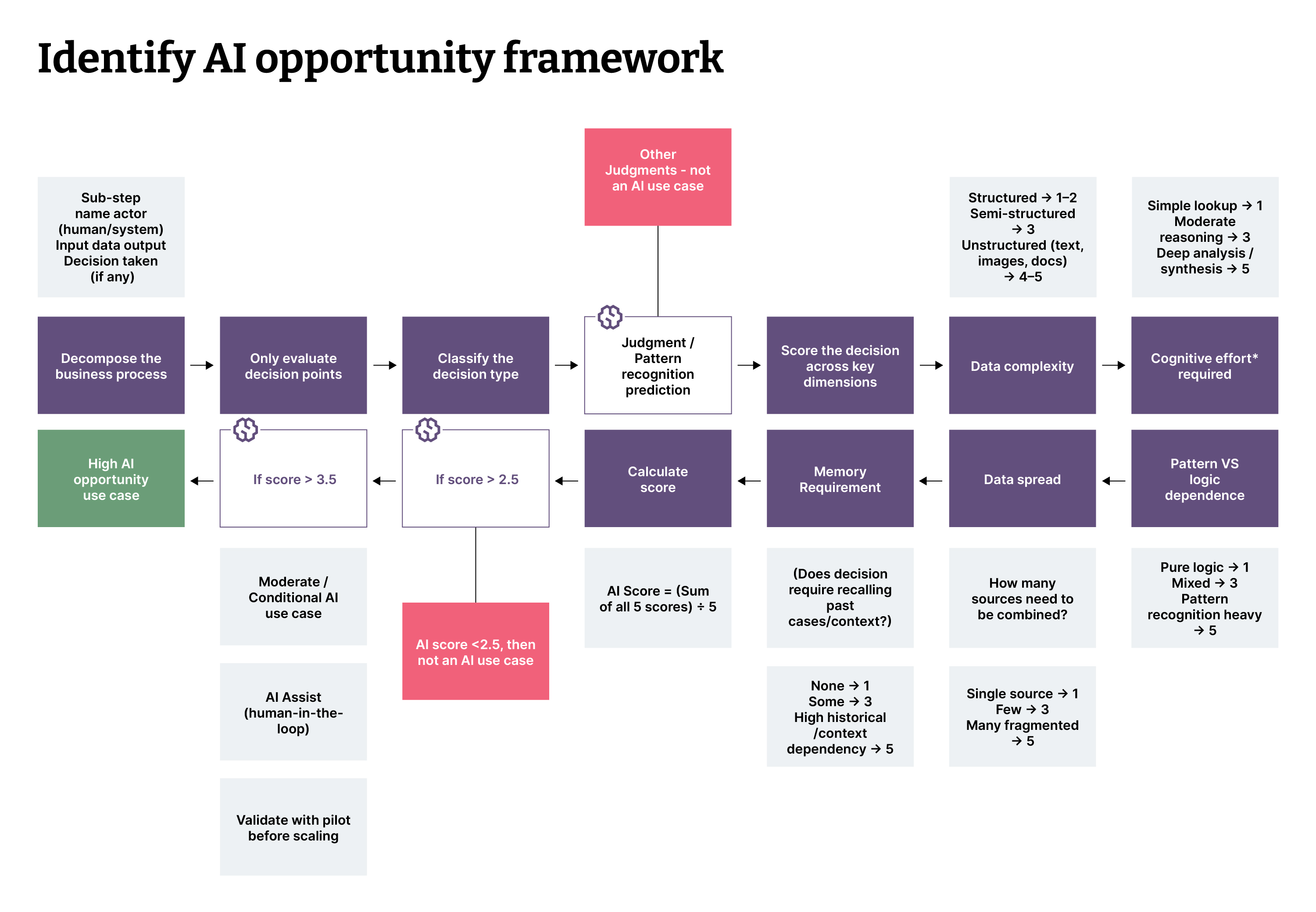
In an AI-enabled underwriting journey, we aim for a step-change in flow, not just marginal productivity gains. These outcomes won't come from a chatbot alone. They require process redesign, data integration, underwriter-centered experience design and a governed agentic architecture.
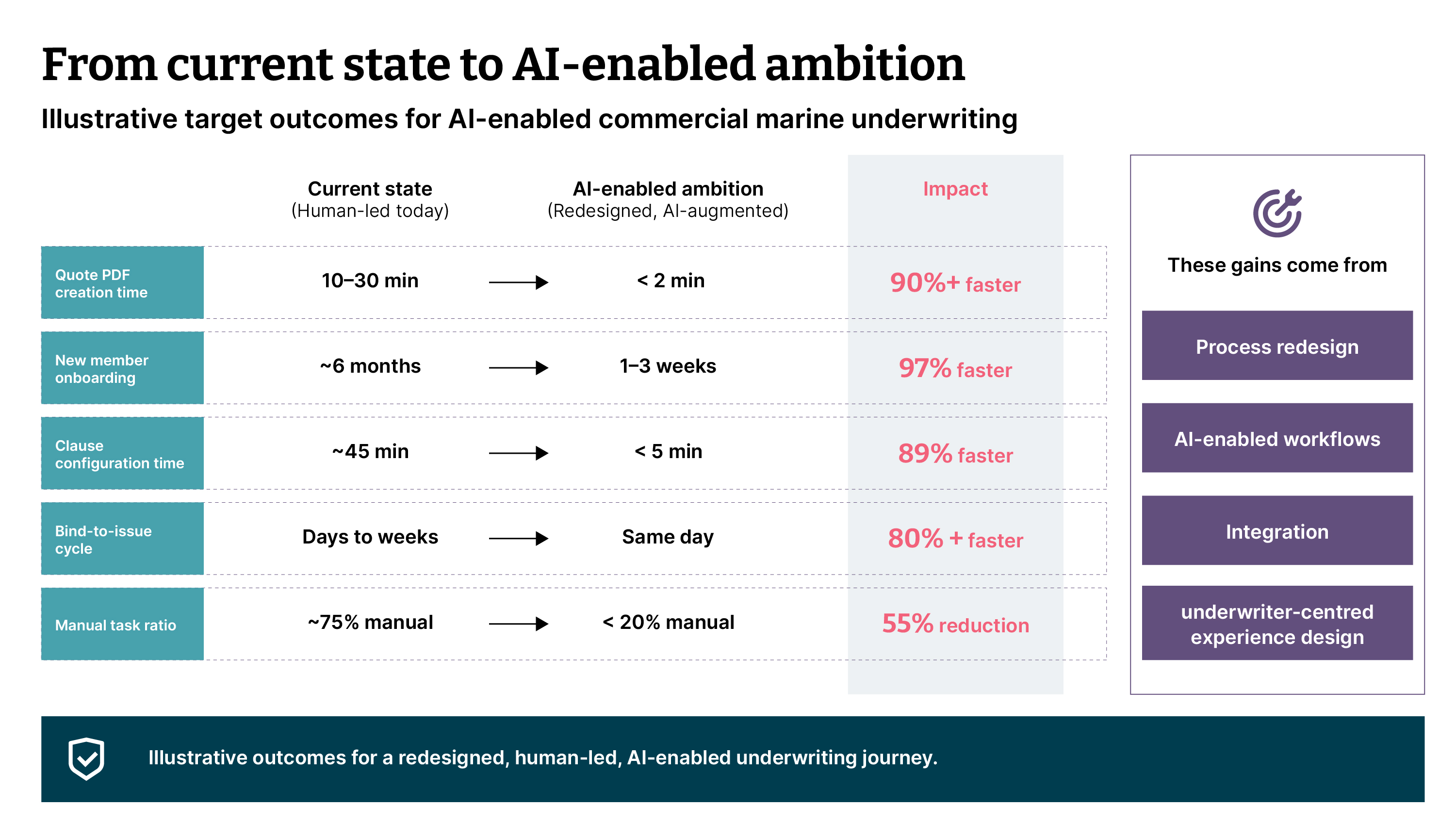
Put simply, the future journey empowers underwriters to quickly match capital demand with risk opportunities. It lets you make fast, informed judgment calls to price risks accurately and decide which business to write.
For those in the London subscription market, this means deploying AI and data intelligently to maintain and scale the subscription model. By keeping administrative expenses low, you can focus your capacity on writing business rather than managing overhead.
As a chief underwriting officer, you should expect your technology leaders to deliver these standards today — not treat them as generic best practices to defer for later. For commercial marine insurance, design agentic AI as a controlled, governed system of specialized agents — not a single monolithic assistant.
First, build around your workspace. The experience must bring together case data, risk signals, missing information, recommendations, approvals and audit history in one place. If AI simply adds another interface without reducing system-switching, adoption will fail. This isn't the unified "workbench" the market has tried and failed to deliver before. Legacy workbenches tried to solve integration at the interface layer, forcing one screen to do every job. Today, integration happens behind the scenes. Specialized agents do one job well, connected to your enterprise systems by a governed layer. The workspace simply presents their outputs for your review — it isn't where the manual labor happens.
Second, use specialized agents instead of one generic assistant. Intake, enrichment, compliance, risk assessment, quote building, negotiation support and issuance validation are distinct tasks. Each requires its own tools, data access, controls and success measures.
Third, connect to enterprise knowledge. You need governed access to clause libraries, underwriting guidelines, authority rules, prior quotes, claims data, vessel records, broker and member history and policy documents.
Fourth, integrate with downstream systems. AI recommendations must flow directly into policy, workflow, document, CRM, pricing and compliance systems. If outputs remain trapped in a chat interface, you'll still spend your day copying, pasting and reconciling data manually.
Fifth, design for governance from the start. Every AI-supported recommendation must be explainable, traceable and reviewable. The system should clearly distinguish between extracted facts, inferred signals and suggested actions. Build human approvals, overrides, confidence levels, audit logs and model monitoring into your core architecture.
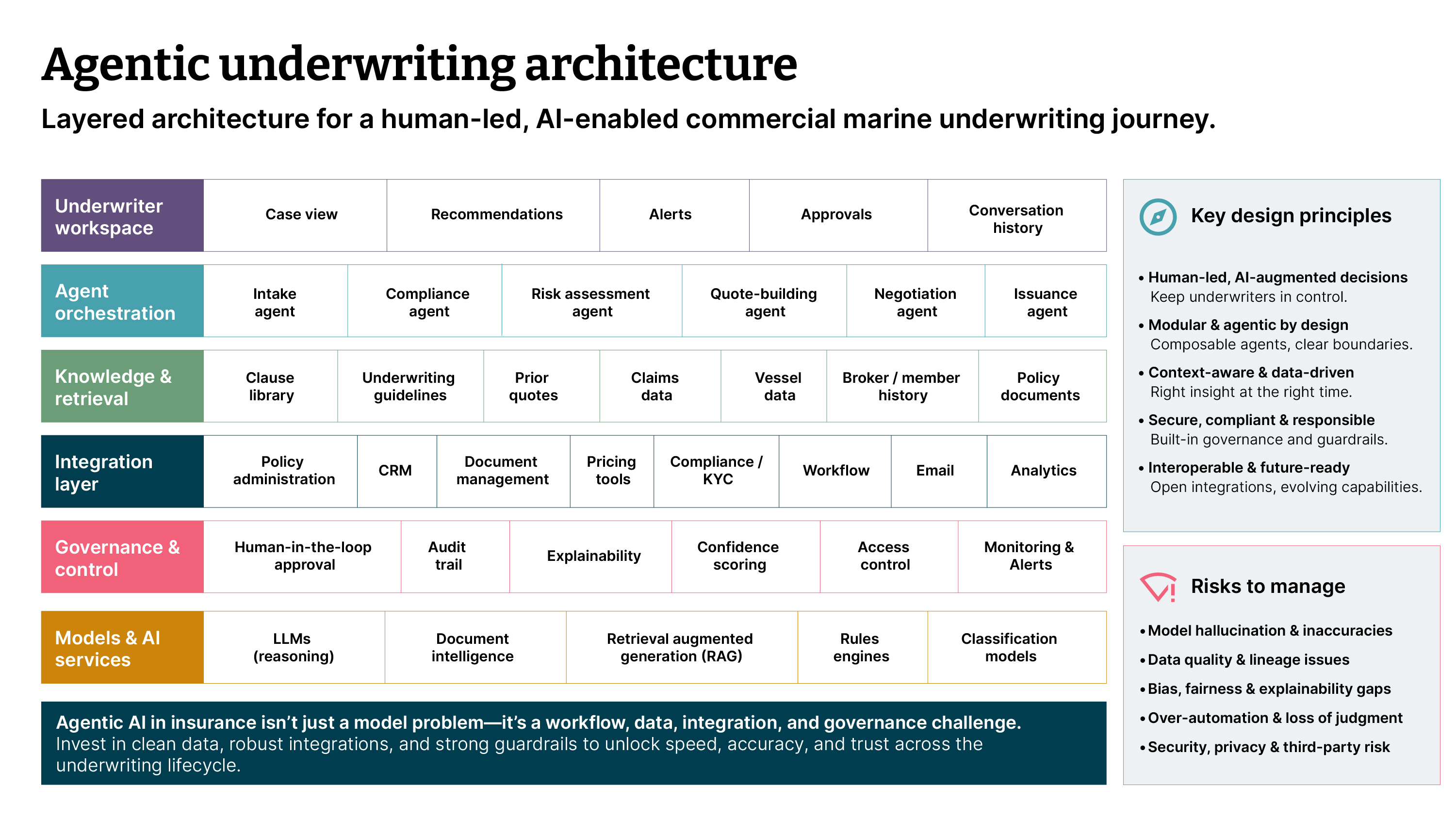
Agentic AI introduces risks you must manage early.
First: adoption without trust. You won't change how you work unless AI demonstrably reduces your effort and improves your confidence on real submissions, not just in pilot environments.
Second: behavioral change. You must shift from manual execution to supervising, validating and directing AI-supported work. This transition requires training, clear accountability and thoughtful change management — especially if teams worry that AI might diminish the value of their expertise.
Third: downstream system dependencies. If your policy, document and workflow platforms can't ingest AI outputs, benefits remain limited and manual rekeying will continue.
Fourth: LLM non-determinism. Large language models can produce inconsistent or inaccurate outputs if you don't properly ground, evaluate and monitor them.
The hardest governance challenge is behavioral: ensuring you override the AI when it's wrong, but don't ignore it when it's right. This requires clear confidence calibration, feedback loops and audit trails showing exactly why recommendations were accepted, edited or rejected.
The future of commercial marine underwriting isn't fully autonomous. Nor should it be. Marine underwriting is too contextual, judgment-rich and commercially nuanced to hand over to opaque automation.
But you don't have to remain trapped in fragmented workflows, offline handoffs and constant system-switching. Agentic AI lets us redesign the underwriting journey around your needs — extracting data, enriching cases, surfacing risk signals, retrieving comparable deals, recommending clauses, supporting negotiation and validating documents.
While some still debate if agentic AI applies to commercial marine underwriting, by 2028 the conversation will be about how well your system performs compared to the market.
Your starting point isn't choosing an agent platform. It's making an honest assessment of how you organize, retrieve and govern data across systems — including vessel records, claims history, clause libraries and broker correspondence. The PRISM framework then helps you identify which tasks to automate first. Only when you have this clarity should you decide what to build versus buy, and begin deploying agents against your highest-value tasks.
The window to define this curve is now. The only thing worse than investing in agentic AI too early is investing too late — after your competitors have already redefined the speed, precision and responsiveness that brokers and members expect.