














Architecture
Modularity and mortality: The importance of ‘skin in the game’


Enterprise AI has reached an unusual point. The models can reason. The agents can plan. But the data they rely on still cannot explain itself. That is the gap most enterprises are now meeting: not a shortage of model or agentic capability, but data that was never made AI-ready.
The gap isn't accidental. Enterprise data was built for two different worlds, and neither was built for AI.
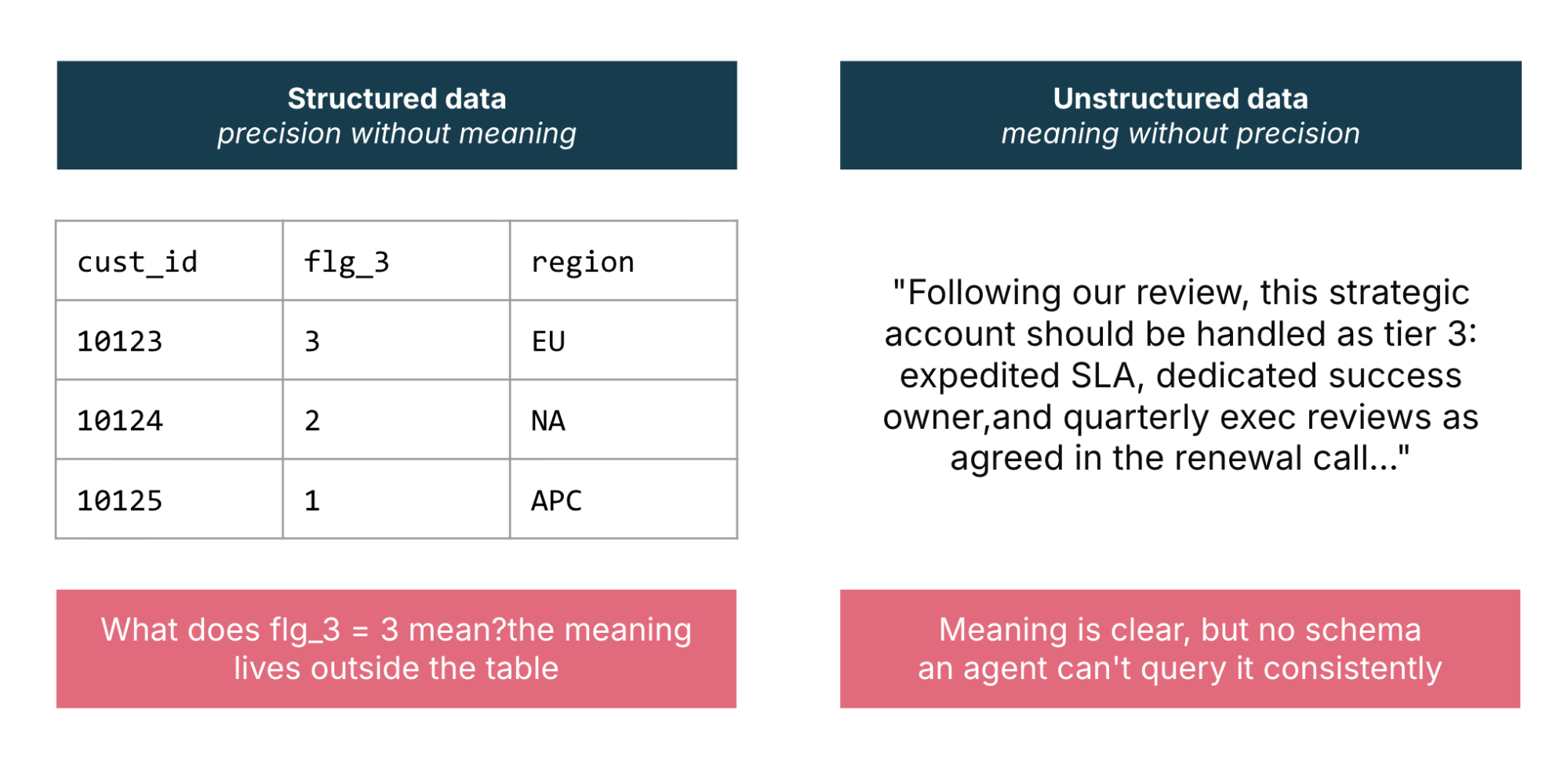
Structured data carries precision without meaning. A table defines types, keys and constraints, and every value is exact; yet a column named flg_3 holding 1, 2, 3 says nothing about what it represents. The precision is real, but the meaning lives outside it: in someone's head, or a document no one really knows.
Unstructured data is the opposite, meaning without precision. A contract, an email thread, a report: dense with intent and context, but the schema is missing. No agent can reliably reason over it without additional structure. The meaning is there; the precision isn't.

LLMs require both. To act correctly and sensibly, an agent needs both the precision of structure and the meaning that tells it what those values are for. When precision and meaning are delivered through two separate mechanisms, the deployment gap emerges and AI adoption stalls.
So what would close the gap? AI-ready data has four characteristics:
Semantic meaning: The agent has to know that flg_3 represents customer tier, and that tier 3 means a strategic account, without a human in the loop to explain it. Meaning has to travel with the data.
Relationships: A correct value is not enough; the agent must reason across entities in an ontology that represents how a reality is constructed.
Temporal validity: It needs a timestamp and a validity period, because context shifts, what was true at a past event may not hold today or in the future.
Machine-readable context: The semantics have to be communicated in a form the agent can read directly, in the moment it acts.
Each characteristic maps to something a data agent needs to function, but the reasons they fail in practice (Table 1) differ from one to the next.
Requirement | What the agent needs | Why it fails today |
Attached meaning | Know that flg_3 is customer tier, and tier 3 is a strategic account with no human to explain it. | Meaning lives in someone's head or a doc, not with the data. |
Entity relationships | Reason across entities in an ontology that represents how a reality is constructed. | Records carry values, not the links between them. |
Temporal validity | A timestamp and validity period, because context shifts over time. | What was true at a past event may not hold today or later. |
Programmatic consumability | Semantics delivered in a form the agent reads directly, at the moment it acts. | A spreadsheet, doc, or Confluence page helps no agent at runtime. |
In short: AI needs data that explains itself, with precision, structure, an awareness of its own validity and a machine-readable format. That is the bar "AI-ready" has to clear.
We see a lack of strategic focus on getting data AI ready in most enterprises, though their data modernization programs focus on the right things: accessibility, ownership, quality, lineage, governance. These are the foundations that make data accessible, trustworthy and managed. For analytics, that was enough, a human analyst supplied the meaning. For agents, it isn't.
So the scope has to extend. Alongside accessibility and quality, modernization needs a semantic context layer: the meaning, relationships, validity and boundaries that let data be reasoned over, not just retrieved.
And it must be long-lived. Semantic context isn't a one-off annotation exercise that ages out the moment a schema changes. It's a standing asset that evolves with the business, versioned, maintained, tracked, audited and governed like any other part of the estate. Building it once and letting it rot reopens the gap.
The shift, then, is from modernizing how data is stored and accessed to modernizing what it means. That's the program AI actually requires.
The approach is to reconstruct the semantics of the data lost, make that reconstruction repeatable and offer the context as a service with a closed feedback loop.
Reconstruction works in three moves:
Recover meaning: align tables and text under a unified ontology map.
Serialize it: express that context in multiple structured, agent-consumable formats, served over MCP, a vector DB or APIs, not a spreadsheet or a wiki page.
Govern it, computationally: AI-ready data must carry its own access policies and row- and column-level security, so agents can act safely and autonomously, meaning and permission travel together.
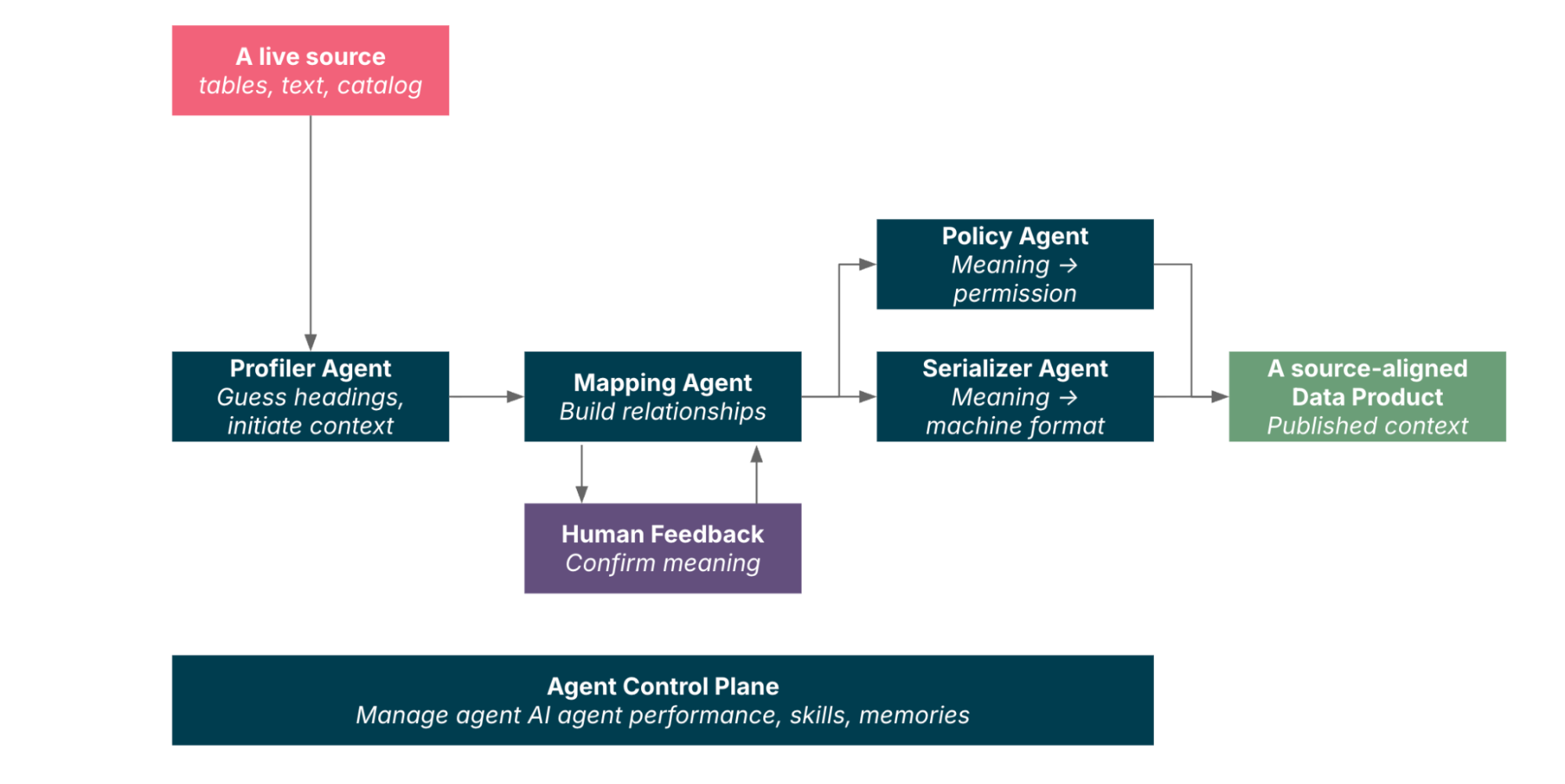
At enterprise scale, this cannot be done manually. We run it as an agentic workflow (Figure 1): agents profile each source, propose mappings to the ontology, draft the serialized context and infer candidate access policies, with humans reviewing and confirming rather than authoring from scratch.

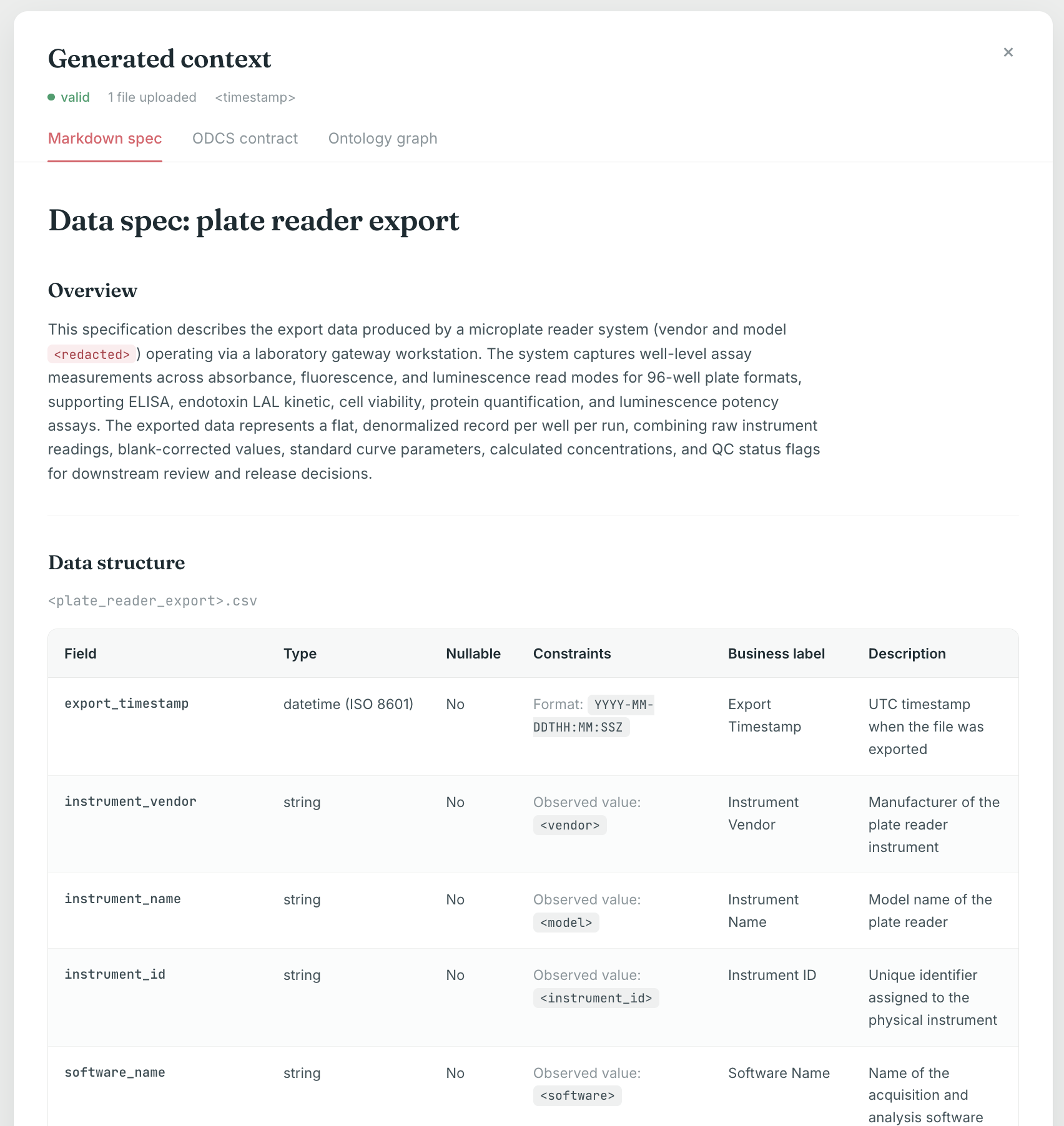
As a result, the agentic flow generates a context (Figure 2) that other AI agents can consume.

The method that makes data AI-ready is itself the kind of system it produces data for, and that's what makes it tractable across hundreds of sources.
Doing this once is a project; doing it across an estate is a strategy, which returns us to the data product approach. We shift from monolithic pipelines toward modular, self-describing data products: composable lego-blocks that package the data, metadata, semantic meaning and governance policies into a single node an agent can plug into.
Self-describing now goes beyond human or deterministic-system understanding to cover LLM reasoning, so we add a new principle alongside discoverability and addressability: Agent-readability.: Cancan an agent, handed this product cold, understand what it is and what it may do with it?
A semantic layer built once and shelved decays, the way to keep it true is to operate it. We put the reconstructed context into live agent workflows and let production surface where it's wrong: a misread field, an over-broad policy, a missing relationship shows up as a failure or a correction, and feeds back into the context.
The layer sharpens through use rather than aging out of it. Modernizing and operating aren't two phases; operating is how modernization stays alive, and how the estate gets more AI-ready with every system it absorbs.
Enterprise AI is accelerating into production, and it's meeting a gap, not in model or agentic capability, but in data. That gap isn't new; it's a consequence of how enterprise data has been built and operated for years, splitting precision and meaning across structured and unstructured worlds.
Agents need more than either provides: meaning bound to the data, relationships, validity and boundaries they can consume at runtime.
Closing the gap means data modernization has to expand beyond accessibility and quality to include a long-lived semantic context layer.
Our approach delivers it in three moves, agentically reconstructing meaning at scale and continuously, binding that context to self-describing data products and using data operations to keep data and context true together. The result is an estate that gets more AI-ready with every system it absorbs, and with it, AI programs accelerate and AI value gets delivered.