














Testing
The code review is dead; long live the code review


Research is one of the most valuable parts of product discovery, and one of the first to be compressed when timelines tighten.
A workshop produces twenty interesting ideas. Stakeholders want momentum. Delivery teams want clarity. Research budgets are limited. Before long, the conversation shifts from "Which opportunities should we explore?" to "Which of these can we start building?"
The problem isn't that teams don't value research; it's that tight budgets and timelines often make it feel impractical.
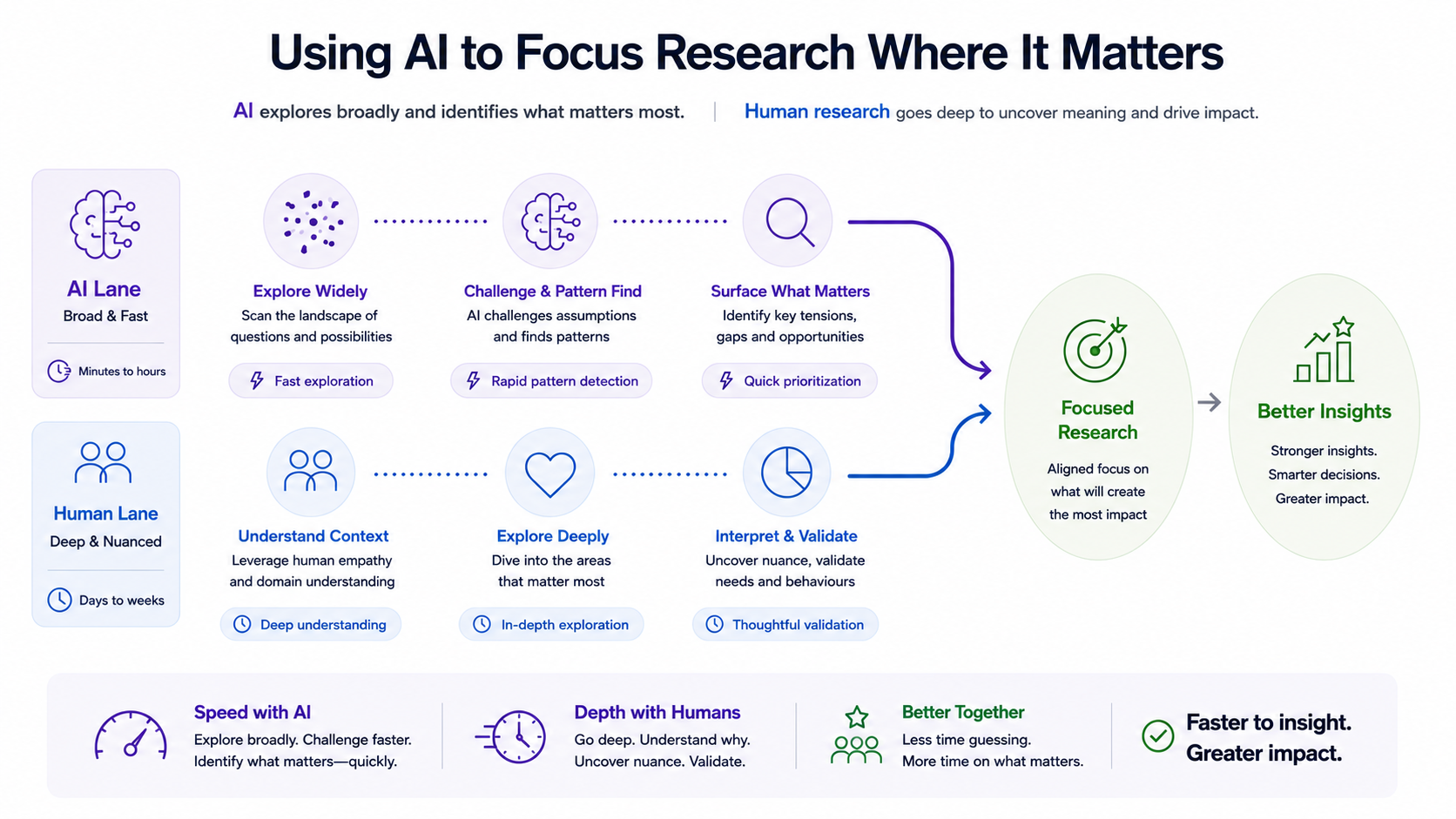
Recently, I led discovery for a greenfield loyalty proposition with a global travel retailer. Rather than iterating on an existing product, we had a fixed discovery window to explore and test a shortlist of concepts before committing to build. We used AI to help us focus research where it mattered most. The result wasn't fewer user conversations, it was better questions before we had them.
The project began with a strategic question: How might a global travel retailer move beyond traditional loyalty mechanics and create a more meaningful travel companion experience?
Through a handful of focused workshops, the team generated around twenty concepts spanning shopping, utility, personalization, airport navigation, local discovery and travel assistance. The goal wasn't to identify the "best" idea immediately, but to explore broadly before narrowing our focus.
At this stage, we faced a familiar discovery challenge: plenty of possibilities, but very little evidence. Traditionally, the next step is prioritization followed by user research. The problem is that prioritization at this stage is largely opinion-driven. Decisions are shaped by the loudest voices or the easiest ideas to visualize, rather than those most worth testing.
We still prioritized concepts and conducted user research, but introduced an additional step in between. Instead of moving straight from a list of twenty ideas to a research plan, we used AI as a thinking partner to pressure-test our assumptions before we committed to testing them with real users.
I integrated Claude as a thinking partner to explore assumptions and model behaviors. After prioritizing via CVP (consumer value proposition) and BVP (business value proposition) lenses, we shortlisted five concepts. We used AI to refine behavior-based traveler archetypes: frequent business travelers, leisure explorers, last-minute buyers, pre-planners and Gen Z digital-first travelers. The real value came from providing context Claude couldn't infer on its own: airport psychology.
A prompt looked something like this:
We're designing a duty-free retail experience for international airports. Here are five traveler archetypes: [list]. For each, consider three journey stages and the emotional state at each: pre-security (mild time anxiety, still in planning mode), post-security (sense of release, open to browsing) and gate area (decision fatigue, shrinking time window). For each archetype at each stage, describe what they're trying to accomplish, what friction looks like and what kind of moment would make them engage with a retail experience.
The outputs weren't conclusions, they were structured positions we could argue with. One example stood out: when we asked how a frequent business traveler would interact with a conversational UI at the gate, Claude surfaced a tension we'd overlooked. Under time pressure, business travelers preferred a conversational interface that helped them reach a decision quickly. Once through security, however, they shifted into exploration mode and preferred a browsable experience.
That reframed the concept entirely: instead of designing a single interface, we began thinking about how it should adapt to different moments in the journey.
After establishing our archetypes, we stopped asking "Would you use this?" and started asking "What would you do here?" Each concept was translated into a concrete journey scenario, a traveler, a moment and a decision. A leisure explorer, 28 minutes post-security, opens the app. Does the concept offer something useful right now, or does it require more time and attention than this moment allows? Running these scenarios across multiple traveler cohorts exposed issues abstract concept testing wouldn't.
A concept that recommended products using social media signals immediately raised privacy concerns. Travelers were uncomfortable with a retailer accessing (or appearing to infer from) their social profiles. The line between personalization and surveillance felt unclear.
Other concepts revealed different weaknesses: appeal that was too narrow to justify investment, or experiences that felt compelling once but offered nothing to bring a traveler back. These were simulations, not validated findings. But they were specific enough to tell us which concepts deserved research time and which ones needed rethinking first.
We tested a prototype with eight users, a mix of Maze sessions and in-person interviews. The sample was small and intended to provide directional signals rather than statistical proof.
Themes that had surfaced during the AI-assisted simulation reappeared in real sessions without prompting. Concepts that appeared useful in simulation generally held up with users, while weaker concepts remained unconvincing.
Eight users can't validate a product. But they can tell you whether you walked into the room asking the right questions and in this case, we had. AI exploration hadn't replaced research, it had made the research more precise.

AI accelerated discovery, and in time-constrained environments that has real value. More importantly, it changed what we could accomplish in the time available. Twenty concepts became five. Five became a set of defined hypotheses, each with a specific tension or assumption attached. Work that would traditionally span multiple synthesis sessions and rounds of internal alignment happened in hours, which meant we arrived at user research faster, and with sharper questions.
That shift matters beyond efficiency. The hardest part of research is often justifying the investment. By stress-testing assumptions and identifying the questions only users can answer, the conversation shifted from "Do we have time for research?" to "What do we need to learn?"
Our experience suggests that AI can be useful for:
Expanding idea spaces.
Exploring alternative perspectives.
Building and refining behavioral archetypes.
Stress-testing concepts.
Generating hypotheses.
It is far less useful for:
Predicting adoption.
Replacing user research.
Making strategic decisions.
Those remain human responsibilities.
Discussions about AI in product development often fall into two camps: it's either portrayed as a replacement for existing practices or dismissed as little more than advanced autocomplete. Our experience suggested a more useful middle ground.
When exploration becomes cheaper, teams can afford to be more curious. They can test more assumptions, pressure-test more concepts and arrive at research with greater clarity about what they're actually trying to find out. The bottleneck shifts from "Can we afford to explore this?" to "What's actually worth exploring?"
For product teams navigating tight timelines and limited research budgets, that might be the most practical application of AI yet: not replacing research, but making it easier to invest in the research that matters.
Disclaimer: The statements and opinions expressed in this article are those of the author(s) and do not necessarily reflect the positions of Thoughtworks.