














Data strategy
AI-ready data, why and how?


The global commodities trading landscape operates in an environment of permanent, structural volatility. While the industry's aggregate value remains roughly twice its pre-COVID baseline, margins are increasingly under pressure as a smaller group of consolidated market players control a larger share of global flows. Historically, competitive advantage belonged to firms with proprietary physical information networks and sheer balance sheet scale. Today, access to raw data is no longer the bottleneck; the true differentiator is the capacity to interpret, prioritize and act upon that information faster than the competition.
To sustain an edge, commodities firms must move past rigid, legacy architectures and embrace continuous-learning, agentic AI systems. While first-generation AI focused heavily on passive, backward-looking analytics, agentic AI introduces autonomous, goal-oriented software engines that work alongside human experts to handle complex, real-time workflows. This article defines the core structural challenges facing commodity trading organizations, brings to life the urgent commercial need to modernize and outlines the strategic opportunity for agentic transformation.
For decades, commodities trading relied on a straightforward formula: information asymmetry plus capital power equaled high-yielding margins. If a firm had the best network of port agents, the fastest access to shipping manifests and the capital to absorb local shocks, it came out ahead.
Today, that playbook is broken. The market has democratized; data is everywhere, but the capacity to process it has stalled. Trading volumes have surged, regulatory compliance burdens have grown exponentially and geopolitical disruptions mean that trade lanes can close or shift overnight, as was demonstrated by the recent Iran conflict and the closure of the strait of Hormuz.
THE OLD PLAYBOOK THE MODERN REALITY
Proprietary Info + Scale Hyper-Volatility + Data Glut
│ │
▼ ▼
Reliable Profit Margins Eroding Alpha/Operational Bottlenecks
Continuing to rely on legacy Commodities Trading and Risk Management (CTRM) systems, which often function essentially as glorified digital ledger books is a major operational risk. When a trading desk spends 60% of its day manually pulling transaction details from messy WhatsApp threads, converting metric tonnes to barrels and cross-referencing PDFs, it is not trading, it is managing operational friction. True modernization means moving from passive systems that simply record what happened yesterday to active, agentic platforms that anticipate and execute what needs to happen right now.
The largest commodity trading houses are currently navigating a tricky structural transition. Following a period of historic, record-breaking profitability driven by extreme pandemic-era supply chain dislocations, market conditions were seen to be normalizing, but the recent Middle East conflict has put a spanner in the works and has increased volatility and uncertainty significantly. This is forcing a structural pivot away from blunt-force capital deployment toward increasing use of data and sheer technological precision. Some examples of what we are seeing include:
A leading commodities trader is facing highly complex, multi-jurisdictional supply chain dynamics and changing metal and energy flows, the focus has shifted heavily toward defensive margin management and aggressive digital tracking of physical inventory. The big priority here is removing the operational lag between physical movements and risk accounting.
Among major energy and LNG houses: In these fast-moving sectors, trading firms are seeing an explosion in unstructured data variables: everything from real-time pipeline flows to sudden shifts in maritime weather. Success is increasingly dictated by algorithmic speed, prompting heavy infrastructure investments to ingest and parse over-the-counter (OTC) communications faster than competitor desks.
For an asset-integrated firm: With vast industrial asset backbones integrated into their trading businesses, the core focus is bridging the gap between physical logistics, mining output and paper hedging. The commercial leakages they (and the rest of the market) are actively fighting include shipping demurrage, manual validation errors and slow contract processing.
Across all these players, the trends shaping the industry are clear: while algorithmic and electronic trading and large investments in technology ended the “relationship-and-ledger” trader, data and generative AI will take commodities trading to the next level. Gen AI has the potential to significantly shorten the time needed to negotiate complex and exotic trades.
Commodity trading requires integrating an overwhelming volume of diverse external and internal data sources. Fundamental data, real-time market data, satellite feeds and shipping metrics typically live in disconnected walled gardens or isolated software silos. The issue is further compounded by a massive reliance on highly unstructured, domain-specific external communication, ranging from complex legal documents to time-critical transaction details shared across disjointed languages, formats and units. The complexity around data sources and types of data keeps increasing with new commodities being traded, for instance renewables, rare earth elements, etc. A reliable and accurate data solution is a major challenge faced by the industry. Since AI and its associated solutions rely heavily on data availability, this is a challenge that needs urgent attention.
Unlike purely financial markets, physical merchant trading requires navigating extreme real-world frictions. Geopolitical disruptions like the Iran war, shifting trade lanes, extreme weather events and severe bottlenecks significantly threaten bottom-line profitability. Managing the unique intricacies of maritime transport requires constantly tracking vessel positions, water levels, weather patterns, freight economics and port congestion. Unforeseen delays can instantly dissolve profit margins through unexpected demurrage penalties or asset underutilization if a vessel is forced to sail under capacity.
While advanced analytics and statistical machine learning models have existed within trading operations for decades, implementation remains highly fragmented across individual desks. Initiatives are frequently disconnected from the core workflow, and traditional CTRM or Enterprise Resource Planning (ERP) systems act as rigid anchors that prevent continuous model training and scalability. Furthermore, many organizations treat data perfection as a prerequisite for transformation rather than designing modular, adaptive infrastructures.
Integrating agentic systems into the lifecycle can unlock an estimated 10% to 18% uplift in gross trading P&L across execution, risk management and operational domains.
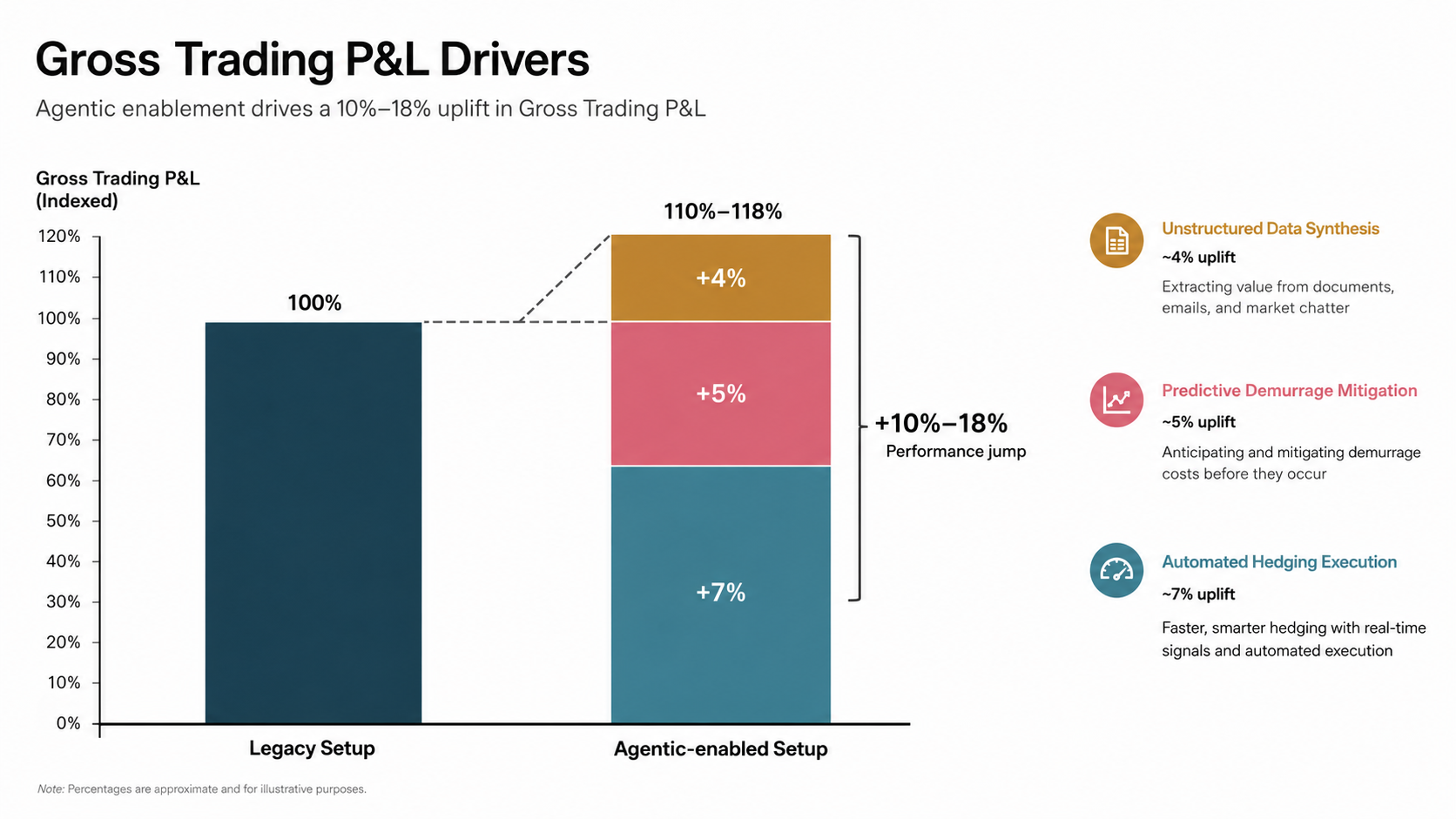
Generative and agentic models excel at answering open-ended, exploratory questions and standardizing unstructured inputs into actionable intelligence. Independent agents can ingest, process and translate messy multi-format text, WhatsApp updates, in-house messengers, Bloomberg chats and freight manifests into structured intent signals. By acting as contextual co-pilots, these engines cross-reference global tonnage, grade-blending parameters and historical flows to augment existing arbitrage strategies.
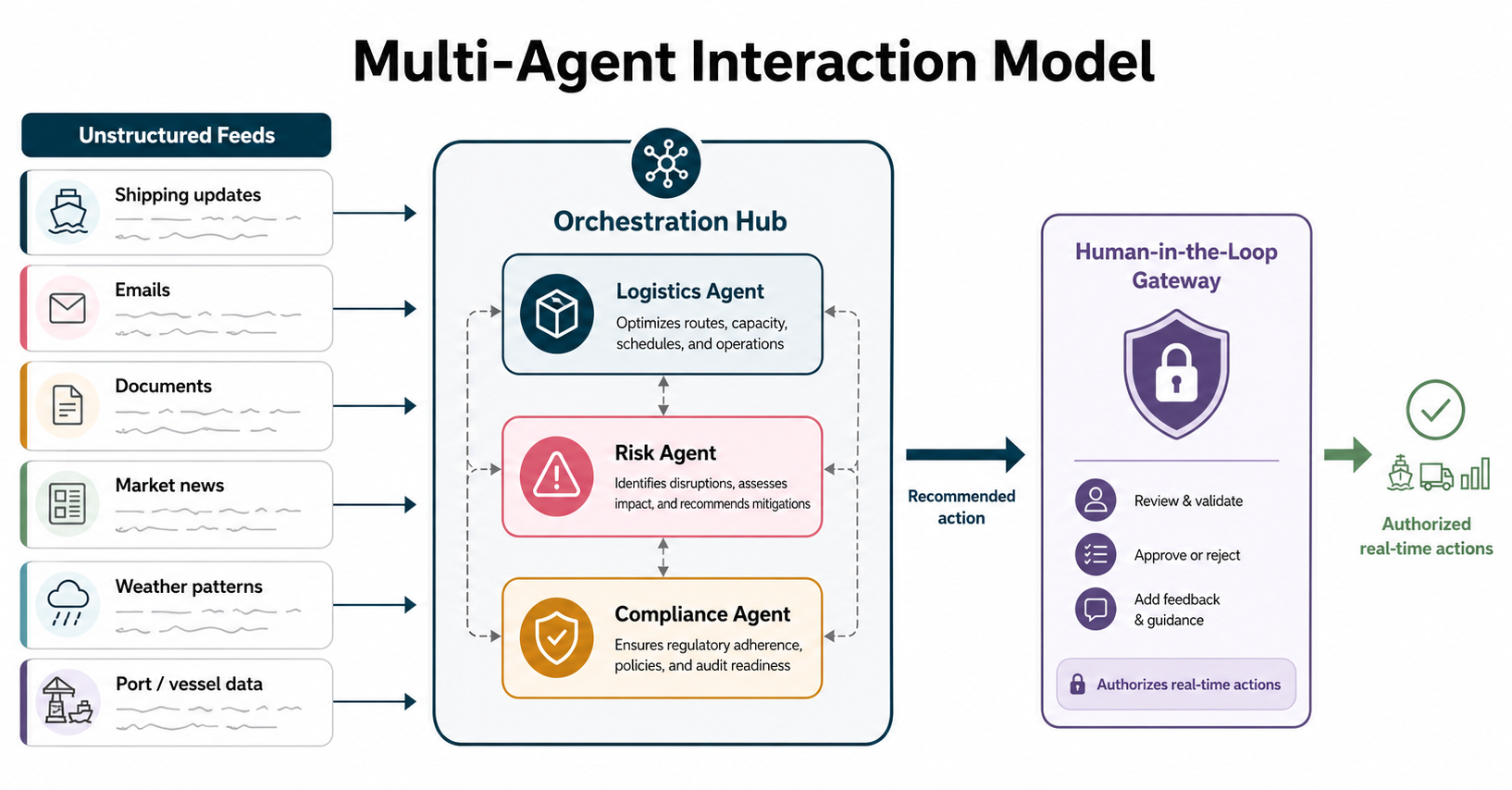
Moving beyond basic tracking, agentic architectures allow independent software units to continuously evaluate maritime risk. For example, a dedicated logistics agent can monitor adverse weather or port infrastructure backlogs. Rather than simply issuing a passive notification, the agent can autonomously compute the projected balance sheet impact of demurrage, review cross-portfolio storage capacities and structure an adaptive routing plan for human sign-off.
In high-volatility markets, real-time execution precision dictates the capture of margin optionality. Agentic AI enables a cohesive decision engine capable of assessing credit risk, country limits, counterparty margin calls and cash collateral requirements simultaneously. Operating within pre-approved risk guardrails, agents can dynamically execute micro-hedging strategies in the paper markets to protect physical exposure, reducing the transaction cost drag by an estimated 10% to 20%.
Thoughtworks is uniquely positioned to help commodities companies bridge the gap between AI ambition and real-world production value through our core engineering and strategy capabilities.
Agent/works™ integration and agentic frameworks: Through our proprietary Agent/works™ platform, Thoughtworks assists clients in bypassing the trial-and-error phase of agentic deployment. We help trading organizations configure, trial and scale independent software agents designed specifically to handle high-value use cases. This includes standardizing unstructured communication, mining chat data for hidden trade intents and deploying autonomous monitoring tools that seamlessly interact with existing core ecosystems.
Data core modernization and API enablement: We design and deliver modular, dual-speed data fabrics that break down the walled gardens of legacy setups without requiring a complete CTRM overhaul. Thoughtworks builds the clean, secure data streaming pipelines necessary to feed live maritime, fundamental and operational data directly into AI models, enabling real-time risk calculations and hedging execution.
Operational model redesign and risk controls: Scaling autonomous agents requires robust pre-trade controls, strict safety parameters and intelligent human-in-the-loop (HITL) system designs. Thoughtworks partners with executive boards to redefine the human-AI operating model. We ensure synthetic workloads automate low-margin, fast-loop processes safely, freeing human traders to focus on high-yield, complex physical negotiations.
Lead with clear commercial outcomes: Avoid fragmented, desk-level experimentation. Anchor initial agentic deployments directly to measurable value metrics, such as demurrage avoidance, execution speed or risk capacity release.
Transition to data-centric architecture: Shift from a monolithic stack to a modular data core. Use modern APIs to cleanly expose siloed asset, freight and pricing data to synthetic models without requiring multi-year system overhauls.
Redesign the human-AI operating model: Establish clear parameters for machine-to-machine interactions and design robust pre-trade controls. Build interactive workflows that maximize human expertise while fully empowering synthetic agents to handle fast-loop calculations.
Maintain an Agile lifecycle: Create a rapid loop of testing, refinement and model retirement to ensure agentic systems remain tightly calibrated to changing physical flows and evolving geopolitical conditions.
By fundamentally embedding agentic execution into the trade lifecycle, forward-thinking commodity traders will transform volatility from an operational risk into a key engine for commercial growth.
Disclaimer: The statements and opinions expressed in this article are those of the author(s) and do not necessarily reflect the positions of Thoughtworks.