


E-Book
Retail insights 2026: Practical actions retail leaders can take



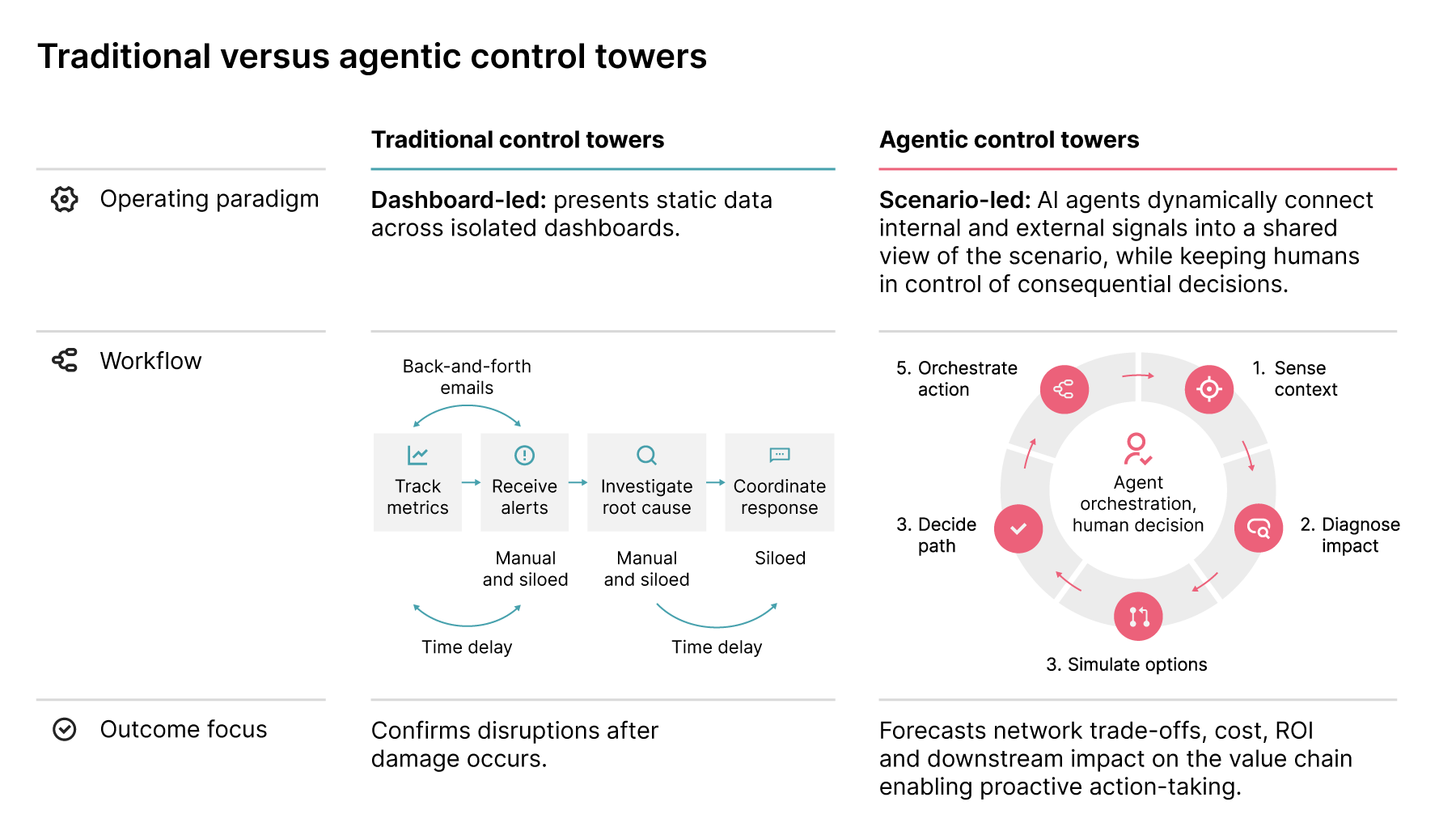
Most supply chain control towers do one thing well: track every movement across a complex network, from origin to final destination. But when a disruption hits, that's when things start to fall apart. Teams are left piecing together endless dashboards while the crisis unfolds in real time.
That delay comes at a real cost, with research suggesting disruptions can wipe out up to 4% of a company's annual revenue.
Yet the appetite for control towers remains strong, as retailers seek greater resilience amid geopolitical, logistical and technological disruptions. The global control tower market is projected to grow from US$12.9 billion in 2026 to US$53.1 billion by 2033, with Asia Pacific being the fastest-growing region.
We'll explore how retailers can reimagine control towers with agentic AI to move beyond basic visibility and reactive response. By connecting the dots across the value chain, scenario-based insights can help teams anticipate potential disruptions and identify opportunities for improvement and innovation, enabling them to act before problems take hold.
An IDC study, sponsored by Blue Yonder, found that 44% of supply chain leaders in India see a lack of visibility – both end-to-end supply chain transparency and early detection of exceptions – as one of the top future problems for their companies if left unaddressed.
That concern tracks with what we see firsthand in many client organizations. Through traditional control towers, information arrives scattered: a supplier update here, a shipment alert there, while signals from other systems, suppliers or external events often sit outside the picture entirely.
Teams are then left to connect the dots themselves. By the time they have pieced together enough information to understand what's happening, the disruption is already underway. What was meant to be a warning system becomes only a confirmation system.
As teams move to act on the information gathered, their response can also backfire. Different functions may interpret the same situation through their own lens, leading to decisions that optimize for one part of the network rather than the whole. An action that solves one problem can create another downstream.
The cost of all this doesn't stay contained to one bad week. It compounds, quietly, structurally, until it becomes the baseline cost of doing business.
Faced with that cost, many teams turned to large language models (LLMs) to bring more intelligence into their supply chain decisions. But intelligence alone doesn't solve the problem. Without the context, orchestration and governance needed to put that intelligence to work, teams risk making faster decisions without making better ones.
Four things get in the way when working with LLMs:
Different users get different answers. Every user brings their own assumptions, context and way of framing the problem. Even identical prompts applied to identical data can produce different results, so two planners can ask what appears to be the same question and come away with different answers.
Output isn't grounded in business context. LLMs don't inherently understand a retailer's supply chain, operating model or business priorities. Their outputs are probabilistic, so without the right context and grounding, teams risk acting on an answer that sounds plausible rather than one that reflects how the business actually operates.
Example: Consider an inventory planner feeding warehouse data to an LLM, asking, “How do I minimize holding costs?” and getting a recommendation to cut replenishment orders by 20%. At the same time, a regional store operations manager feeding store inventory data to the LLM, asking, “How do I guarantee 99% on-shelf availability?” and getting a recommendation to double safety stock. Both answers may make sense in isolation, but neither accounts for the trade-offs across the network.
Nothing validates or contains the output. Without proper governance, an unsupported interpretation moves from one workflow to another, becoming an input to subsequent decisions without a clear record of its source, context or validity.
The economics quickly become opaque. When analysis happens independently across teams and tools, organizations accumulate duplicated usage and token costs without building a reusable decision-making capability.
The result is the same siloed, reactive decision-making from before, just running faster, and now harder to govern and audit.
If the problem is that supply chain decisions are fragmented, slow and disconnected from execution, the answer isn't another dashboard. It is a system that can bring the relevant signals, context and decisions together around the scenario at hand.
This is the thinking behind Thoughtworks’ agentic control tower. Rather than treating the supply chain as a collection of disconnected metrics, it treats it as a network of interdependent decisions across first mile, distribution and last mile, and across the systems, functions and people involved.
The approach is built around three capabilities: Sense, Simulate and Solve.
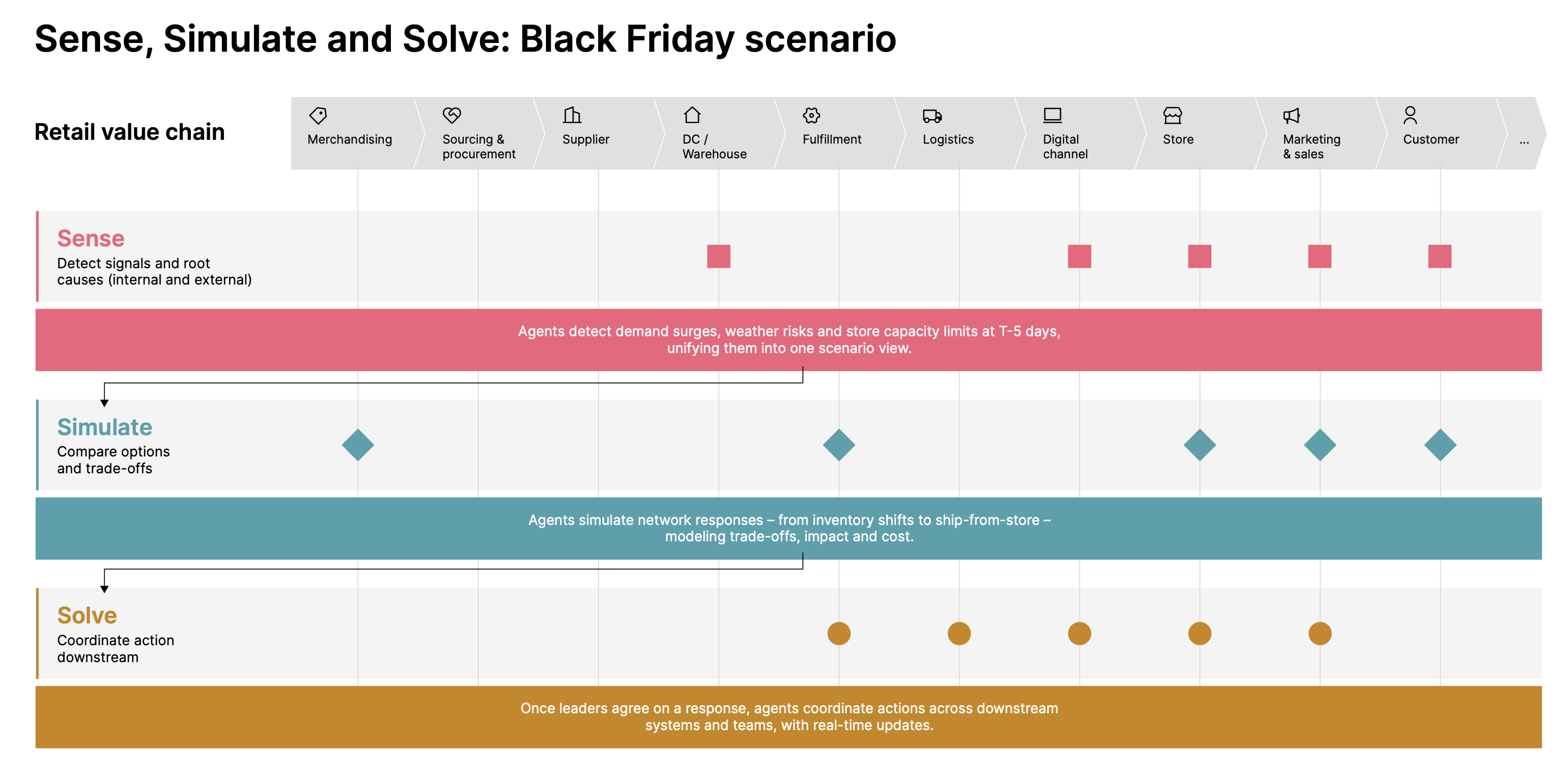
Sense: Brings together internal and external signals to identify disruptions, opportunities for improvement and potential areas for innovation. Supplier orders, truck schedules and demand intelligence are considered alongside signals such as traffic and weather. Rather than simply surfacing a metric that has moved, agents connect these signals to identify what is happening, why it is happening and what the impact could be across financial, operational and customer outcomes.
Simulate: Moves from diagnosis to options. Agents look across the retail value chain to explore potential responses at strategic, operational and tactical levels, modeling their likely impact, trade-offs and consequences. Humans remain in the loop to assess those options and make the decision.
Solve: Closes the gap between deciding and doing. Once a course of action is agreed, the control tower maps and communicates the required actions to downstream systems, functions and teams, so decisions can be executed where they need to be, when they need to be.
So what does this look like in practice? Imagine it's five days before Black Friday. Demand for several priority products is running above forecast and severe weather is threatening a major distribution center. Inventory is available, but unevenly distributed, while store capacity and delivery commitments are already under pressure.
An agentic control tower connects these signals rather than treating them as separate events, giving leaders a shared view of the emerging scenario and its potential impact. It simulates responses across the network, from reallocating inventory and rerouting orders to activating ship-from-store, showing the trade-offs, impact and cost for each option. Once leaders agree on a response, the control tower coordinates the required actions across downstream systems and teams, updating the shared picture as the situation changes.
This way, teams shift from interpreting metrics and coordinating responses to working directly with scenarios and decisions while there is still time to influence the outcome.
An agentic control tower isn't just built for when things go wrong. Because it connects signals across the value chain continuously, it can surface other kinds of scenarios too. Not just disruptions, but also opportunities.
Some of these are improvement opportunities: sharpening performance in supplier management, transport routing, goods receiving, warehouse capacity or store operations. Others point toward innovation, with signals from changing consumer behavior, competitive moves or market trends suggesting a new way of operating.
The distinction isn't always clear-cut. An opportunity to improve an existing process can lead to an entirely new way of doing things. What matters is that the control tower can connect the signals, understand the scenario and help teams move from insight to action proactively.
An agentic control tower isn't something organizations can simply layer onto their existing technology stack. A few challenges need to be solved to make it work:
Supply chain data is fragmented across Warehouse Management System (WMS), Transport Management System (TMS), Order Management System (OMS), supplier systems and more. Some of it isn't available in real time. Some of it was never structured for an agent to make sense of. Before agents can do anything useful, they need a reliable way to get the right data, at the right moment, in a form they can actually work with.
An LLM doesn't inherently know how a particular retailer operates, what its supply chain constraints are or which trade-offs actually matter. That knowledge lives across systems, documents, teams and a fair amount of tribal knowledge nobody's written down. Without this context, agents can produce recommendations that sound reasonable but don't hold up against how the business actually runs.
An agentic control tower relies on multiple specialized agents, each handling a different part of the supply chain, sharing context, handing off tasks and working toward one shared picture instead of pulling in different directions. Getting that right means striking a balance: giving agents enough freedom to reason through unfamiliar situations, while using defined guardrails and checkpoints to keep their behavior predictable and observable, including what they consume in compute and tokens.
Agentic control towers don't just surface information; they generate analysis and recommendations that shape real decisions. For people to act on that, they need to see why an agent reached a conclusion, what it based that on and whether it actually holds up. This traceability and observability can't be bolted onto a dashboard after the fact. They need to be built into the experience from day one.
Thoughtworks helps organizations address these challenges by bringing together the architectures, reference implementations and accelerators needed to build and scale an agentic control tower
A connected intelligence layer: A reference semantic layer provides a common foundation for ingesting and structuring the data agents need for specific supply chain scenarios, making fragmented information easier for them to consume and reason over. Specialized agents are then grounded in supply chain and organizational context, including processes, network design and decision approaches.
An orchestration layer built for collective intelligence: Reference implementations for common supply chain scenarios help orchestrate the specialized agents, showing how they can share context, hand off tasks and contribute to collective decision-making. This approach balances deterministic processes with agentic reasoning, while Agent/works™ provides governance and observability across the system.
A decision layer, not another dashboard: The experience is built around scenarios rather than static metrics, with standardized decision processes that connect what's happening to what should be done about it. Conclusions can be traced back to the data behind them, helping teams distinguish a data problem from an interpretation problem. Reference UX prototypes help validate the experience before a larger rollout.
Thoughtworks' 3/3/3 methodology gives this a flexible cadence: three days, three weeks and three months as guiding milestones for validating the idea, testing a working prototype and moving toward production, with the exact pace adapted to the organization's needs.
That journey starts with Sense. Organizations can test whether agents can identify meaningful scenarios, connect signals and provide useful analysis in their own context. From there, they can expand into Simulate to explore options and trade-offs, and ultimately into Solve to connect decisions to downstream systems and execution.
This approach lets teams learn and adapt as they go, and they don't need to build the entire control tower before starting to see results.
Visibility alone is no longer enough. Traditional control towers can show what's happening across the supply chain, but teams still have to connect fragmented signals, understand their implications and coordinate a response.
An agentic control tower changes that. Specialized agents work across Sense, Simulate and Solve to connect the dots across the value chain and turn fragmented signals into one end-to-end view of the scenario while there's still time to act on it. Different functions work from that same view instead of their own slice of it, weighing the same trade-offs and moving toward the same goal, so decisions get made holistically instead of in silos.
This isn't about replacing dashboards with AI or handing decisions over to agents. It's about redefining what a control tower is for: not giving teams a clearer picture of what's already happening, but helping them see what's coming and act before it takes hold.

