














Leadership
AI in the enterprise: From individual enablement to organizational impact and back again


The term ‘SaaSpocalypse’ has been circulating across technology and business worlds in recent months, supposedly marking the death of the software-as-a-service market thanks to AI.
But what’s the reality? While it’s clear the evolution of AI capabilities are transforming the way businesses think about purchasing software, from my seat leading Thoughtworks’ go-to-market (GTM) stack, this isn't a theoretical debate. It's showing up in practical decisions about what stays in the stack, what becomes harder to justify, and where AI is genuinely changing the economics and expectations around software. The views in this piece come from working through those questions directly, including the good, the bad, and the uncomfortable parts.
The SaaSpocalypse is what happens when a model that made real sense in the pre-AI era starts to strain. Standardize workflows in a shared product, spread build and maintenance costs across customers and charge per seat for access to the UI.
That was rational when custom software was expensive and took longer to build. AI changes that equation, but not just because it makes software cheaper. More importantly, it raises expectations. The shift is from a one-size-fits-most organizations to systems of intelligence that understand your strategy, context, and ways of working.
That distinction matters. Much of the current industry conversation is being pulled toward cost, and the term is gaining traction because several forces have collided at once. Capital markets love a label, and “SaaSpocalypse” captures the fear that AI makes parts of SaaS vulnerable. AI-native founders and implementation consultancies benefit from framing this as a rupture, so many are doing exactly that. At the same time, enterprise leaders are increasingly frustrated with software stacks that cost millions yet still fail to deliver usable intelligence without spreadsheets, workarounds, and manual effort.
But treating cost reduction as the main prize risks driving the wrong decisions. In our own AI4GTM work in Thoughtworks marketing, cost is the third driver, not the first. The real opportunity is to create systems that embed the processes and intelligence of your best people, move faster than human teams can on their own, and only then reduce the cost to serve. Quality can't be compromised; speed and productivity is the goal, with cost reduction downstream of any changes you implement.
So yes, there is an economic thread here, including growing pressure on SaaS pricing models built around seats rather than usage, outputs, or outcomes. But the deeper issue is not cost alone. It is that AI is changing what buyers should expect from SaaS in the first place.
It’s not unreasonable to question whether SaaS really is dead or dying. As with many things in this industry, the answer is ‘it depends’. What is worth bearing in mind though is something my colleague Martin Fowler said 15 years ago: some software is utility and some is strategic, and you shouldn’t run them the same way.
In the pre-AI world, “buy the package” was rational for utility systems because software was expensive and slow to build. AI changes the economics by making software creation dramatically cheaper and faster, so the build vs buy boundary shifts. And there’s a second twist: systems we treated as utility, like CRM, can become strategic in the AI era because the competitive edge is no longer the system of record, it’s the customer intelligence you can extract and act on from it. That’s why startups and mid-sized companies can choose to classify their GTM systems as strategic, and go the custom route without paying the traditional SaaS rent.
However, enterprises are different. With the tech available today, organizations can easily replace point solutions that have a narrow feature set. We did exactly that at Thoughtworks marketing, eliminating three SaaS platforms with a narrow feature set in 2025 and replacing them with bespoke AI workflows, which removes vendor complexity from our stack, and the lower price is also a bonus. The inflection point is when businesses choose to abandon CRM-class systems that are used by hundreds or thousands of employees, with deep feature sprawl, uneven user behavior, support expectations, plus security and privacy obligations that SaaS quietly absorbs. Our first attempt at ripping out a rock system in Thoughtworks marketing and replacing it with an AI-native solution has taught us some important lessons. If you take such a challenge, you need to shift from a traditional pre-AI era, classic agile product/IT team delivery model, otherwise it’s impossible to keep up and build the full feature set, even when using vibe coding tools like Lovable and coding assistants like Claude Code to expedite the development process.
We’ve all seen entrepreneurs using tools like Base44 to generate a CRM for personal use in a few hours. We know that this doesn’t hold in enterprise grounds. The issue is not whether AI can help generate software. It is whether you can deliver enterprise-grade systems fast enough, with the right quality, governance, and cost profile, to make replacement a serious option. To make “replace big SaaS” viable you need a new software development lifecycle.
That is exactly why Thoughtworks launched AI/works™ in January 2026, our agentic development platform. We are now using it internally across sales and marketing as we work to replace a core SaaS platform in our GTM stack. The goal is to reach the full feature set and workflows the business requires, while continuously regenerating application components as business requirements and regulations change, with less human intervention. In that model, humans shift from manually chasing every feature to acting as architects and overseers of an AI-native development process. With such an approach, the economics to replace SaaS in the enterprise can make sense.
But until that model matures, the more immediate trend is not mass SaaS extinction. It is how to get more value from the SaaS and the data your organization already has. This has been a major focus for us in Thoughtworks marketing. Before touching the core stack, we focused on improving value by building the intelligence layer above the SaaS. The aim was to help our GTM teams get better signals, better recommendations, and better timing than the pre-AI model allowed. To do this, we established an AI marketing applications team and introduced forward-deployed AI engineering graduates to work directly with marketers, sitting alongside them in the business. Their role is to bring together data, context, and business logic to generate more useful intelligence than any single SaaS platform could provide on its own. To act on that intelligence, we introduced GTM Engineers focused on workflow automation using low-code tooling such as n8n, helping turn insight into execution faster. We also built a close working relationship with internal IT, which provides infrastructure, guardrails, agent-building protocols, and other horizontal capabilities.
Once organisations prove they can generate better intelligence and faster action on top of the existing stack, they are in a much stronger position to challenge legacy pricing, reduce vendor sprawl, and decide more selectively which platforms still earn their place.

Stay adaptive, stay hands-on so you can test things yourself and be bold enough to change strategy when the evidence changes, not when the noise does.
Stay adaptive, stay hands-on so you can test things yourself and be bold enough to change strategy when the evidence changes, not when the noise does.
AI agents are good when they have the right data foundations. If that’s in place, you can stop treating SaaS as the place work happens and start treating it as a set of data sources, not destinations.
Clay is a good example of SaaS as a data source. We’re not partnering with them for “a nicer screen;” we partner for their ability to enrich our data to enable our Go to market. We have two GTM engineers on an approximately 150 person marketing team that are responsible for Clay configurations. The broader marketing organisation consumes intel from Clay via our five super agents that cover our critical GTM capabilities and workflows, rather than having to go directly into the Clay. In a world where that data can be fetched on demand, we’re able to combine it with intelligence from other systems in a governed way.
That’s why our first move at Thoughtworks marketing was to rewire the stack for agents. In practice this involves making critical structured data queryable and governed, reorganizing unstructured data so it can be retrieved reliably, and pulling business logic out of SaaS workflows so agents can orchestrate it without being trapped in the Salesforce worldview.
In terms of the data we pull from the SaaS into our Super agents, we onboard regularly used data into BigQuery and pull opportunistic data on demand by invoking governed tools and sources, including direct SaaS API calls, and Model Context Protocol (MCP), depending on the context. This means that our teams no longer need to go to five different tools to get an answer.
Once this foundation exists, agents can do what SaaS UIs have been trying (without success) doing for years: answer questions across your entire data ecosystem in context, route work and trigger actions across systems. Without it, you just get shiny chat over messy data.
A challenge that we are facing right now is on the experience layer. Our super agents have a bespoke experience layer, and as a marketing leader, this is not something I want to worry about. However tools like Glean that want to be that single chat interface for teams that’s so compelling to users, they’re invariably expensive and offer limited control. You’re also more likely to run into hallucinations when the logic isn’t truly yours. Given we are on the Google stack and deeply invested in it, Gemini Enterprise, meanwhile, is admittedly cheaper but not as feature complete; that’s why, for now, we’re building a bespoke Super agent experience layer while actively watching the market for a well priced option that can reduce the need for us to run our own.
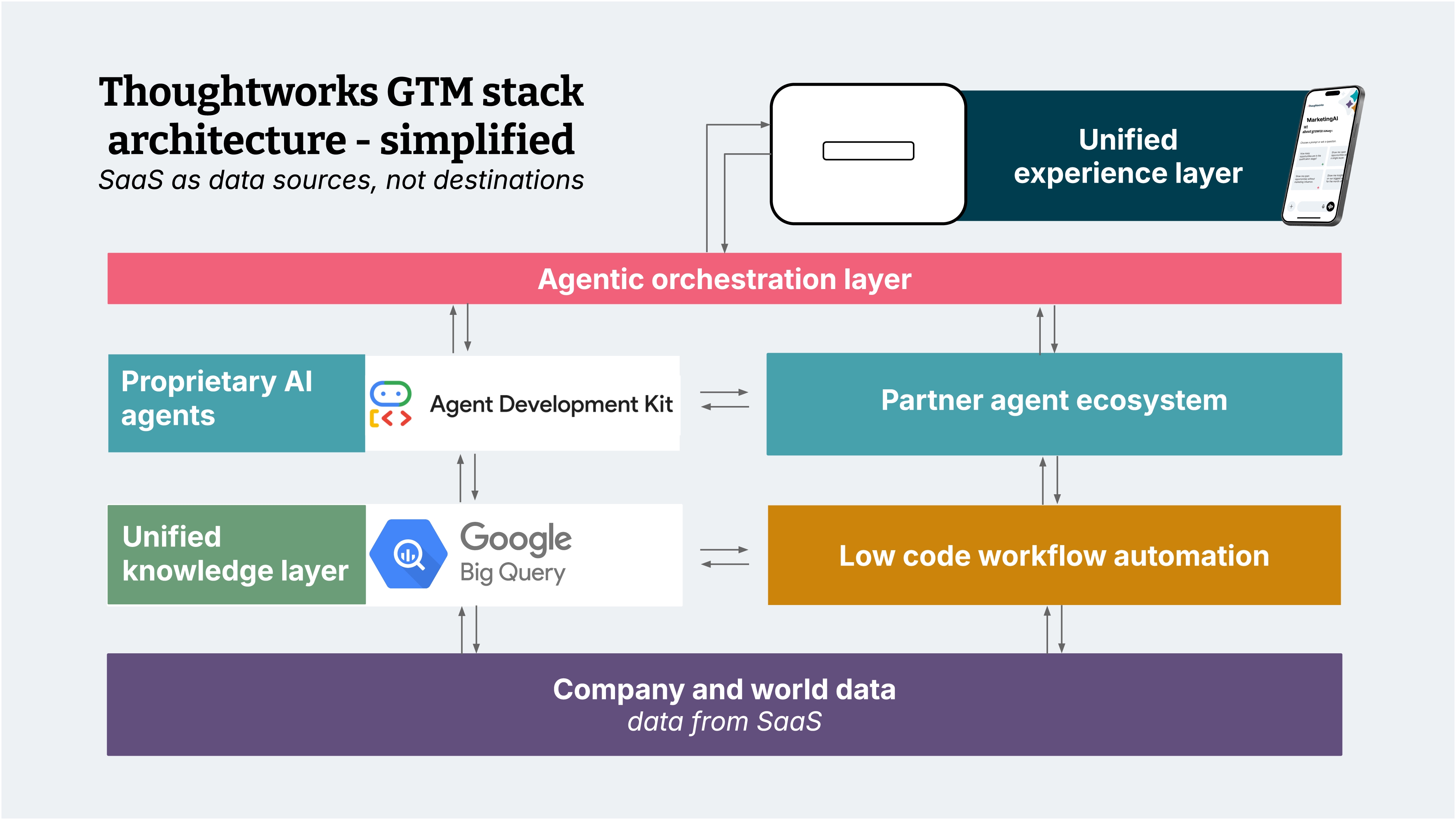
If the Saaspocalypse is at all accurate then it’s deserved for those parts of the SaaS market that have been overcharging for many years. The real villain in the old model is the combination of platform rent and licence economics: you pay a platform tax when everything has to be built on, integrated through or licensed around a dominant ecosystem like Salesforce, and you then pay high per-seat fees that don’t reflect usage or value.
In the AI era, as per my earlier point, when you treat your SaaS as data sources rather than destinations, and value extraction is done at our Super agent layer bringing data and capabilities of multiple systems together, which supports my point on SaaS pricing having to move toward consumption, output and outcomes.
While cost is not the main driver of the program, at Thoughtworks marketing we effectively began shifting SaaS contracts to cheaper, AI-friendly alternatives and pushing existing vendors we want to keep in our stack into aggressive price reductions because they know parts of their feature-set are increasingly replicable and because breaking away from expensive platform ecosystems (Salesforce is the obvious one) changes the math. In our case, we’re seeing 50%+ in SaaS vendor contract reductions and moving from licence-heavy seat models to consumption-based pricing that fits B2B volumes. Broadly, the industry is experimenting more with consumption and outcome-style pricing, even if seats don’t disappear overnight. We recently replaced a rock system in our stack for a modern version of that SaaS at 30% of the incumbent’s cost. Suddenly the whole GTM SaaS economics start to make sense again.
So, where SaaS is actually properly priced for the AI era and earns its keep on reliability, security, compliance and support, you should feel fine about it. That’s still a good trade.
A warning is deserved, but it’s not “AI is fake;” it’s “personal productivity is outpacing enterprise profit.” We see significant adoption at the individual level with Microsoft’s Work Trend Index reporting 75% of global knowledge workers are using generative AI, enterprise returns are still uneven. An S&P Global survey found 46% of companies said no single enterprise objective produced a strong positive impact from genAI initiatives, and only 19% reported strong positive impact across most objectives.
The key point is that AI will not help you if you have a bad strategy. If your teams become more productive, but work on the wrong thing in the wrong way, AI and automation will not impact the bottom line. The key is to amplify what’s working, the processes of your best employees, with AI. Those are the companies that win.
In six months, a year, or three years, any prediction can be made to look silly because the pace of change is brutal. The way we handle it at Thoughtworks marketing is to treat this as a continuous sensing problem: my AI and data team in marketing monitors the market daily; we then test what’s showing up as the next big thing, and we review what it means for our strategy and roadmap. The real skill is knowing when something is a genuine milestone that changes the industry versus more hype you need to ignore.
The other reality is ecosystem lock-in. Your path depends on the stack you’re on and the partners you’re aligned to, because it’s not easy to change a company-wide platform direction. Thoughtworks is on the Google stack, so we stay very close to their AI innovations and use that as our baseline for what’s possible; luckily it’s one of the strongest AI ecosystems out there right now.
My advice is simple: stay adaptive, stay hands-on so you can test things yourself and be bold enough to change strategy when the evidence changes, not when the noise does.
I’m beginning to see a new class of SaaS that looks very different to what’s been the norm over the last 15 years. The winning products won’t be “another UI with features,” they’ll be systems designed to be accessed by agents, built to expose data, and actions safely into an enterprise’s broader intelligence layer. In that world, SaaS is less a destination and more a set of transaction rails and governed capabilities that agents can compose, while the user experience consolidates into fewer surfaces.
We’ll also see new economics. The old seat-based licence model makes less sense when agents are doing the work and human logins become optional, so the products that win will price around consumption, output and outcomes. They’ll earn trust by reducing operational risk, not just adding features. That’s also where you’ll see differentiation: vendors that can ingest and structure unstructured data, enforce custom business logic and integrate cleanly into your data architecture will thrive.
The “new SaaS” isn’t dead. It just has to be priced and engineered for the agentic, data-centric operating model.