














AI and ML
Quantifying AI adoption: From initial challenges to doubling speed


Orgs have traditionally coordinated work across a portfolio of assets (people, capital, technology, physical infrastructure, intellectual property, information and relationships), with autonomous agents now emerging as a distinct new substrate within that operating system.
A regional sales manager opens her morning dashboard. Overnight, her agent twin has drafted three renewal strategies for a wavering enterprise account. Each strategy is grounded in real usage data, internally consistent and defensible. The agent has also automatically emailed two smaller accounts on her behalf, flagged a pricing anomaly to finance and rescheduled a quarterly business review she had forgotten about. She did not request any of this. She now has to decide which renewal strategy to greenlight, whether the sent emails match her communication style and who explains a potential error to her boss if the pricing flag turns out to be inaccurate.
Traditional business education does not prepare leaders for this operating environment. For a century, leadership theory quietly relied upon a fundamental premise: everyone a leader manages is human. Trait theory, servant leadership, situational leadership and transformational leadership represent different eras and emphases, yet they were all engineered for a workforce that experiences fatigue, requires motivation and exists as single entities. Agentic AI breaks this assumption by introducing a secondary member to it. This new entity lacks a job title or a career trajectory, and it can be spun up, scaled or terminated mid-task. Every leader, manager and employee now manages an agent twin: an autonomous counterpart handling an increasing share of the work that historically defined their professional role. This transformation is fundamentally a leadership shift rather than a pure technology narrative, rewriting role definitions, structural design, decision-making authority and ultimate accountability.
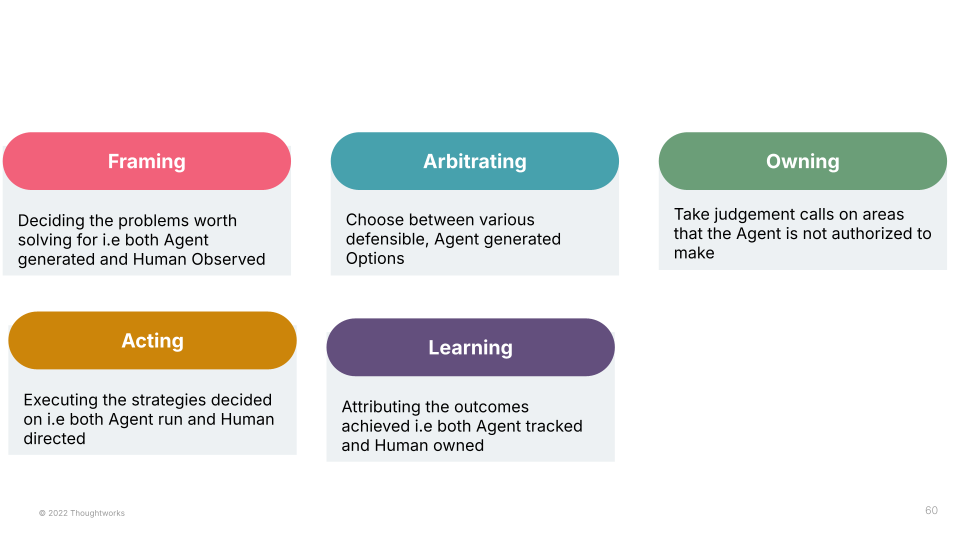
The common reflex is to ask what AI will eliminate. A more strategic inquiry questions the fundamental purpose of a role once an agent twin absorbs the majority of daily tasks. A manager's twin can draft plans, synthesize reports and surface options in mere seconds. The remaining responsibility represents a shift to a different category of work. Humans must focus on framing which problems are actually worth solving, arbitrating between multiple twin-generated options that are all individually defensible and owning judgment calls the agent cannot make when a problem is not yet well-posed. This boundary is not static. It must be renegotiated continuously as agents become more capable, turning the job itself from a fixed description into a dynamic allocation decision made daily.
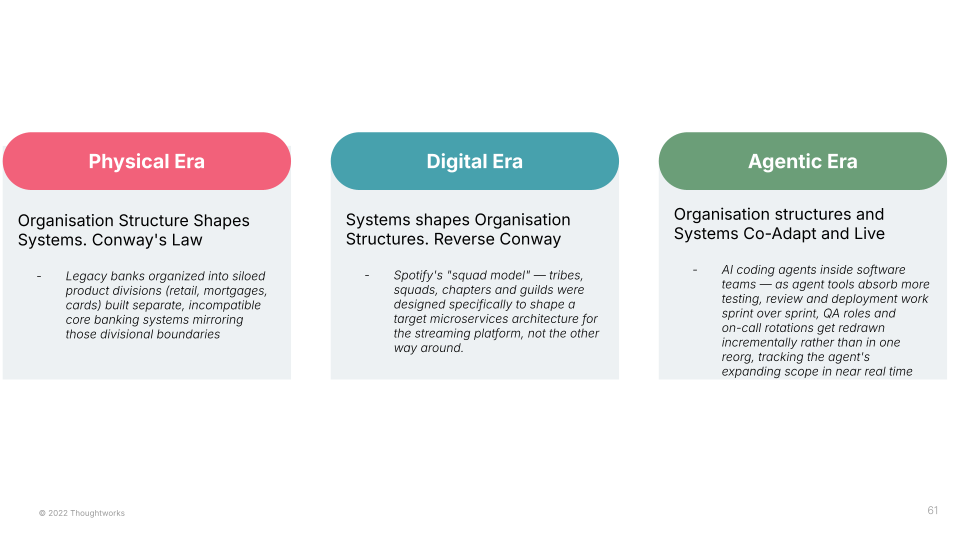
Conway's Law observed that systems end up mirroring the communication structure of the organizations that build them. In the digital era, we saw the reverse: organizations began deforming to fit the software they bought, like Salesforce, SAP, Slack: an invisible, one-time reshaping of the org around a fixed artifact.
The agentic era breaks that pattern a second time. The "system" is no longer fixed and has become adaptive, learning and increasingly making its own calls. So the relationship between org and system stops being a one-time deformation and becomes a continuous, bidirectional loop: the organization shapes what its agents can do, and what the agents can now do reshapes the organization back, in near real time. A leader deciding what to delegate to their own agent twin isn't a personal productivity choice, it ripples upward into how the business unit is structured.
Much of middle management exists to aggregate and supervise human execution such as collecting status, resolving bottlenecks, translating strategy downward. When agent twins execute directly, that aggregation function has less to do. What survives is a very different version of the job, in the lines of auditing human-agent decision flows rather than supervising human throughput. Organizations that simply shrink the layer without redefining its function will lose the oversight capacity they didn't know they needed until an agent twin makes a costly autonomous call nobody was watching for.
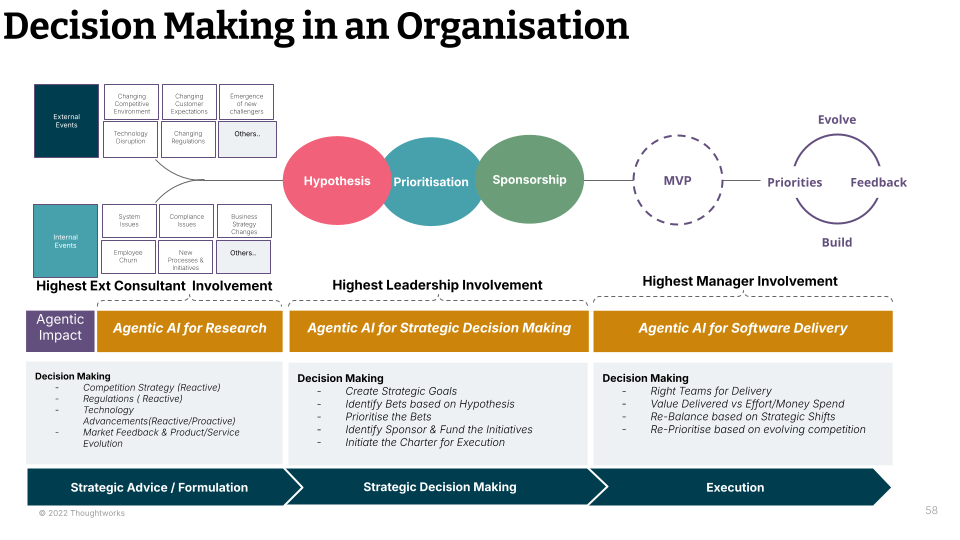
Delegation will also vary across the strategy-to-execution chain. Identifying signals, forming hypotheses, prioritizing investments and executing initiatives involve different levels of ambiguity and consequence, so they should not inherit the same human-agent decision rights.
Recent research from MIT's CISR offers a genuinely useful lens here: decisions should be split between human and AI based on two dimensions, i.e., ambiguity and risk, and the split isn't binary but plays out across three activities: framing a decision, acting on it and learning from the outcome.
Framing: Deciding what's actually worth solving, stays predominantly human, especially where ambiguity is high.
Acting: Where delegation accelerates fastest, particularly for low-ambiguity, low-risk decisions a twin can execute directly.
Learning: Closing the loop, attributing cause and deciding what changes next time is the contested middle ground and it's where a genuinely new leadership skill lives.
The allocation of framing, acting and learning changes according to the type of decision.
Accountability without full authorship, which would essentially mean a leader takes complete ownership, answerability, and legal or professional liability for the final output or decision, even though they did not fully write, create or originate the content themselves. A leader increasingly has to answer for outcomes they didn't personally produce and may not be able to fully explain after the fact. That is psychologically harder than owning your own mistakes, and no leadership model built before this decade trained anyone for it.
A useful discipline here comes from an older governance model, the classic framing of corporate governance flowing from the board through the senior executive team into two coequal branches: strategy and desirable behavior, each governing a set of key organizational assets (human, financial, physical, intellectual, informational, relational) through its own mechanisms.
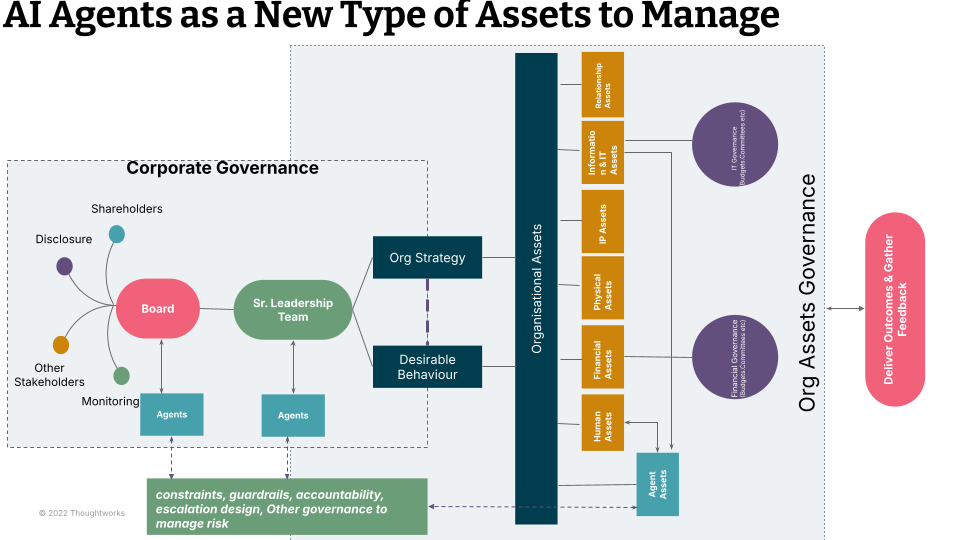
The diagram above highlights the need for managing agent twins as a different class of assets which could share traits of both human as well as IT assets.
Agentic AI doesn't fit cleanly into any of those asset classes. It behaves partly like a human asset, i.e., adaptive, contextual, exercising delegated judgment; and partly like an IT asset, i.e., owned, versioned, auditable. Governed like neither, it falls through the gap. The fix isn't complicated in principle. Treat autonomous agents as their own asset class, with their own governance mechanisms (decision-rights registers, escalation protocols, audit trails), sitting alongside financial and IT governance rather than folded uncomfortably into one or the other.
The behavioral half of governance needs the same fork. "Desirable behavior" used to mean one thing: shaping human conduct through culture and incentives. It now needs a second branch governing agent conduct: the guardrails, constraints and escalation design that keep autonomous decisions inside acceptable bounds. In most organizations today, that branch is barely resourced.
The principle worth holding onto through all of this is that delegating execution to an agent does not automatically delegate accountability.. A leader still owns the vision-level call. A manager still owns the trade-off. An employee still owns the quality of the work at their level. What's changed is that the execution of that responsibility now routes through a non-human partner, which means accountability has to be deliberately pinned to the human role, or it will quietly drift to nowhere, discovered only when something goes wrong and no one can say who was supposed to be watching.
None of this is solved by a personality trait. It's solved by practiced discipline:
Judgment under irreducible ambiguity: Framing problems an agent twin can't yet see the shape of.
Calibrated trust: Knowing an agent twin’s competence boundary precisely enough to delegate aggressively inside it and intervene sharply outside it.
Values-based arbitration: The tie-break skill, for when every twin-generated option is defensible and only judgment can choose.
Accountability without full authorship: Owning outcomes you didn't personally produce.
Architectural thinking: Treating the design of who talks to whom, human or agent twin, as a leadership lever, not an IT afterthought.
Delegation design: Defining what an agent may recommend, decide and execute and under what conditions authority returns to a human.
Leadership models from the last century weren't wrong. They were scoped correctly to a workforce that was entirely human. That scope has quietly expanded, and most organizations haven't noticed the boundary move. The work now isn't to discard servant leadership or situational leadership. It's to recognize that every leader, manager and employee is now the senior partner in a two-member team, and the real leadership question of this era is simple to state and hard to live: what do you keep, and what do you hand to your agent twin, and who answers for it either way?
References:
Disclaimer: The statements and opinions expressed in this article are those of the author(s) and do not necessarily reflect the positions of Thoughtworks.