
Technology strategy
Themes in Technology Radar Vol.35


When autonomous coding agents write thousands of lines of code in minutes, who ensures that what gets built actually honors the design system?
At the recent Thoughtworks North America AI/works™ Global Hackathon regional semifinal, our team — DriftSense — took home first place after wrestling with that exact question. What started as a shared obsession between a designer, a product manager and a business analyst quickly evolved into a fully functional visual observability and governance platform.
As we prepare to represent North America at the Global Final of AI/works™ Global Hackathon, we wanted to pull back the curtain on our journey: why design drift is the silent tax of generative software development, how we engineered a solution under hackathon constraints and what late nights building with AI taught us about the future of cross-functional product craft.
We’re currently witnessing an unprecedented explosion in software generation velocity. Between agentic workflows, scaffolding tools and LLM-assisted development, engineering output is accelerating exponentially. To keep this surge from spiraling into chaos, the industry has responded with an impressive suite of evaluation frameworks, unit-test synthesizers and guardrail harnesses.
However, one critical dimension has been almost universally overlooked: design drift.
Modern organizations invest millions in crafting cohesive design systems with standardized design tokens, accessible components, rigorous UI guidelines and meticulously organized Figma libraries. But maintaining parity between design intent and production implementation has always been a fragile balancing act. Over time:
Developers hardcode ad-hoc hex codes and pixel paddings to move quickly.
Component variants diverge across disparate codebases and micro frontends.
Documentation rots as design tokens fall out of sync with code repositories.
Trust between design and engineering steadily erodes, culminating in another costly, painful "design system overhaul" cycle every few years.
Now, inject generative AI into the equation. When AI agents crank out frontend code without an active, semantic understanding of your design system, this drift doesn't just happen gradually; it compounds overnight.

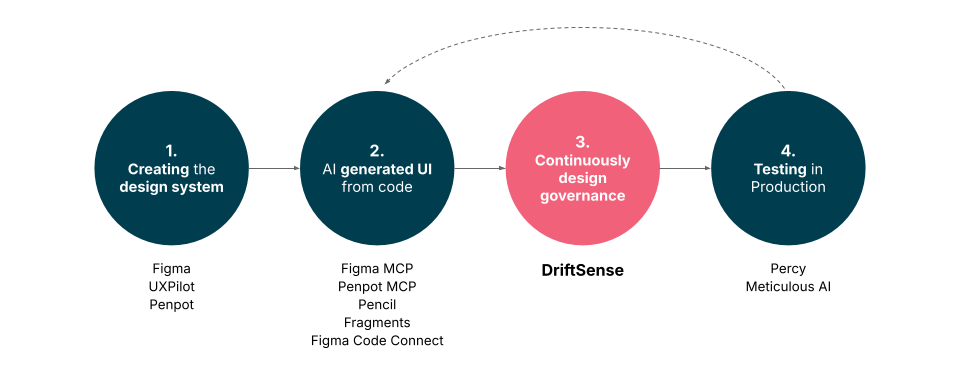
When evaluating existing market solutions, we noticed a critical architectural gap:
Figma Model Context Protocol (MCP) helps AI interpret design canvas assets.
Coding agents (like Claude Code, GitHub Copilot and Cursor) help developers rapidly generate boilerplate and UI components.
Visual regression testing tools (like Percy or Chromatic) catch snapshot pixel mismatches on staging or CI.
None of these represent a continuous governance and observability layer.
Visual regression checks tell you that a pixel changed, but they cannot tell you why an engineer (or an AI agent) bypassed a $spacing-lg token in favor of an arbitrary margin: 22px. They do not reason about semantic accessibility, component hierarchies or design token graphs.
DriftSense isn't another design input. It’s the governance layer that sits across all of them.
While AI will continue gaining context and producing more software, human teams still need an automated, reliable system to verify that implementation stays faithful to intent. DriftSense acts as that missing visual safeguard.
DriftSense anchors on a single premise: Your design system and style guides are the canonical source of truth.
Instead of waiting for UI inconsistencies to reach production, DriftSense works cyclically through two core operating loops:
Whenever a developer (or an autonomous AI agent) opens a pull request or commits code locally, DriftSense acts as an intelligent gatekeeper. Rather than simply diffing static pixels, DriftSense evaluates the code semantically against the latest design tokens and component contracts:
Has an undocumented color value been introduced?
Is an accessible component being replaced by an unstyled raw HTML primitive?
Does the markup respect design token constraints and typography scales?
DriftSense surfaces actionable feedback directly within the PR review workflow, preventing drift before code ever merges.
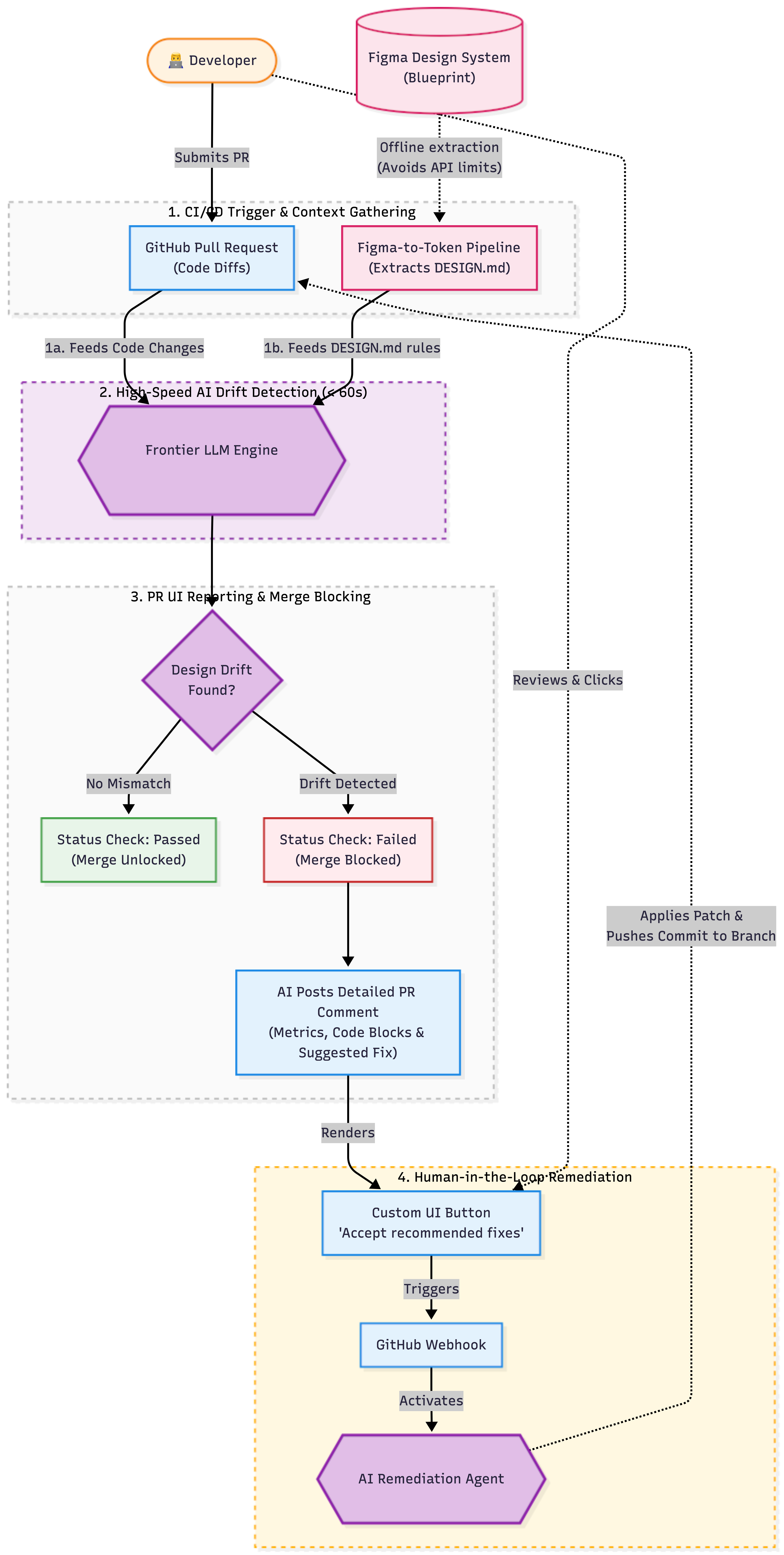
Design debt already exists across enterprise codebases. DriftSense continuously scans your repositories, indexing, scoring and prioritizing historical drift into an executive health dashboard.
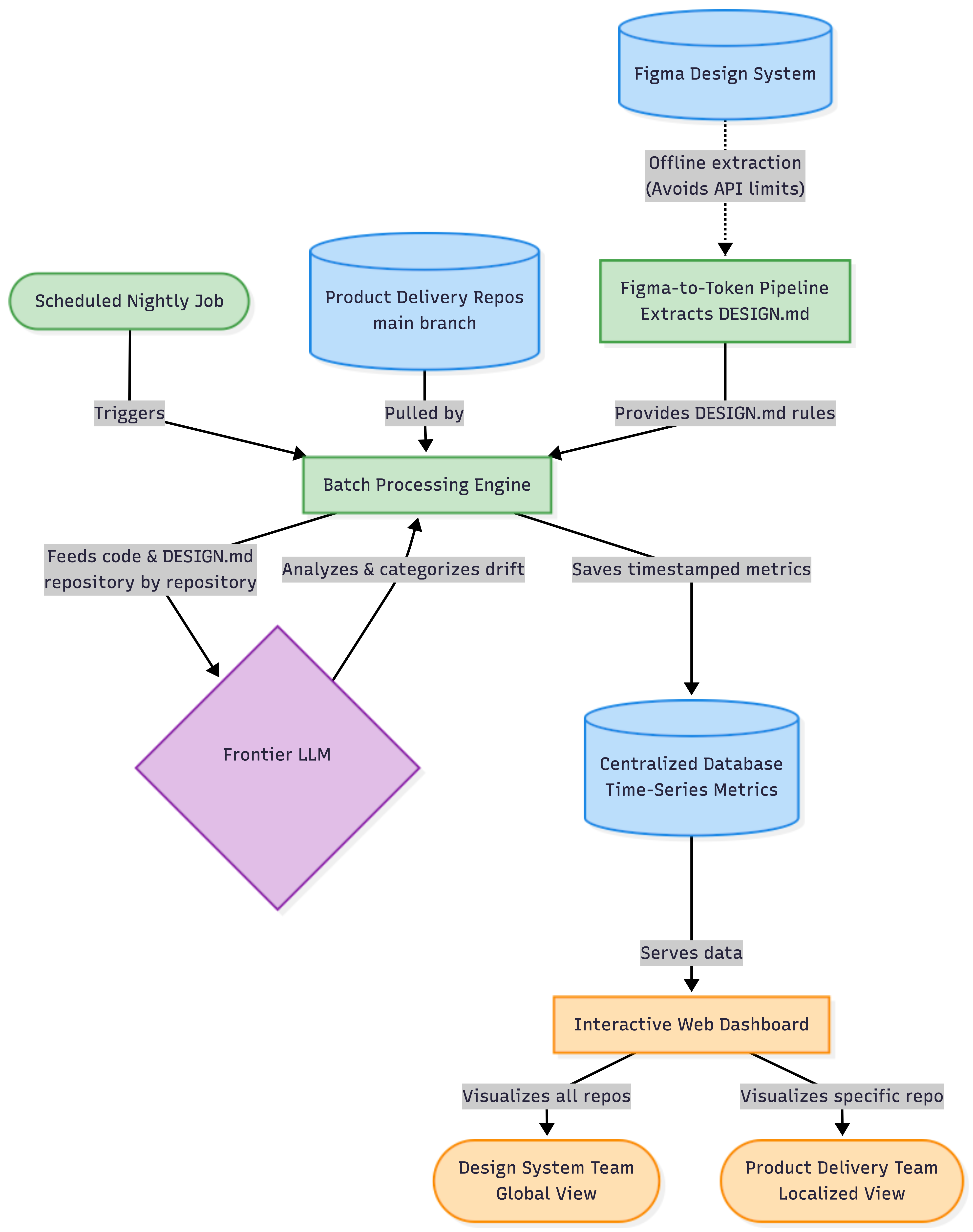
Crucially, it doesn't just present a laundry list of problems; instead it generates one-click remediation pull requests, automatically mapping hardcoded values back to official tokens and refactoring legacy markup to use standardized components.

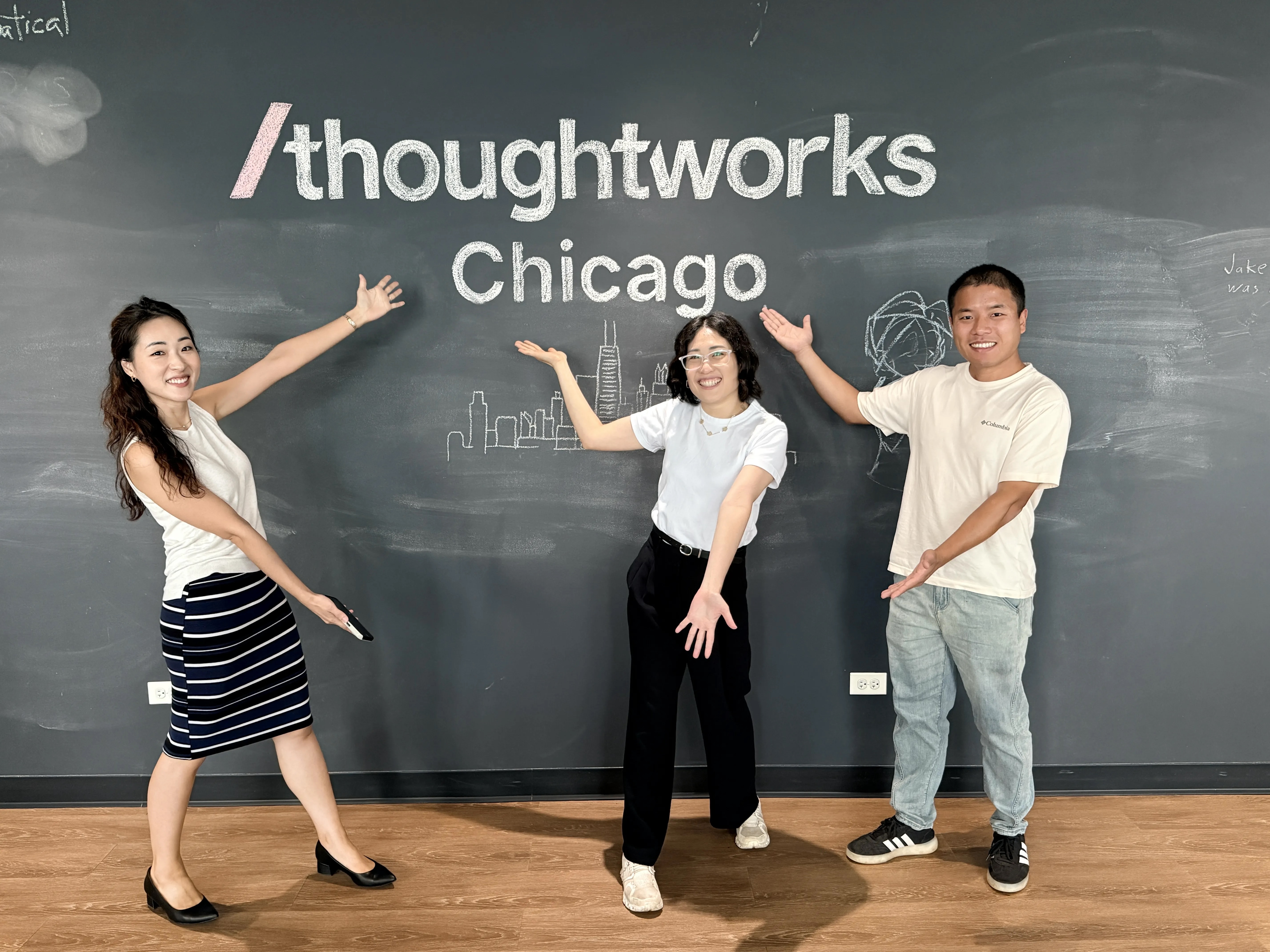
Behind every piece of technology is a team with a story. Ours began with Jeen, our designer, who has felt the real pain of design drift throughout her career. Long before this hackathon, Jeen had been prototyping concepts and even built a dedicated site articulating how automated design system alignment should work.
When the North America AI/works™ Global Hackathon kicked off team formation, Jeen pitched the concept. For Yooboo and myself (Shunfa), the problem statement resonated instantly. It was tangible, unaddressed and urgently needed in the enterprise space. We committed on the spot—we didn't even wait to hear the second pitch.
As we started chatting, Jeen and I realized we were not strangers. We had actually crossed paths back in 2019, when I was on a Long-Term Assignment (LTA) at Thoughtworks' Thailand office in Bangkok. Reconnecting years later across time zones to tackle a shared challenge felt like closing a creative circle.
Hackathons on paper look like linear sprints. In reality, they're a fast-paced mix of quick decisions, sudden pivots and constant iteration.
What started as daily check-ins inevitably blossomed into two-hour whiteboarding sessions, fierce debates on product taxonomy and deep-dive architecture mapping. Balancing demanding client commitments, family responsibilities and kids at home, our team rallied with complete ownership from minute one.
We also walked the walk by embedding AI into almost every step of our own development pipeline:
Ideation and brainstorming: Stress-testing edge cases and challenging our value proposition.
Visual mockups and synthesis: Generating architecture diagrams, summary digests and customer user journeys.
Code and scaffold generation: Accelerating our frontend harness and prototype logic.
Adversarial critique: Prompting models to act as skeptical design systems leads or enterprise platform architects to poke holes in our governance model.
Without AI acting as a multiplier (alongside the generous advice of our Thoughtworks mentors) delivering a working end-to-end prototype within such a compressed timeline would have been impossible.
Winning first place at the regional level was an honor, but the lessons we extracted were the real prize:
AI accelerates execution, but human conviction provides direction. Generative AI can scaffold an application in minutes, but it cannot decide what is worth building. Deep domain empathy, like Jeen's firsthand frustration with inconsistent design systems, was the anchor that kept our product grounded.
Harnesses and validation prevent hallucinations in code and design alike. Just as an LLM requires structured evals, temperature bounds and retrieval grounding to stay accurate, generative UI code requires structural guardrails. If you don't evaluate AI output against a strict design grammar, you are simply manufacturing technical debt at higher speeds.
Cross-functional fluency is an unbeatable superpower. When designers understand code semantics, business analysts grasp technical architecture and product managers synthesize user pain into systems thinking, magic happens. DriftSense succeeded because it wasn't built by engineers in isolation or designers in a vacuum; it was designed at the intersection of all three disciplines.
Mentorship accelerates clarity. Never underestimate the value of fresh eyes. Regular checkpoints with our mentors helped strip away unnecessary features and focus on our core differentiator: governance as an observability category.
As AI coding agents continue to reshape software engineering, the need for continuous visual guardrails will only grow. DriftSense demonstrates that design governance doesn't have to mean manual policing or slow visual QA bottlenecks; it can be automated, developer-friendly and seamlessly integrated directly into modern development workflows.
By combining the version-controlled clarity of DESIGN.md, pull request design validation and human-approved AI remediation, we have established a foundational platform for Design Observability. As we continue to refine the underlying evaluation engine, expand multi-repo analysis capabilities and deepen integrations across the AI/works™ ecosystem, our focus remains centered on one core principle: ensuring that as AI scales code production speed to unprecedented levels, visual integrity, accessibility and brand standards stay completely intact.