














Product innovation
Beyond the prototype: The reality of delivering generative AI products


At Thoughtworks, the Digital Workplace team has long been an invisible backbone of operations. It’s the team that enables teams to collaborate, deliver and scale by ensuring reliable IT infrastructure, secure networks, functional laptops, peripherals and connected devices.
In the past, it operated as a manual IT function that was essential but largely unseen. Today, though, the Digital Workplace is being reimagined as a value-driving core. AI is embedded at the center of operations, helping to transition our IT teams from manual troubleshooting to orchestrating agentic systems.
In this blog post, we’ll explore how this is being done from, including the necessary shifts in operating models, and discuss what it means for the future of Digital Workplace operations.
Supporting a global workforce across dozens of offices and countries exposes the limits of traditional IT. Manual and reactive processes, 20K tickets every year, heavy hardware maintenance and fragmented workflows across ServiceNow, Coupa, Workday and Zendesk create bottlenecks.
In the past, IT operated under a regional model, which has now evolved into a global Digital Workplace function. While processes are designed with a global mindset, they still carry regional nuances, leading to fragmentation.
Hardware management alone accounts for nearly 80% of IT effort and is inherently non-linear, as multiple disconnected systems support the hardware lifecycle with minimal automation and limited integration. This results in heavy manual workflows across procurement, asset management and support processes, making the end-to-end flow fragmented, linear and time-consuming.
Global hardware refresh cycles every four years further amplify this complexity by creating predictable but large-scale surges in workload. These require close coordination between employees, Workplace IT and underlying systems, ultimately slowing service delivery.
The core challenge is that current processes do not scale efficiently. Delivering a seamless, responsive employee experience therefore requires a shift toward automated, data-driven IT operations.
Transforming a hardware-heavy, manual IT operating model required more than incremental automation. Simply layering automation onto existing processes would only optimize the same inefficiencies. Instead, the Digital Workplace transformation adopted a “Clean Slate” approach — rethinking workflows from the ground up with AI embedded at the core.
This approach enabled the team to redesign the operating model with a fresh perspective, using years of operational insight to determine where AI could drive autonomous decision-making and where human oversight remained essential.
AI was applied where it could intelligently orchestrate and automate standard workflows, while humans remained in the loop for approvals, governance and handling non-standard or exception-based requests. The result is a more scalable, efficient and AI-first Digital Workplace model.
This transformation focuses on three key shifts:
Automating the majority of workflows to replace manual, ticket-driven operations with seamless, end-to-end execution.
AI-led self-service (L0/L1) through conversational interfaces, supported by human-in-the-loop models for exceptions and complex needs.
A unified knowledge layer, leveraging platforms like Confluence, Gemini and Rovo to create a consistent, high-quality source of truth.
By starting with high-impact areas such as hardware lifecycle management, the model is validated before scaling—shifting the Digital Workplace from reactive support to an AI-first, scalable operating model.
Although infrastructure teams have deep domain expertise, their exposure to AI is somewhat limited. That’s why, in January 2026, we established AI University. The goal was to build enterprise-wide capability in AI-driven operations.
This was a six-week program delivered in two phases:
Learning hub: Weekly “AI-focused Fridays” provide dedicated time for hands-on learning in areas such as agentic AI, prompt engineering and workflow design, leveraging tools like Gemini.
Innovation lab: Focused build sessions where teams apply their learning to real-world challenges, developing production-ready solutions with measurable business impact.
The program is anchored in clear outcomes: achieving functional fluency in AI workflows across the team and delivering scalable solutions that accelerate automation.
Scaling IT through added headcount was not feasible. The complexity of global hardware lifecycles demanded a solution beyond traditional automation. Not all automation can handle real-world variability, and standard AI agents lack full workflow orchestration.
To determine the right approach, we evaluated three automation options, paying specific attention to workflow complexity, decision-making needs, scalability and orchestration requirements.
This is best for repeatable, high-volume and rule-based processes with clearly defined inputs and outputs. Typical use cases include workflow automation, approvals, ticket routing and form processing. However, it does not handle exceptions well or adapt to dynamic scenarios.
This is best suited to tasks that require reasoning, natural language understanding and context-aware interactions within defined boundaries. Typical use cases include things like AI assistants, support agents, knowledge retrieval and intelligent task execution. However, AI agents operate within predefined workflows and decision constraints, which are limiting.
This is most suited to complex, enterprise-scale workflows that require dynamic decision-making, orchestration, autonomy and multi-agent coordination. Typical use cases include autonomous workflows, end-to-end enterprise operations and large-scale orchestration systems.
Agentic AI was ultimately selected because it can orchestrate the complete hardware lifecycle — from provisioning to return — through adaptive and goal-driven execution. By reducing manual handoffs and coordinating multi-step workflows autonomously, it enables a scalable, resilient and intelligent operating model.
This vision is realized through a multi-agent hardware cluster, designed as a modular, collaborative ecosystem where specialized agents handle distinct aspects of the hardware lifecycle, supported by a robust and scalable technical infrastructure. Each agent plays a role in ensuring the system operates efficiently, securely and with minimal human intervention.
Master agent (orchestrator): Acts as the central ‘brain’ of the cluster, interpreting intent, coordinating workflows across agents and ensuring end-to-end process continuity. It identifies dependencies, sequences tasks and monitors the overall progress of requests, enabling the system to dynamically adjust to unexpected conditions.
Eligibility agent: A policy-driven agent that enforces global IT rules, such as validating laptop replacement eligibility based on the four year cycle policy. By embedding policy logic, it ensures consistency, compliance and operational fairness across all regions.
Dispatcher agent (wait-resume): Handles asynchronous interactions that require human input. For example, if an employee needs to confirm a delivery address or hardware preference, the agent pauses the workflow and automatically "resumes once the input is received. This eliminates workflow bottlenecks and reduces the need for constant human monitoring.
Lifecycle agents (procurement, return, buyback): Specialized units manage the logistics of hardware acquisition, return and buyback. Each agent automates its respective stage, handling complex regional processes, vendor interactions and inventory tracking, which previously required extensive manual coordination.
The cluster is supported by the DW-MCP Server (Model Context Protocol), a secure middleware layer that helps agents interact safely and audibly with enterprise systems such as ServiceNow and Workday. The MCP server allows agents to perform key operations like:
Retrieving employee and asset information
Updating task states in real time
Triggering events across workflows
For scalability and resilience, the system uses Cloud Firestore for persistent state management and Cloud Pub/Sub for an event-driven messaging layer. This combination ensures agents can operate concurrently across multiple regions, handle peaks in demand and maintain operational efficiency without manual intervention.
By combining specialized agents, intelligent orchestration and a robust cloud-based infrastructure, the multi-agent hardware cluster transforms hardware lifecycle management from a rigid, manual process into a scalable, autonomous and audit-ready system.
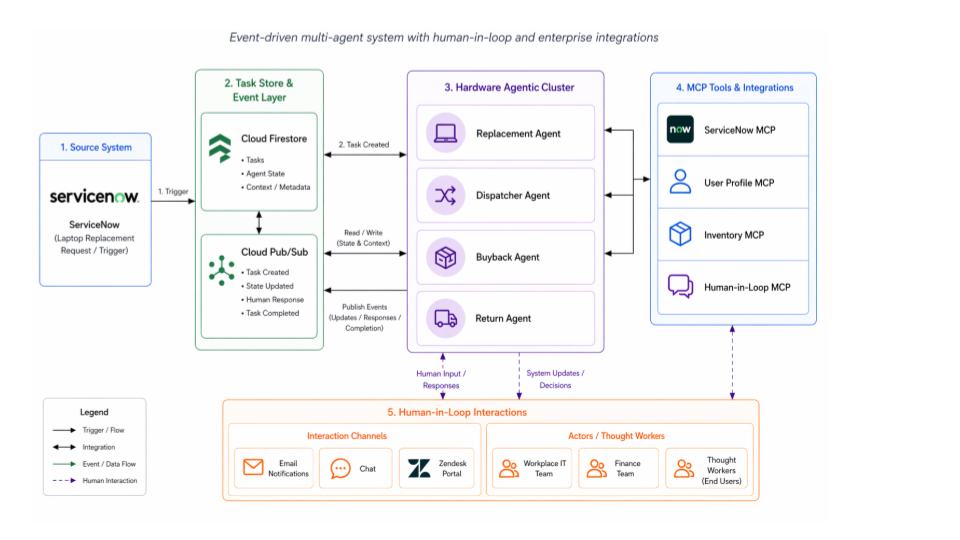
We have positioned ourselves as client zero for our AI-driven transformation. Our hypothesis, backed by data, indicates that a process that once required eight to 12 days for a laptop replacement can now be completed autonomously by AI agents in under an hour. This would represent a 10× improvement in efficiency and operational impact.
To validate this, we deployed the solution with a select group of pilot users. Early results show that the approach is not only feasible but also faster, more resilient and more adaptable than traditional methods. In evaluating alternative market solutions, we found that our agentic hardware cluster is uniquely dynamic and non-deterministic. It’s capable of reasoning, orchestrating multi-step workflows and adapting to real-world variability, unlike rigid, rule-based systems.
Leveraging the Google ADK ecosystem and Vertex AI, the architecture is modular and flexible, enabling seamless integration with existing IT infrastructure without hardcoding. As client zero, we have validated the system at scale, and a global rollout is planned for Q2 2026.
We believe organizations facing similar challenges, complex hardware lifecycles, high manual effort and bottlenecked service delivery can directly benefit from this approach. With the internal validation complete, we’re now ready to bring these insights to market, offering a scalable, AI-driven blueprint that delivers measurable speed, efficiency and operational resilience.
Building a multi-agent, AI-driven Digital Workplace team requires a careful balance between autonomy and enterprise-grade control. Our experience surfaced several critical trade-offs and insights:
1. Agentic vs. deterministic workflows
We found that rigid, step-driven workflows are necessary for critical business logic, while agentic autonomy is essential for dynamic decision-making. By combining these approaches, the system can handle complex, real-world scenarios without compromising reliability or compliance.
2. Prompt design and control
Unstructured AI reasoning can be unpredictable. To ensure consistent outcomes, we moved toward bounded, step-by-step prompts. This approach preserves flexibility while enforcing control, ensuring agents act within defined operational parameters.
3. State management
Persistence is vital for long-running, real-world workflows. By externalizing state in Cloud Firestore, the system can pause, resume and retry tasks seamlessly, enabling agents to manage multi-step processes across time and locations without losing context.
4. Human-in-the-loop
Humans are integral to the system, particularly for exceptions and high-value interventions. Modeling human input as a formal system component ensures traceability, accountability and operational control, while freeing teams to focus on strategic work.
5. System integration and auditability
The MCP (Model Context Protocol) layer maintains a clean separation between agents and enterprise systems like ServiceNow and Workday. This ensures every action is auditable, secure and fully compliant, without limiting agent autonomy.
The success of AI-driven operations lies in striking a balance between flexibility and control leveraging agent autonomy to handle complexity while maintaining structured oversight through enterprise systems.
The transformation of the Digital Workplace team at Thoughtworks exemplifies how strategic, AI-driven operations can redefine the role of IT from reactive support to enterprise-wide enabler of change. By combining domain expertise with agentic AI, we have automated complex workflows, accelerated decision-making and scaled operations across a global workforce.
These teams are no longer just service providers, they’re drivers of innovation, resilience and competitive advantage. At Thoughtworks, we’re demonstrating that bold investment in people, processes and AI creates a foundation for sustainable transformation and lasting organizational impact.