














Technology strategy
Caught between ephemerality and materiality


To realize value from AI, organisations need a standardized Path to Production. This is far more than an engineering pipeline; it is a repeatable operating model that takes an enterprise AI initiative from idea generation and prioritization through funding, discovery and continuous production at scale.
Complex organizations keep getting stuck in the same pattern. While AI value realization is elevated to the top of the corporate agenda by Boards, very few ideas ever make it into production. McKinsey highlights that nearly two-thirds of organizations remain stuck in the piloting phase, while Gartner predicts that through 2026, organizations will abandon 60% of AI projects unsupported by AI-ready data.
For business leaders, this delivery gap comes with a massive commercial penalty: recent data shows that organizations lose an average of 2.4% of their annual revenue on AI initiatives that fail to scale. Despite growing investment and executive attention, relatively few initiatives successfully make the transition from promising experiment to enterprise product. The reasons extend well beyond model performance.
The roadblocks behind this "PoC graveyard" are a mix of technical and non-technical factors.
Modern enterprise AI is a top-tier strategy under intense scrutiny, but legacy corporate processes are stalling execution. Traditional innovation, funding and portfolio management frameworks are simply too rigid and slow to match the fast-moving, iterative nature of AI.
Relying on subjective human judgment during testing rather than automated evaluations leads to immediate failures when models encounter real-world complexity.
Production environments are messy. Data is often fragmented, arrives late and sits on unstable legacy foundations that cannot support real-time streaming or low-latency requirements.
While a simple demo costs a few hundred dollars to spin up, scaling to production can jump to thousands weekly. Without early cost modeling, projects quickly become financially unviable.
Because teams are left to experiment in silos without shared guidance and standards, every initiative ends up reinventing governance, engineering practices and delivery processes instead of building on proven approaches.
Through our work with clients, we find that technology is rarely the primary blocker. The bigger challenge is organizational: enterprises struggle to connect existing engineering, governance and delivery capabilities into a repeatable operating model.
Many organizations already have mature technology platforms, data governance and MLOps practices. Enterprise AI builds on these foundations, but requires them to work together with new capabilities such as AI evaluation, governance and operational cost management.
Willingness is rarely the bottleneck either; while specialized AI talent is scarce, many employees are genuinely eager to adopt tools that make their daily tasks faster and more efficient. Instead, the lack of a standardized path to production stalls transformation through three major impacts:
Becoming paralyzed by uncertainty across ideation, funding and execution. The bottleneck begins at the whiteboard. Without a repeatable framework, organizations struggle to prioritize use cases, prove commercial viability or secure predictable funding. This early ambiguity trickles down; a team might get a model working, but the project stalls when forced to leap from an unvalidated business concept into an enterprise service requiring data lineage, security clearances and ongoing tracking.
Reinventing the wheel across disparate tech stacks. Without centralized standards, teams choose tooling in a vacuum, leading to architectural fragmentation. Breakthroughs cannot easily be shared, creating isolated silos of code, knowledge and infrastructure.
Spinning up solutions from scratch without a repeatable plan. Lacking reusable blueprints or shared pipelines, every project becomes a one-off endeavor. This unpredictability balloons delivery costs, worsened by unoptimized token usage, and makes scaling impossible.
True transformation requires organizations to focus on redesigning the end-to-end workflow to transform PoCs into actual products, moving away from ad-hoc point solutions towards a rigorous approach to AI product engineering.
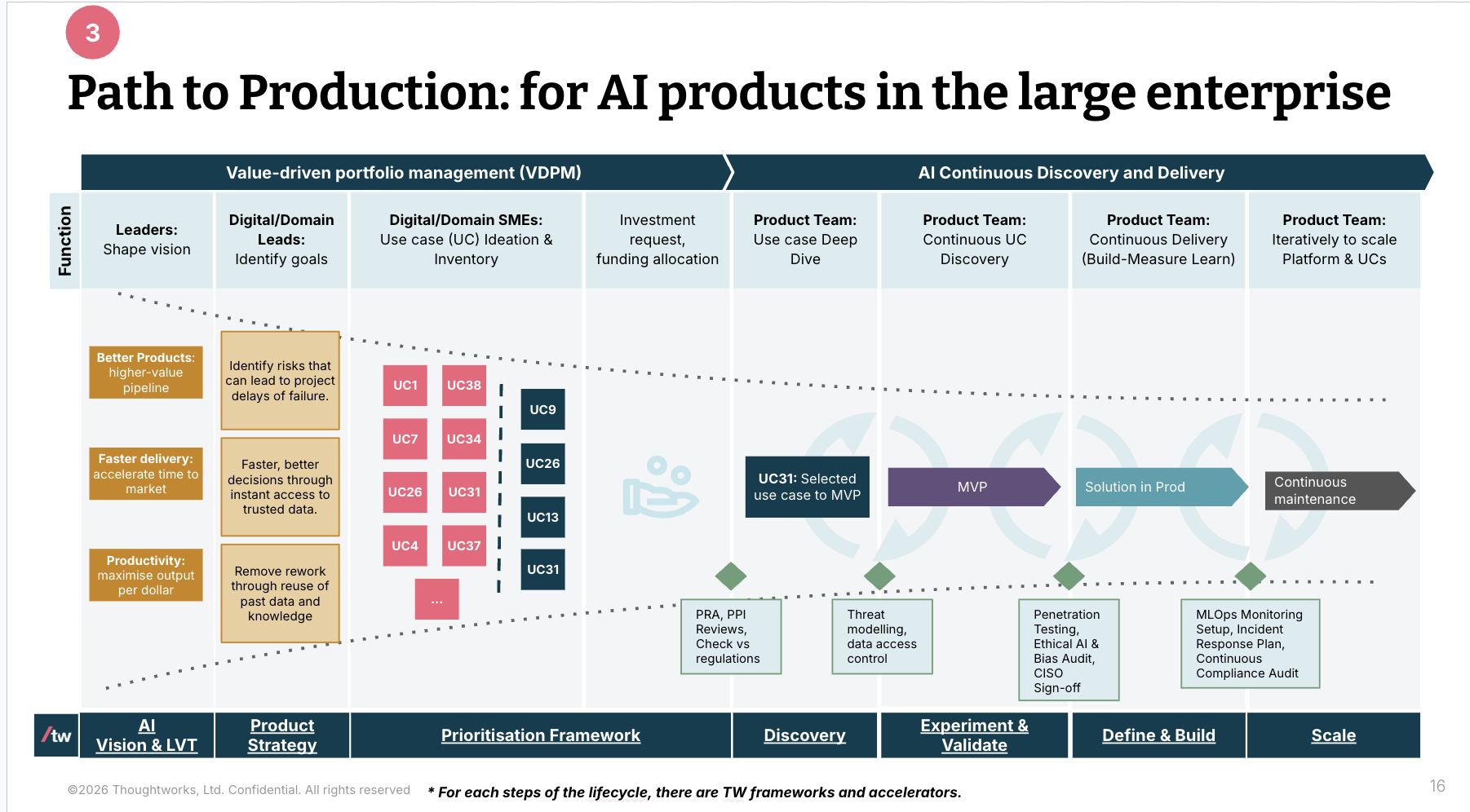
AI solutions cannot simply drift into production. They need clearly defined decision points that validate business value, technical readiness and governance before additional investment is made (see a simplified version of path to production in image 1). Those stage gates should be streamlined, automated to large extent and form part of the platform. This approach builds on traditional product-led thinking (desirability, feasibility and viability) while adding enterprise AI guardrails.
Value-driven portfolio management prioritizes opportunities aligned with company goals, followed by a lean funding process to establish delivery focus. Compliance and security guardrails are embedded throughout the journey, increasing in rigor as the solution progresses through four stage gates.
Gate 1 (Compliance & feasibility): Establishes ownership, validates the baseline business case and runs automated Preliminary Risk Assessments (PRA) against regulations like GDPR and the EU AI Act.
Gate 2 (Secure sandbox): Focuses on threat modeling and data access controls to ensure the environment is fully isolated, utilizing sanitized, realistic datasets before building the MVP.
Gate 3 (Production readiness): Requires penetration testing, use-case-specific bias and safety validation and final CISO sign-off to harden the solution for live enterprise data.
Gate 4 (Operational handover): Transitions to automated MLOps monitoring to track performance degradation, model drift and continuous compliance.
Each stage of the path to production is supported by established frameworks (e.g. Thoughtworks own) that help teams accelerate delivery while maintaining alignment, governance and quality.
The Lean Value Tree (LVT) framework breaks down boardroom mandates into actionable initiatives with measurable value, helping deploy strategy responsibly.
Read How to brew a perfect strategy, responsibly
The Three Horizons model identifies the most viable initiatives, helping leadership balance near-term quick wins with long-term transformative ambition.
Read How to build the organizational muscle needed to scale AI beyond PoCs
Early phase mapping of technical and operational problem spaces to understand user needs and establish agile delivery workflows.
Read How to run a successful discovery
Controlled prototyping and hypothesis-driven development find what resonates with users, determining the exact "good enough" point to move to product build.
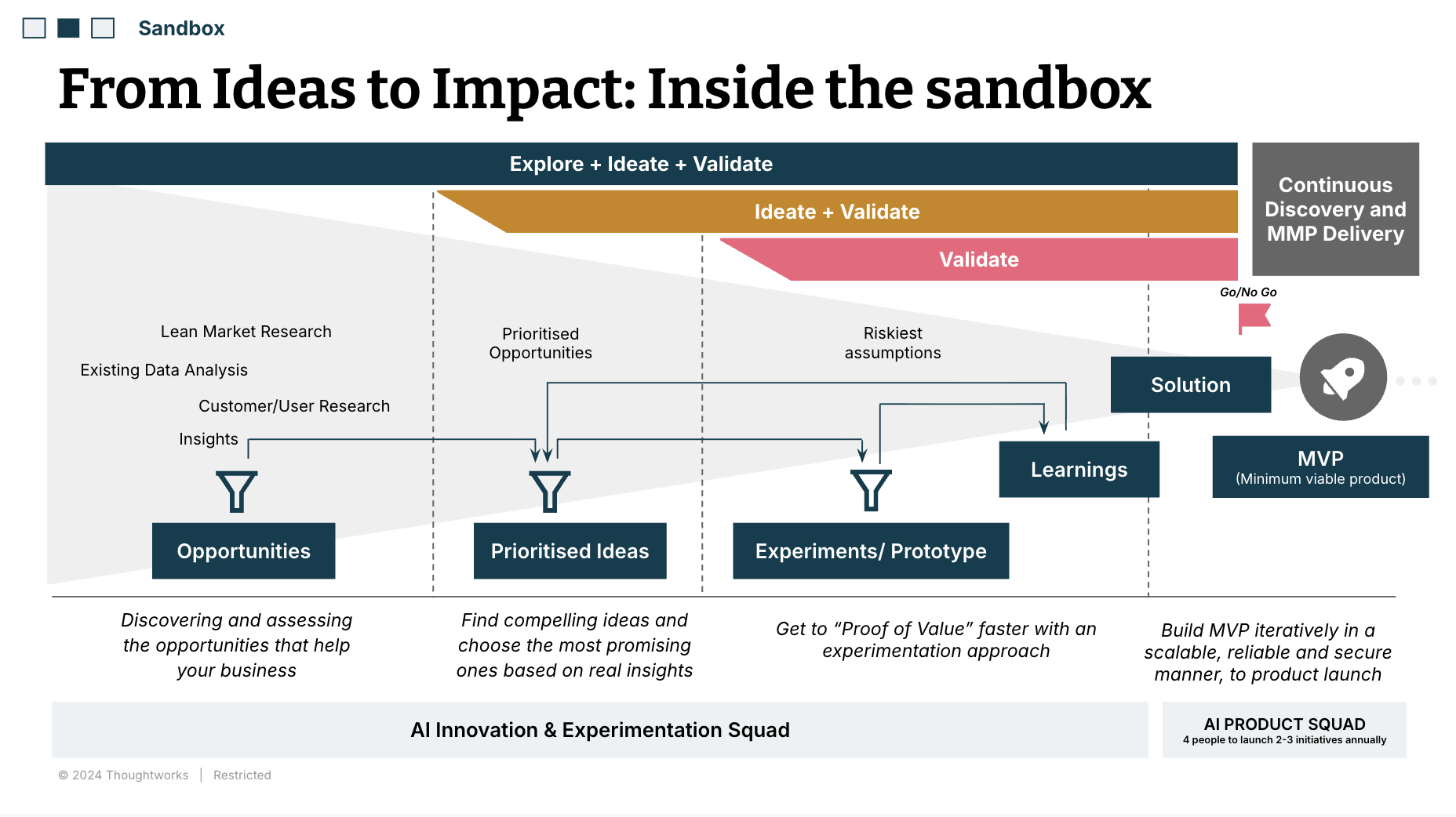
Prescribed, cloud-native runtimes and unified orchestration layers ensure seamless integration with corporate security and prevent costly, non-compliant shadow AI platforms.
Read How to avoid the pitfalls of the pseudo-MVP
Shifting from passive maintenance to an active optimization loop. By capturing production traffic, teams continuously build new evaluation benchmarks (evals) to iteratively tune AI agents, making the system more efficient and allowing organizations to safely test lower-cost models to maximize ROI.
Read MLOps culture and automation are key to scalable machine learning
Standardization reduces unnecessary variation and uncertainty across AI delivery. By defining a clear path to production that integrates governance, funding and engineering practices, organizations can move beyond experimentation and deliver value consistently at scale.
At Thoughtworks, we use a thin-slice approach supported by client-tested templates to help organizations establish this path quickly while reducing delivery risk. Building an enterprise AI capability is a significant undertaking, but a standardized path to production provides the foundation for turning promising experiments into scalable business outcomes.