













Digital transformation
Start smarter: How to identify your digital transformation exemplar


Digital transformations fail all the time. Sometimes, even when teams have done everything right on paper, a year later there’s no business impact to show the process was a success.
While there are many reasons digital transformations fail, one of the most problematic is over-investing in structural change too early while under-investing in establishing strategic clarity. In such instances, you have teams optimizing within the system, while leadership fails to properly optimize the system itself.
The underlying issue beneath this is one of sequence and focus. Leaders will jump straight to the tangible, visible changes — the structural transformation, the reporting lines, the new organization chart — without a proper framework for how to set, monitor and adjust objectives for the newly formed teams. We mistake motion for progress.
We recently worked with an energy company that had built an impressive data engineering team, but found their analytics products weren’t being used. Without strategic direction and without linking initiatives to actual business needs, the team delivered high-quality work that simply did not matter. This is what we call Zombie Work: efficient output but zero impact.
To overcome this situation, we need disciplined change. We need to ensure strategy can be translated into measurable business-critical goals, that allow teams to prioritize the things that matter. There’s a sequence that can be followed for this, as I’ll demonstrate.
The key point, with which you need to begin, though, is that north star objectives are needed first before structural changes. There’s no point having a map of optimizations if you haven’t clarified where you’re going and why.
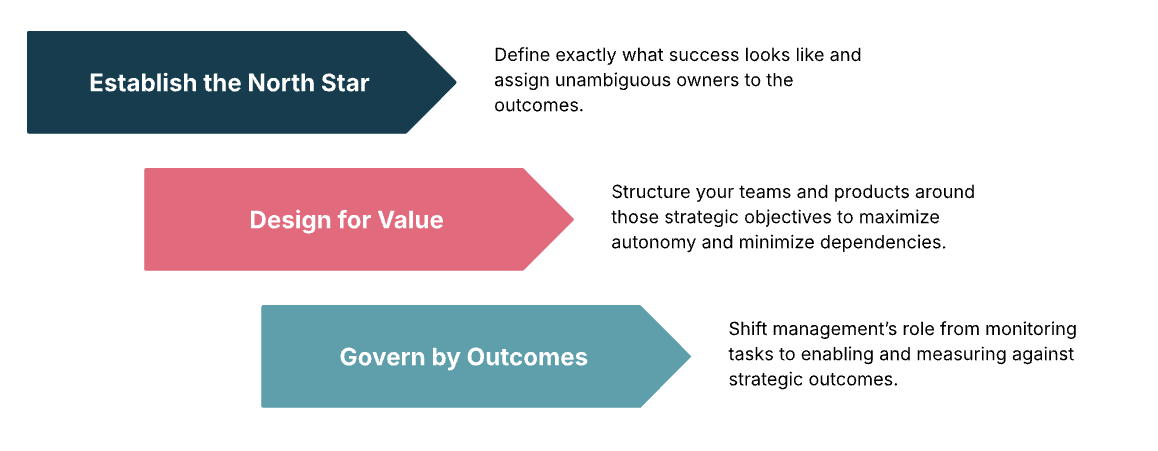
Let’s now dig into this process. Broadly speaking there are three key steps you need to remember:
Establish your North Star. Define exactly what success looks like and assign unambiguous owners to the outcomes.
Design for value. Structure your teams and products around strategic objectives to maximize autonomy and minimize dependencies.
Govern by outcomes. Shift management’s role from monitoring tasks to enabling and measuring against strategic outcomes.
This tripartite approach might be elegant but there is, of course, a lot of detail hidden beneath it. What’s more, implementation of this process will be highly context-specific and shaped by how your organization operates, its current challenges and precisely what it’s trying to achieve.
One of the most critical mistakes a transformation office can make is treating organizational structure as the goal, rather than a necessary tool. It wastes budget, it diverts management attention and rapidly consumes an organization's capacity for change. Indeed, the end result might not even be fit for purpose.
Imagine your new cross-functional teams and product owners don't know the exact business outcome they’re accountable for or how their work connects to an overarching strategy. In a best case scenario they might build something of value, but it’s unlikely to be something of real strategic value. In the worst case, they may focus on something that just isn’t aligned with the rest of the company or being built somewhere else. This is distracting, wasteful and incredibly frustrating for those involved.
So, your first step must be to lock down your North Star.
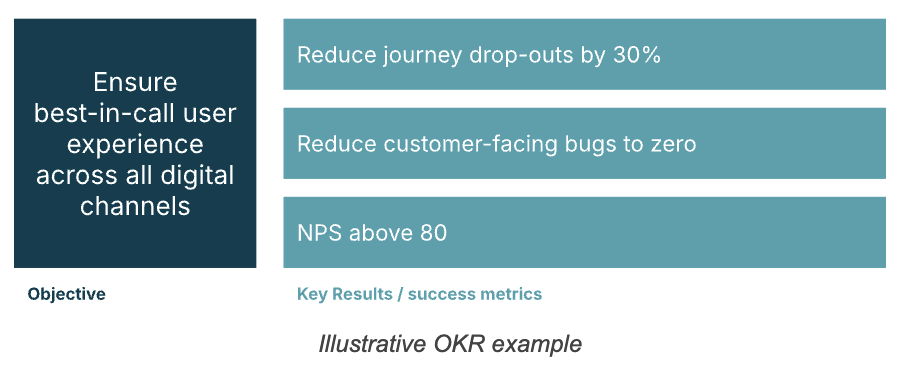
It’s not enough to have a mission statement. You need a system that translates high-level strategy into daily prioritization decisions. Whether you’re using objectives and key results (OKRs) or another framework, there are two essential principles you should focus on:
Outcome focus to clearly articulate business value that you want to create (your objective).
Measurable and time-bound key results to assess your progress, and to demonstrate a clear line of sight between work and desired impact.
One thing to watch for is ‘goal overload.’ We’ve seen product areas saddled with more than 20 objectives and even more metrics they need to monitor.
Ultimately, teams had no direction because they were almost always able to justify any activity by mapping it to one of the various, high-level goals. To achieve true focus, leadership will need to identify and prioritize a limited number of critical strategic objectives for the organization or value stream. If everything is a priority, nothing is.
Once an objective is defined, it’s important to assign unambiguous outcome ownership. This ensures clear accountability for the business impact, not just the effort expended. For every strategic objective, there should be a senior leader solely accountable for achieving the key results. A goal without a committed owner is merely a wish.
At Thoughtworks, we usually recommend setting up a ‘product pair’. This is where a senior business leader is paired with a tech counterpart; the business side is accountable for the ‘why’ while the tech side owns the ‘how’. This collaboration ensures objectives are both ambitious and grounded.
However, the accountability model needs to fit the organization’s level of maturity. In companies where the business-IT gap is pronounced, these people will likely collaborate across functions or units and follow a more project-oriented model. Conversely, in more mature, product-led organizations, the boundaries between business and tech may have disappeared, with both sides able to work together in cross-functional teams.
Nevertheless, accountability for the outcomes should be clearly defined and sit with a product owner or similar role. In turn, they will be supported by a tech lead who drives the quality of the solution, ensures architecture compliance and manages speed of delivery with long-term sustainability.
Congratulations, you’ve clearly defined your North Star. Now — and only now — are you equipped to make intelligent, targeted changes to your organizational chart.
However, the purpose of this article isn’t to go into detail about high performing cross-functional teams, team topologies and scaling agile. There’s an abundance of content on that and structures are continually evolving, almost at the same pace as the technology itself.
My point is simpler: Any structural change is merely an empty container until it’s filled with the strategic clarity defined in Step 1 and governed by outcomes. That brings us to Step 3.
Once structure is aligned to strategy, governance ensures everybody stays focused on the goal.
This final step involves replacing traditional, hierarchical oversight with Lean Governance. This is a management model designed to sustain autonomy and ensure continuous strategic alignment.
To link back to the strategy defined in Step 1, we need to establish an understanding of our key metrics.
To sustain the entire system, your metrics must reward the right behavior: impact. If you reward feature completion, your teams will inevitably deliver features. If you reward outcomes, they will deliver business value.
The core measurement must shift to key results. Instead of celebrating ‘features shipped’, you celebrate, say, ‘customer retention increased’. This forces the conversation back to strategic impact and validates whether the structure and the strategy are working together effectively. To do this effectively, focus on a handful of metrics that are easy to measure and directly traceable to your North Star.
Governance should primarily review these outcome metrics, reserving deeper dives into internal outputs (like DORA metrics, which are used to measure the quality of your software delivery) only when outcome delivery is lagging.
You’ve resisted the most common trap in digital transformation: mistaking motion for progress. By following the correct cascade, you’ve ensured every structural change is rooted in business strategy and sustained by outcome-focused governance.
The payoff isn’t just faster delivery; it’s a fundamental shift in your operating model. Your teams will be high-performing because they know exactly what success looks like, and your leadership will be truly strategic because it focuses on removing impediments and allocating capital to the most impactful outcomes.
True, sustainable transformation starts long before the restructuring meeting. It begins with the difficult, disciplined work of defining the direction. Invest in establishing your North Star, and you’ll not only ensure your transformation succeeds, but you will also create a resilient organization prepared for the next wave of change. Resist the urge to draw the org chart first.
Don’t worry though: if you’ve already taken the second step before the first, it’s never too late to define your objectives. Start aligning your teams and product priorities around them today.
Disclaimer: The statements and opinions expressed in this article are those of the author(s) and do not necessarily reflect the positions of Thoughtworks.