














Programming languages
Is a codeless future an illusion?


Enterprise AI has moved past the experimentation phase. The early era of generic chatbots and simple vector search is giving way to harder questions about reliability, accountability and return. That shift matters most as organizations move from assistive tools to agents that orchestrate workflows, touch systems of record and act on the business's behalf.
Those agents will inevitably hit a wall. A language model can read your documents, but it doesn’t hold your operating logic. It might infer that a driver operates a vehicle, but it has no way to know that, in the context of your business, a driver cannot be assigned to an international route without a particular customs clearance. That rule lives in people's heads, in policy documents and in the quiet conventions of a department; it doesn’t live anywhere a machine can reason over.
Closing that gap is ultimately a semantic problem: an issue of what terms actually mean. The usual answer to this is a single artifact in the form of a domain ontology. One way to think about this is to see meaning as a layer; the question then is how far you build that layer out. It’s never a simple yes or no on whether to have an ontology; it’s a question of what needs to be captured.
Schemas, controlled vocabularies, semantic layers, ontologies and knowledge graphs all sit on one continuum. It runs from how data is stored, to what it means, to what a machine can reason and act on. Every step up the stack adds expressive power. It also adds cost, governance weight and the need for someone to actively own it. The axis here is formal expressiveness, not how widely each layer is used.
For example, a semantic layer is often the broadest, most business-facing piece in the building, but it sits lower on the stack because it standardizes definitions rather than encoding the relationships and logic an agent can traverse.
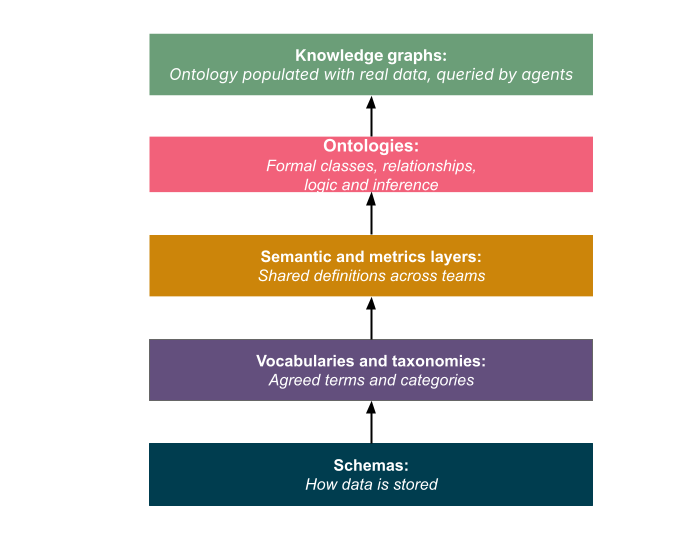
The top two tiers are easy to blur together, so it helps to keep them apart:
An ontology is a blueprint: the classes, the relationships and the rules.
A knowledge graph is that blueprint populated with your actual data; it’s also the thing an agent actually queries.
Most organizations assume they need to climb higher than they really do. A well-governed semantic layer and disciplined metadata capture much of the value for analytics and retrieval, with none of the formal description-logic machinery. Full ontologies earn their cost in narrower territory: multi-hop reasoning, automated constraint checking and cross-domain integration that a flatter model simply cannot express.
So the first decision is more diagnostic than aspirational. The question isn’t so much 'do we want an ontology?' It’s ‘what’s the minimum semantic structure that solves the problem in front of us?’
With that framing, three commonly cited benefits hold up. Each one works, as long as you read it as a contribution to a system rather than something the ontology delivers on its own:
Better retrieval. Pairing unstructured text with a structured graph lets an agent follow defined relationships instead of guessing from surface similarity. That cuts out a whole class of errors on complex, multi-hop questions. But the value comes from a populated graph, which means entity resolution and relationship extraction done against your real data — it doesn’t come from the schema that describes it. The blueprint is the (relatively) easy part. Populating and maintaining it is the harder work; retrieval quality is ultimately capped by that work.
Guardrails for agents. An ontology gives an agent a model of what’s allowed before it acts. While that’s useful, it’s just knowledge; it isn’t enforcement. A rule only binds when a deterministic runtime checks it and respects the answer and when you can show the check actually happened. Plenty of operational rules belong in a policy engine, not in formal axioms. The ontology informs the guardrail but it shouldn’t be mistaken for the guardrail itself.
A shared language across teams. Sales tracks accounts; legal reviews entities; support handles users. A shared model can map those dialects to a common reference. The real value here isn’t just the mapping, it’s the consensus behind it and the ownership that keeps it current as meanings drift. Without a steward and a regular reconciliation, the model goes stale within two quarters. This is a governance problem in technical clothing, which is exactly why it has defeated a generation of master-data programs.
If ontologies are so useful, why doesn't everyone have one? Unfortunately, there are a number of relatively consistent failures, most of which are cultural and organizational more than technical:
The translation gap. Ontology engineers know the formalism but not your business; subject matter experts know the business but not formal modeling. Moving knowledge between the two groups by interview is typically slow and lossy.
Scope creep. Because the model describes reality, teams are tempted to model all of it before shipping anything. Those projects tend to die after a year. The model may be comprehensive, but there’s no real value to show.
The maintenance problem. This is the one people most often underestimate. Compliance shifts, teams reorganize, products evolve and all of it moves faster than a hand-maintained model can keep up with. If an update takes weeks of debate and manual rework, the model quietly drifts out of sync. Construction is a one-time event, but reconciliation is continuous. Most advice solves the first problem and stays silent on the second; this is the one that actually kills the program.

The ontology that survives contact with the real world is one where an ontology is treated as a product rather than a project.
The ontology that survives contact with the real world is one where an ontology is treated as a product rather than a project.
So, what actually works? The ontology that survives contact with the real world is one where an ontology is treated as a product rather than a project.
Scope to a use case, not the enterprise. Build a minimum viable ontology around one high-return use case, like contract compliance or customer onboarding. Get it into production, show the value and then expand to neighboring domains. An enterprise-wide master model is just the boil-the-ocean trap with a tidier name.
Make competency questions a funding gate. Before anyone models a single class, ask the business to name the precise questions the system cannot answer today, and tie each one to a decision or a dollar. If a proposed concept does not serve one of those questions, cut it from this phase. And if stakeholders cannot produce the questions at all, the problem is unclear value, not missing semantics. No method will rescue that project.
Curate, don't draft from scratch. Use LLM pipelines to pull draft taxonomies from your existing schemas, API definitions and wikis. The expert's job shifts from writing definitions to reviewing and refining them. This is a real accelerator. Just remember that it speeds up construction only. It does nothing for maintenance.
Give it an owner and a lifecycle. A product has an owner, users, a roadmap and a release process. Your ontology needs the same: clear decision rights over contested terms, version control, a set cadence for reconciling against systems of record, and a way to retire concepts that no longer earn their place. This is the piece most programs skip, and the piece most of them need.
Decide build versus buy on purpose. Graph databases, data catalogs, master-data tools and semantic-layer platforms already cover parts of this ground, and some are probably already funded in your estate. The real question is where custom modeling beats configuring what you own. Regulated environments add another wrinkle. A four-to-eight-week iteration and a validated change-control process do not automatically fit together, and reconciling them is part of the design, not an afterthought.
The contrast between the old way and the product way is stark:
Dimension | Conventional approach | Product approach |
Scope | Enterprise-wide, all at once | One high-return use case, expanded in modules |
Construction | Manual interviews and drafting | AI-assisted extraction, expert curation |
Expert's role | Interviewee explaining concepts | Validator refining drafts |
Ownership | Ends with the project | Standing owner and lifecycle |
Time to value | 12 to 24 months | Four to eight weeks per iteration |
Problem it solves | Construction | Construction and maintenance |
A domain ontology is the ‘meaning layer’ that the rest of the stack consults. It’s ultimately worth exactly as much as the discipline you put into its scope, its population and its upkeep. And it’s a result of mature data products, not a shortcut around them. Layered over ungoverned data, even a sophisticated model adds confidence without adding correctness. The honest order of work puts data readiness first and treats the semantic layer as the thing that makes ready data something a machine can reason over.
The most effective stance sits between two extremes. It’s not the academic hunt for a complete model of the enterprise and it’s not the assumption that retrieval over a pile of documents is good enough. It’s something narrower and more practical: build the smallest semantic structure that answers a funded question, own it as a product and expand it only when the next funded question asks you to.