














Generative AI
Generative AI's uncanny valley: Problem or opportunity?


Across industries, a familiar pattern plays out: organizations launch AI proof-of-concepts (POCs) that show initial promise, only for momentum to stall. These initiatives often hit organizational walls: compliance signoff requires yet another committee approval, critical data sits in silos, integrations prove difficult, business stakeholders engage too late (if at all), development teams are reallocated to other projects and securing the next round of funding becomes a major hurdle. Employees may not even use the tool. Eventually, the pilot everyone was so excited about is quietly shelved, joining a list of failed initiatives.
Furthermore, headlines suggesting 95% of AI initiatives fail to generate ROI have fueled skepticism among leaders who already suspect the technology is overhyped. This hesitation keeps many organizations on the sidelines, uncertain about where to start or whether AI can truly deliver on its transformative promise.
But what can be done? First, we need to acknowledge that AI transformation can’t be bought. Then, we need to adopt the right strategic mindset and practices that will build the necessary organizational muscle for AI initiatives to be effective. In this blog post we’ll explore how that can be done.
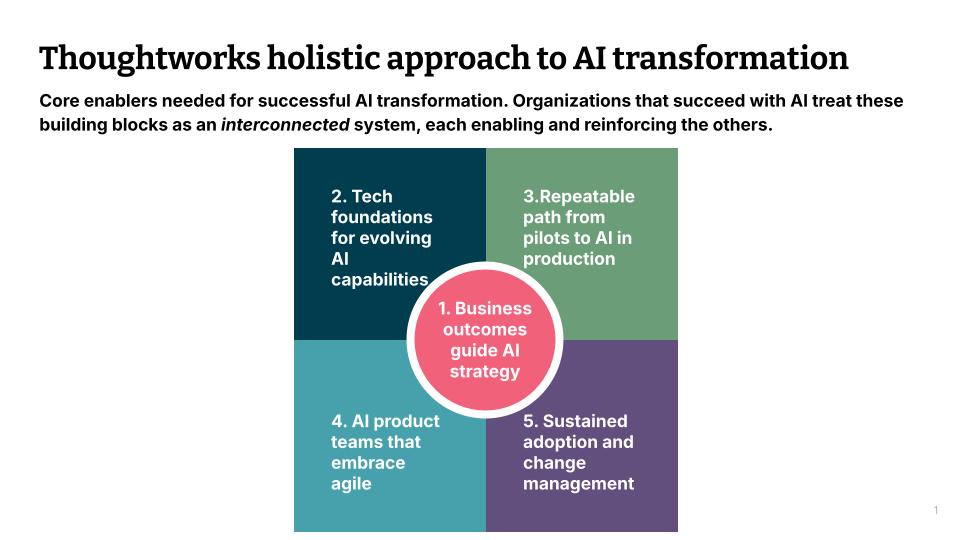
Our experience across various sectors has helped cement our belief that successful AI transformation requires addressing five core building blocks:
Business outcomes guiding AI strategy
Technology foundations for evolving AI capabilities
Repeatable paths from pilots to production
Product teams that embrace Agile
Sustained adoption and effective change management
When done in a simultaneous manner, using a ‘thin slice’ approach, where you focus on only those discrete elements required for a given use case, it becomes much easier — and less risky — to deliver value, faster.
In practice this means building the necessary underlying platform components, assembling the right cross-functional team, solving data compliance issues and driving the adoption for that specific group of users. While a thin slice isn’t comprehensive it does, through real-world application, build organizational muscle. Organizations learn by doing, treating AI initiatives as an interconnected system that remains manageable and informative for future iterations.
Ultimately, this can unlock a competitive advantage that’s impactful and sustainable.
A strong AI strategy starts with clarity, not technology. What pain points are we solving? How does this tie to business objectives? What does success look like in measurable terms? Without this grounding, AI initiatives become solutions in search of problems.
Organizations that succeed with AI maintain tight alignment between opportunities and strategic goals. At Thoughtworks, we use the Lean Value Tree (LVT) framework to systematically translate organizational vision into concrete AI use cases, creating a clear line of sight from boardroom priorities to execution. We used this approach with a financial services conglomerate recently, helping the company move from organizational vision to concrete AI use cases:
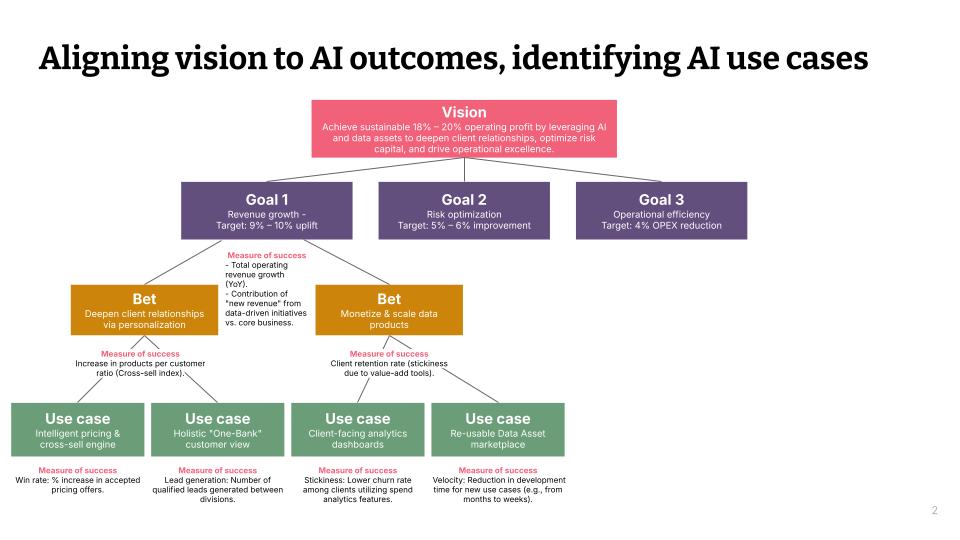
The challenge is rarely a shortage of ideas; enterprises typically uncover dozens of potential AI applications. The real challenge lies in prioritization: determining which opportunities warrant investment, executive sponsorship and navigating funding gates to reach production.
It’s important to be explicit about what you're optimizing for: is it revenue growth? Cost reduction? Perhaps customer satisfaction? Each demands different metrics and involves different trade-offs.
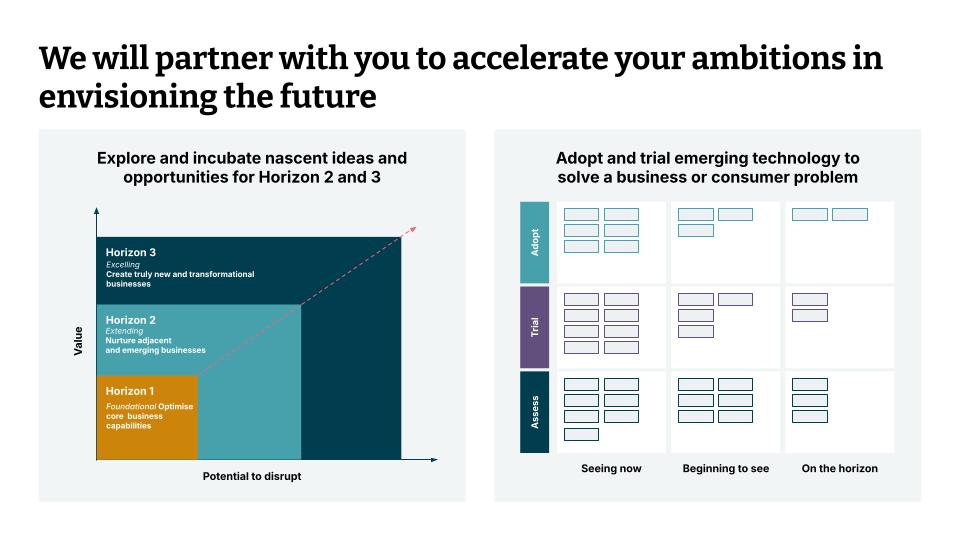
To balance quick wins with transformative ambition, you can use the three horizons model: initiatives delivering value in one to two years (horizon one), those needing three to five years of foundational work (horizon two), and breakthrough opportunities for five to 10 years out (horizon three).
Critically, senior sponsorship must extend beyond initial approval. Executives need to actively champion initiatives, removing organizational roadblocks and ensuring teams have the clear mandate to succeed. This implies the explicit authority to challenge the status quo, bypass legacy processes and make rapid decisions. Without sustained top-level support, even well-designed AI strategies falter against inevitable organizational friction.
A strong AI vision means little without the right foundations across technology, data and governance. Many organizations attempt to build the perfect platform before delivering value. This approach invariably fails. Instead, platform evolution should be directly tied to concrete use cases with investment in the capabilities needed to implement targeted initiatives. Each component should solve immediate problems while building reusable infrastructure for future AI solutions. Letting governance requirements guide your overall implementation approach is a trend we see across different industries. Shaping your approach to establish these solid guardrails right away makes a path to production more sustainable.
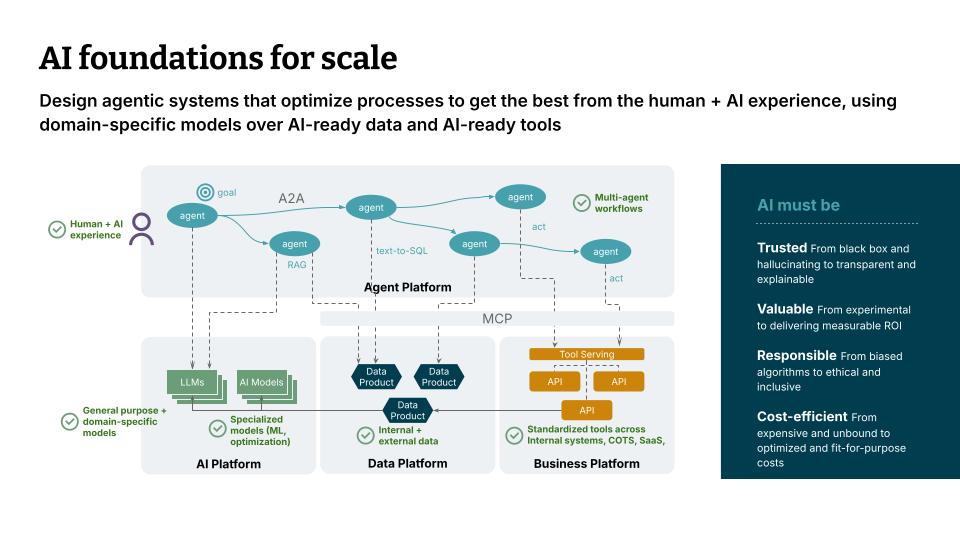
The AI landscape evolves rapidly. New tools, frameworks and models will emerge as the industry matures. Design for change: prioritize scalability and interoperability from the start, enabling teams to swap components and avoid vendor lock-in. Build abstractions that let you upgrade models or orchestration tools without rewriting applications.
AI solutions demand significant cloud compute, making cost discipline essential. Implement FinOps practices early to track spending by team, use case and environment. Without this visibility, experimentation quickly spirals into budget-draining costs that erode executive confidence and funding for AI programs.
Data products should be the foundation of your AI architecture. Treat datasets as products with clear ownership, quality standards and documented interfaces. The differentiator between organizations that advance versus those that stall is access to AI-ready data and domain-specific models. Design data products for this dual use, serving both analytics and machine consumption, to accelerate the shift toward agentic AI systems that require reliable data access.
Governance should enable rather than block progress. It’s important to establish clear frameworks for model risk management, data privacy and ethical AI use from the outset. Teams also need to define approval processes, production monitoring requirements and human oversight triggers. Strong governance provides guardrails for confident, rapid experimentation within acceptable risk boundaries.
Impressive AI pilots are common. What's rare is a repeatable process for scaling them. Many organizations watch their technically feasible pilots stall in the gap between experimentation and production. Organizations should build well-defined pathways. Automation is the engine of these pathways, ensuring technical efficiency and reliability through practices like MLOps. But the pathway itself must be holistic, and include the funding gates, the governance checkpoints, and the clear steps for business adoption. This facilitates the move from one-off projects to a sustainable, organization-wide capability.
Becoming an AI-driven enterprise requires adopting product thinking over project mindset. This means standing up long-lived, cross-functional teams that continuously discover, build and maintain AI solutions, not assembling temporary groups that disband after launching a model. These teams should own the full lifecycle: experimentation, deployment, monitoring, retraining and iteration. Post-deployment shouldn’t be an afterthought; it's where real value compounds as models improve through feedback loops.
Embrace an experimentation culture where failure drives learning. Not every pilot will reach production, nor should it. The goal is to fail fast, extract insights and scale what works. At Thoughtworks, we use a dual-track approach to continuously explore new opportunities through rapid experimentation while delivering and refining proven solutions. This approach maintains innovation momentum while steadily expanding production capabilities.
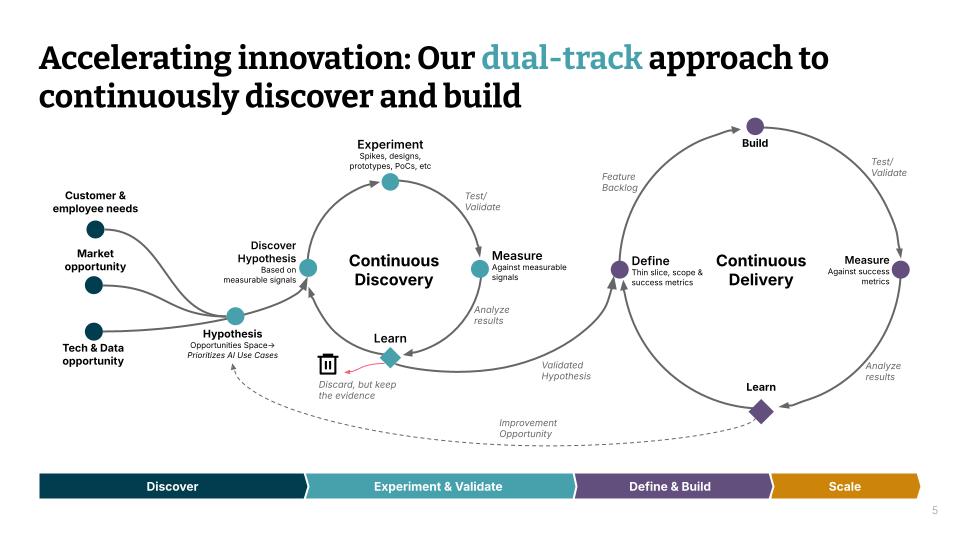
Build factory-like operations with automation embedded throughout - be aware that there is surely a tradeoff between premature optimization and leaving automation out. Finding the right balance, and ensuring a lean approach very much depends on your organizational maturity. Take this opportunity to implement CI/CD pipelines and MLOps practices that allow teams to move from idea to production in weeks, not months. Automate model training, testing, deployment and monitoring. Bake governance and evaluation frameworks directly into the pipeline - models shouldn't reach production without passing automated checks for bias, performance degradation and compliance requirements.
The path from pilot to production should be well defined. Each successful deployment strengthens the pathway, making subsequent AI solutions faster and more reliable to launch.
Successful AI transformation requires moving beyond isolated data science experiments to building cross-functional AI squads that act as catalysts for enterprise adoption.
Beyond data scientists and data engineers, there are critical roles often missing in traditional structures. It starts with an AI Product Manager, who defines the vision and ROI, balancing feasibility against business impact. Equally critical is an AI governance & ethics lead, who establishes guardrails for responsible AI, ensuring models are fair and compliant before deployment. The squad also requires business analysts to act as translators between complex data realities and business needs and AI UX Designers who design for trust, creating interfaces that help users understand non-deterministic outputs and know when to intervene.
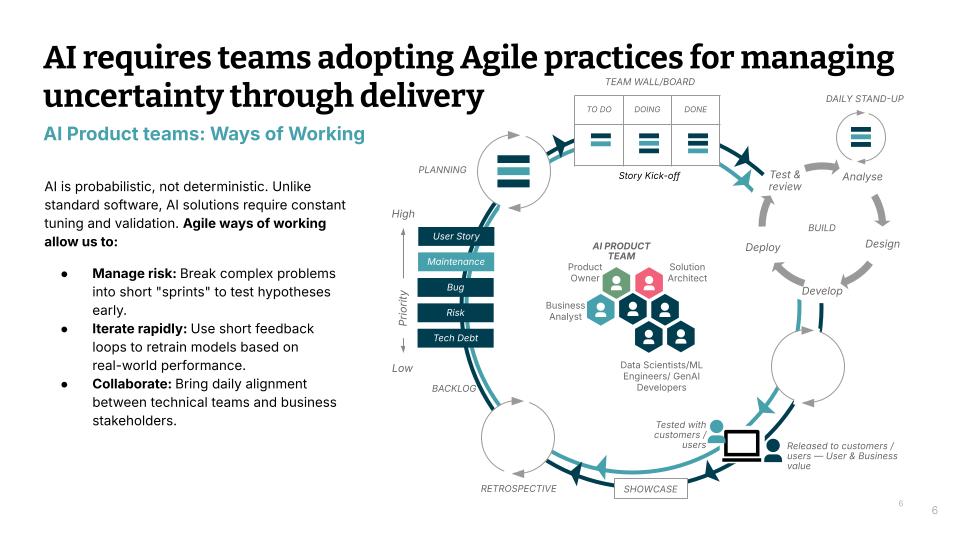
However, assembling the right talent is only half the equation. They need to adopt ways of working that match the nature of the technology. Unlike traditional software, which is deterministic, AI is probabilistic. AI solutions require constant tuning, validation and retraining.
This uncertainty makes Agile practices a necessity. Adopting Agile ways of working allows teams to manage risk through early hypothesis testing, iterate rapidly based on real-world performance and ensure continuous collaboration between technical experts and business stakeholders.
This element cannot be understated; it’s the primary reason AI transformations derail. AI adoption represents a profound organizational shift, and resistance is a natural human response. Teams often fear losing hard-earned expertise, struggle to reimagine their work with AI augmentation or simply revert to old routines amid competing pressures. Addressing these responses requires systematic planning, but planning alone is not enough.
Tried and tested change management frameworks remain relevant: ADKAR, Kotter's 8-step process and Thoughtworks own Changeworks. These approaches recognize that change is a journey. People move through predictable stages — from uncertainty and resistance to exploration and adoption. Successful AI transformation requires meeting people where they are and deliberately moving them through this change cycle with structured support.
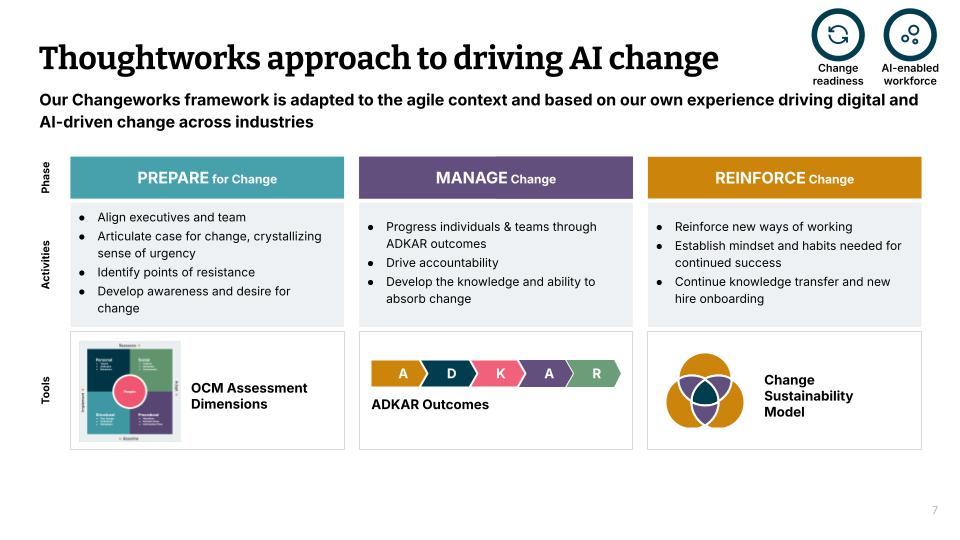
However, having a framework isn’t the same as executing it. The bottleneck we often see isn’t a lack of methodology, but a scarcity of skilled change agents and catalysts capable of driving this execution. These individuals are essential to translating high-level strategy into daily behavior and onboard both the workforce and executives.
AI literacy is non-negotiable, starting with leadership. Executives must become fluent in AI capabilities, limitations and implications deeply enough to model the behaviors and attitudes needed throughout the organization. This requires real investment and commitment from the top.
It’s important to design for human-AI collaboration from the start. Build interfaces that explain AI reasoning in plain language. Give users override control — trust is built when people feel empowered. Also, let users correct AI outputs and feed those corrections back into training loops; this will create reinforcing cycles where human expertise continuously improves AI performance.
To sustain momentum it’s vital to follow proven change practices. Train users early, before AI solutions launch. Communicate value clearly and repeatedly — people need to hear how AI makes their work better, not just that they must adopt it. Celebrate small wins publicly to demonstrate real impact. Finally, measure adoption metrics alongside technical performance; if people aren't using your AI solutions, they’re not delivering value.
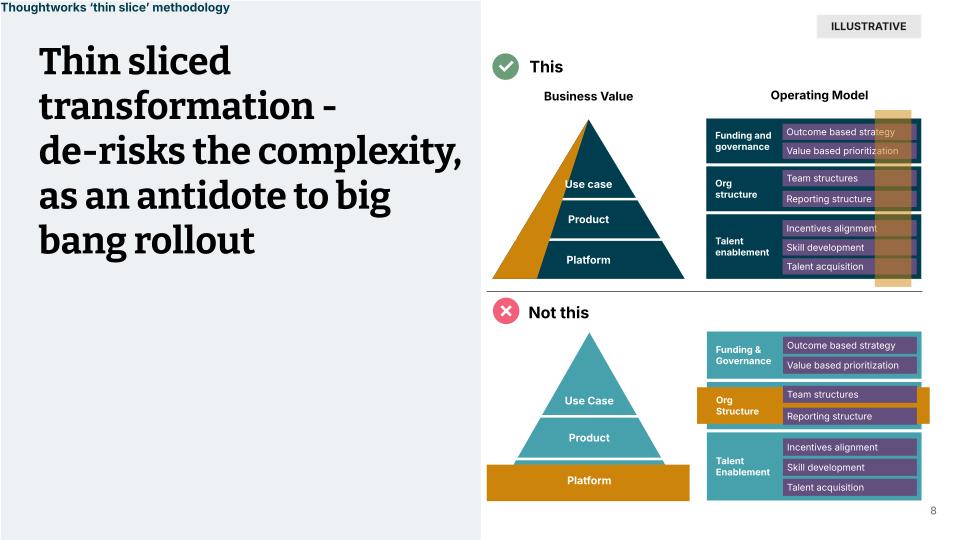
By combining these five building blocks with a thin slice approach to transformation, it becomes possible to learn quickly and unlock value while avoiding the risks that come with more comprehensive, big bang initiatives.
The value will be cumulative; each subsequent slice you tackle compounds on the previous one: platform functionality will expand as new use cases demand it; operating models will evolve through consistent practice; AI talent will develop as teams are able to tackle tangible problems. This means by the time you scale, governance has already been stress-tested in the real world.
The key lesson is this: start small, prove value and scale what works. Doing so will help stop you from becoming part of the failure statistics and ensure a sustained, long-term competitive advantage through AI.