
Generative AI
Model sovereignty is not about owning the model


Sovereignty is rarely all-or-nothing. The useful question is “Sovereign enough for what?
What happens to your organization when an AI provider raises its prices, changes its terms or stops serving a region?
We've been there ourselves. Our developers were using Cursor across several projects, and they liked it. Then its pricing changed, and the new costs no longer worked for us. We had alternatives, including GitHub Copilot and Claude Code, but switching took more than a new subscription. We had workflows to migrate, developers to bring along and disruption to manage across projects.
That experience raises a question for enterprise leaders. Which parts of your AI capability must remain under your control, and which can you safely leave to a provider?
Sovereignty is about reducing the risks that matter to your organization: regulatory exposure, supplier dependency, loss of proprietary knowledge, cost volatility or losing a critical service when circumstances change.
“Sovereign AI” means very different things depending on who’s asking. At a national level, technological sovereignty often means being able to build or control essential technologies, infrastructure, services and data, while relying less on others, including rivals, to supply them.
For an enterprise, the scope is usually narrower and more practical. A bank typically cares first about controlling sensitive information and managing third-party AI risk. A multinational organization, meanwhile, needs to know which data, models or services it can move between countries or regions.
A public-sector organization treats continuity of access to compute as a strategic requirement. A retailer may decide that the main risk is cost concentration rather than physical control of infrastructure.
A system can be portable and still not sovereign enough for a particular workload. You might switch model providers easily and still face unacceptable jurisdictional exposure. Equally, a system can depend heavily on a managed cloud provider and still provide adequate sovereignty if its contractual, technical and operational controls match the risk.
Sovereignty is rarely all-or-nothing. The useful question is “Sovereign enough for what?”
We look at each workload rather than write a single sovereignty policy for the whole organization.
Must control covers anything where losing control would create an unacceptable regulatory, security or continuity risk. That could include highly sensitive data, encryption keys, critical business rules, audit evidence or any workload where provider outage would stop an essential service.
Should control covers capabilities that set you apart or would be expensive to recreate. Enterprise knowledge, evaluation suites, prompts, agent skills, policies, workflow logic and reusable connectors often belong here. No regulator may require you to hold them, but letting them become inseparable from one provider creates a real strategic dependency.
Can rent covers capabilities where depending on someone else is acceptable: the market offers sufficient alternatives, switching is manageable and the workload is not materially exposed if the provider changes. For many organizations, general-purpose model inference and cloud compute will land here, at least for some workloads.
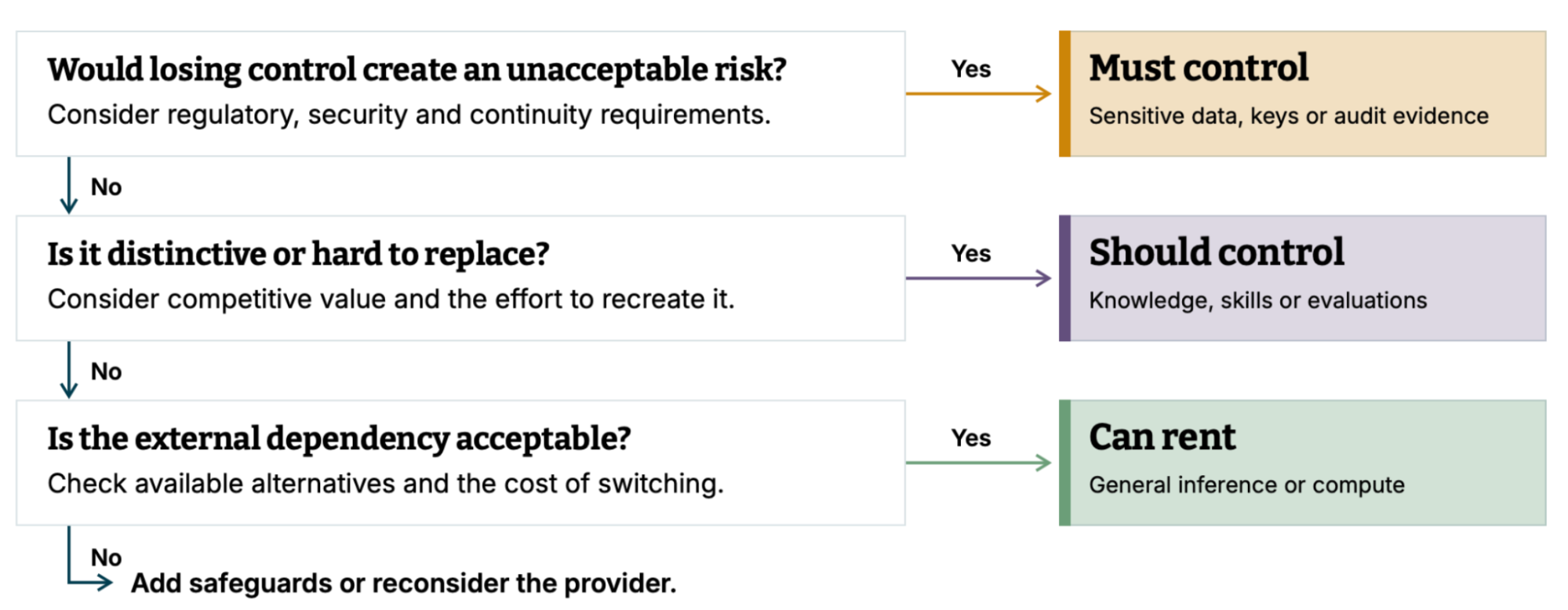
The same technology can fall into different categories for different workloads. A managed frontier model might be fine for summarizing public research, while the same organization may decide that a model handling confidential merger documents requires stronger controls.
Once you understand the risk, it helps to map sovereignty across three architectural layers: context, models and infrastructure. Governance and operations cut across all three.
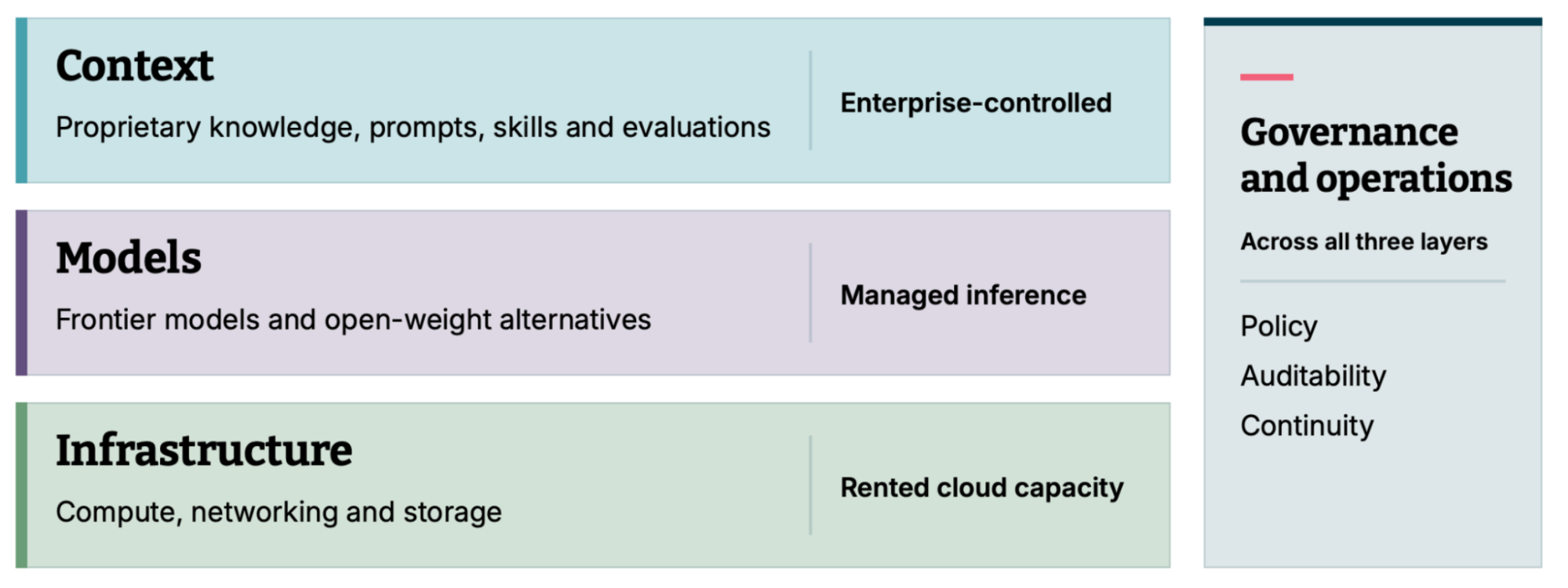
The context layer holds your proprietary knowledge and intellectual property, along with the prompts, evaluations, agent skills, guardrails and policies that make AI useful within your organization. This is often where differentiation lives.
The model layer is about which models you use, where they run and how easily you can switch between them. This includes choosing between proprietary frontier models and open-weight alternatives.
The infrastructure layer covers the compute that runs those models, including whether you own your GPUs or rent capacity from cloud providers.
You can control your most valuable AI assets without owning the models or GPUs underneath them. You can also own your infrastructure and still depend heavily on a particular vendor, toolchain or operating model.
For many enterprises, the context layer is the most valuable place to establish sovereignty. It holds the proprietary knowledge, business processes, policies, workflows and organizational expertise that make general-purpose AI models useful for your specific needs.
As AI agents become more capable, their effectiveness increasingly depends on the engineering around the model: how they access knowledge, use tools, follow organizational policies and improve through feedback.
An enterprise harness brings together reusable agent skills, integrations, guardrails and evaluations. By managing these as shared enterprise capabilities rather than embedding them in individual AI products, organizations can retain control over the knowledge and workflows they've invested in. That also makes it easier to change models or providers without rebuilding everything around them.
Controlling your enterprise context is one part of sovereignty. The next is ensuring that your AI capabilities don't depend entirely on a single model provider.
Until recently, enterprises had relatively few alternatives to proprietary frontier models. Open-weight models are changing that, as reflected in Thoughtworks Technology Radar Vol. 35.. As their capabilities grow, organizations get more choice over which models they use, where they run and how much they depend on external providers.
Take the GLM family of open-weight models. In our internal evaluations, we've found GLM 5.3 can handle many everyday coding tasks at a lower inference cost than some frontier alternatives. It may not match the strongest proprietary models on every task, but it’s a viable option for workloads where its performance is sufficient.
If a provider raises prices, changes its terms or restricts access, having an alternative helps you keep running and reduces your dependency.
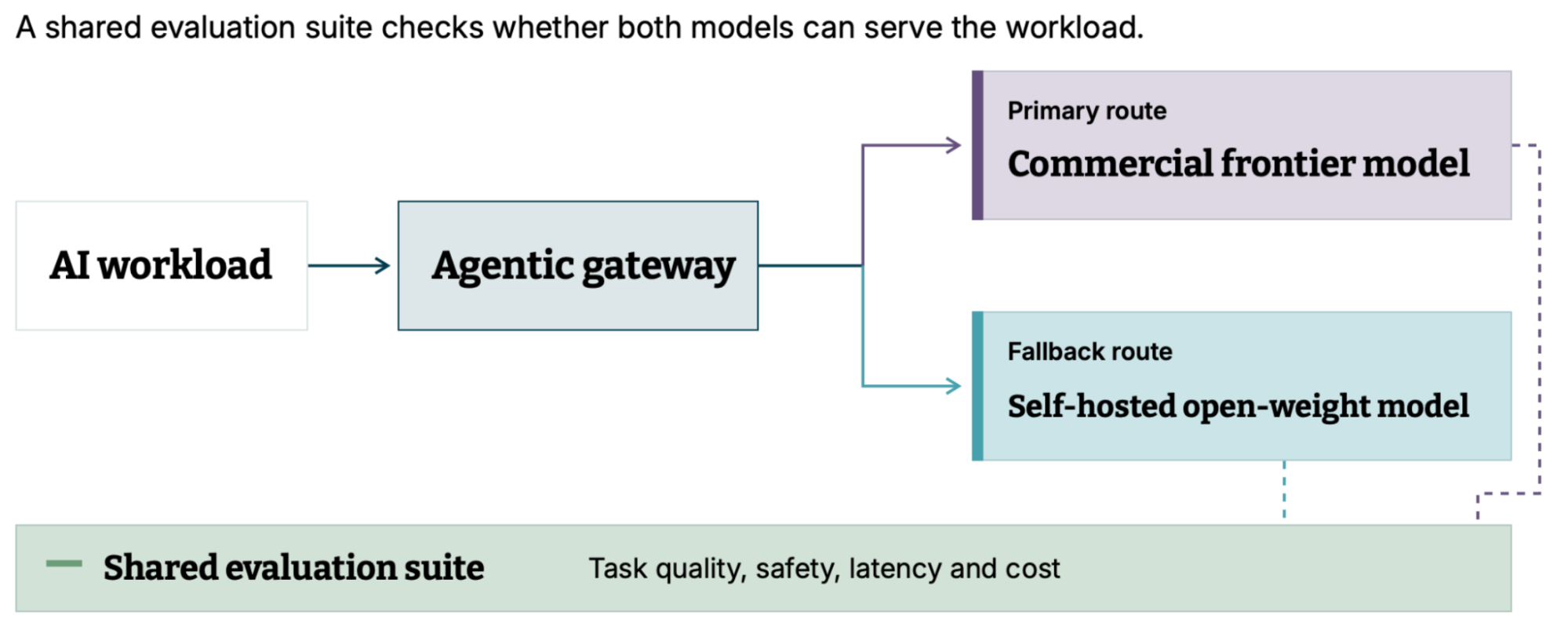
We're exploring this approach internally through an agentic gateway that routes requests between commercial frontier models and self-hosted open-weight alternatives. Most traffic still goes to commercial providers, but keeping other options gives us greater control over model selection and a stronger negotiating position.
Infrastructure is often where sovereign AI conversations begin, but for most enterprises, it should be the last layer you consider owning.
AI infrastructure is turning into programmable platforms that manage models, compute, networking and storage as one integrated capability. Technologies such as KServe, KAITO and llm-d make AI workloads easier to deploy and operate, whether on owned infrastructure or rented cloud capacity.
For many organizations, managed infrastructure provides sufficient control. Others have specific reasons to invest more directly: regulatory constraints, critical service continuity, predictable high-volume workloads or a need for tighter control over deployment and operations.
Let requirements drive the decision. Invest in infrastructure control where it creates measurable value, and look outside for whatever the market can provide safely and economically.
The answer depends on your industry, where you operate and what you're trying to protect. Accountability for third-party AI doesn't mean you have to self-host it. A managed service may provide sufficient control for one workload, while another involving sensitive data or critical operations may justify stronger measures.
In Singapore, for example, the Monetary Authority of Singapore (MAS) sets expectations for financial institutions around technology risk and governance. For banks using AI, that means auditable AI workloads and tight control over sensitive information. But meeting those requirements doesn't mean owning the models or infrastructure.
For some government and defense organizations, continuity of access is a bigger concern. Singapore's Home Team Science and Technology Agency (HTX), for example, operates its own GPU infrastructure. In these environments, relying entirely on external compute providers introduces risks they won’t accept.
Geography also affects the choices available. Our own teams in China can't use OpenAI or Anthropic models, while multinational enterprises serving European markets must consider applicable data protection and residency requirements. A model hosted in an AWS European region can meet some residency needs without building your own infrastructure. But keeping data in a particular region doesn't automatically settle who can access it, which laws apply or what happens if a provider becomes unavailable.
The starting point is to translate these concerns into specific requirements. Where must your data reside? Who can access it? What audit evidence do you need? How critical is uninterrupted access to compute?
Those answers should determine whether managed services provide sufficient control or whether a workload justifies regional deployment, sovereign cloud or self-hosting.
Greater sovereignty isn't free. It often costs more in infrastructure and specialist talent, adds operational complexity and can slow your access to new capabilities.
Self-hosting takes more than GPUs. You need expertise in model serving, capacity planning, security, observability and ongoing operations. Low utilization can make owned infrastructure considerably more expensive than rented capacity. Conversely, predictable high-volume workloads may benefit from dedicated infrastructure or smaller, optimized models.
Energy efficiency, latency and access to talent shape the economics too. Organizations that already run AI infrastructure face a different calculation from those building it from scratch.
That's why we suggest weighing the sovereignty premium at the workload level. What happens if a provider doubles its prices, withdraws service or becomes unacceptable to a regulator? What would it cost to maintain an alternative?
The goal is sufficient control at a cost the organization can justify.
For most enterprises, the place to start isn’t which models to build or which GPUs to buy. It’s understanding the dependencies your organization is creating, what would happen if they changed and which capabilities are too important to leave outside your control.
Start by mapping your AI dependencies and who controls each one. Then test one fallback to confirm it works when circumstances change.