Continuous delivery
The 14 GB cold-start problem: Rebuilding self-hosted GitHub Actions runners on Azure Kubernetes Service


In January 2027, one frontier model provider will shut down two model families and European Union rules will end switching fees for data processing services. Both put a harder question to organizations using AI: how much control do they have over the models they use, the data those models process and the infrastructure they run on? Model sovereignty is that control, and it doesn't require owning or operating everything yourself.
Most leadership teams approach it as a single yes-or-no question: do we run our own models? That framing can lead to bad decisions in both directions. Some organizations try to own everything; others hand their most valuable work to a vendor by default. Sovereignty comes down to two separate questions:
Control: Who runs the computation and who can see it, stop it or change it?
Differentiation: Whose knowledge is in the model, and how much of the result depends on it?
These two questions give organizations a way to map their AI workloads. Plot each workload on two axes: how much your own knowledge differentiates the result, and how strict your security or sovereignty requirements are. A commodity workload with light requirements might be best served by an inexpensive API. A highly differentiated workload with strict control requirements may justify fine-tuning a model and running it on infrastructure you manage. The heat map below shows where the combinations in-between land.
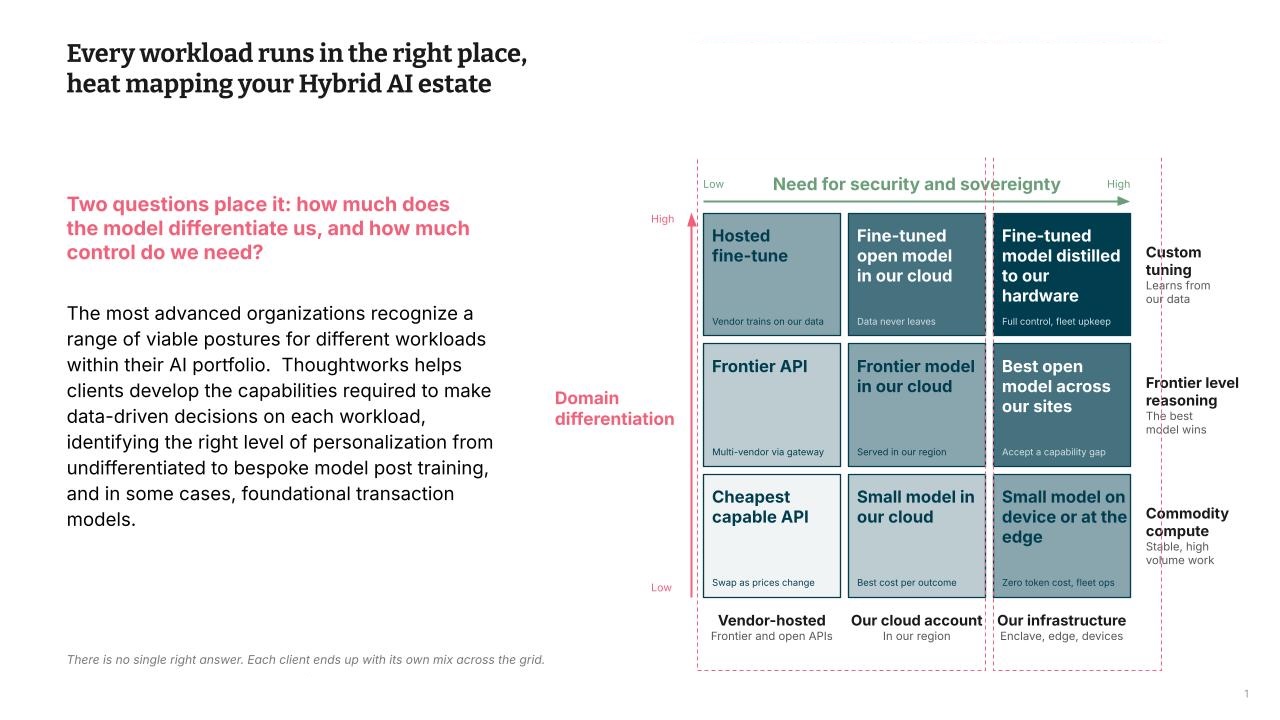
A closed frontier API answers both with "the vendor." Every other option lets an organization separate them. It can rent a frontier model and serve it in its own region; own the weights and keep them generic; or tune a small model on its own data and run it on hardware it controls. A sovereign cloud environment, such as the AWS European Sovereign Cloud, can address infrastructure control, operational independence and data residency requirements without changing how much an organization's own knowledge differentiates the model. Contracts still matter: major providers don't train on paid-tier business data by default, but retention, residency and retirement terms are negotiated.
Our research puts 78% of companies on two or more model families, and the share on three or more rose from 36% to 59% between July and October 2025. With that many models in play, the decision is which parts of each workload the organization cannot afford to rent, and it has to explain each choice.
Control also depends on where inference happens. Organizations already manage infrastructure across data centers, regional sites, factories, branches and devices. As smaller models become more capable, more AI workloads can run across that existing estate. That gives organizations new choices about latency, data movement, cost and operational control.
For an organization that owns the model, the most sovereign inference happens where the data is created, on a small model, without the data crossing a network. Apple fits a 20-billion-parameter model into a phone by keeping the weights in flash memory and activating one to four billion parameters per request. That moves the trade-offs rather than removing them. The best model the hardware can run sets a ceiling on capability, and the per-token bill becomes a fixed cost divided by a utilization number the organization can influence but cannot easily forecast. What replaces the invoice is operational work: shipping new weights across a fleet, keeping versions consistent, evaluating models that run offline and retiring hardware that can no longer run the current model.
Sovereignty is a property of the portfolio. The goal is to understand where each workload belongs, why it belongs there and what it would take to move it when prices, capabilities, regulation or hardware change.
Three assets make that possible, and they are worth owning wherever the compute runs: the evaluations that define what good looks like, the behavioral data and policies that shape how the model behaves and the routing layer that decides where each request goes. One frontier model provider gave 92 days' notice that it will shut down two model families in January 2027, against its own stated minimum of six months, and a fine-tune dies with the base model it was built on. That same month, European Union rules ended switching fees for data processing services. Models, compute and serving can be rented, swapped or distilled. Evaluations, behavioral data and routing have to be owned, because a provider can sell an evaluation service but cannot give you one that survives leaving.
Owning evaluations, behavioral data and routing isn't enough on its own. Design them to be portable across platforms and models, so a workload can change where it runs without losing what makes it yours.