


A hybrid AI strategy is a plan for running AI across more than one kind of model and more than one cloud. Frontier models will continue to push the art of possible. Open-weight models, hosted by you or a provider, handle high-volume work. Fine-tuned models carry the tasks where your own data gives you an edge. You decide which workload goes where based on cost, quality, risk and strategic value, and you revisit those decisions as the market moves.

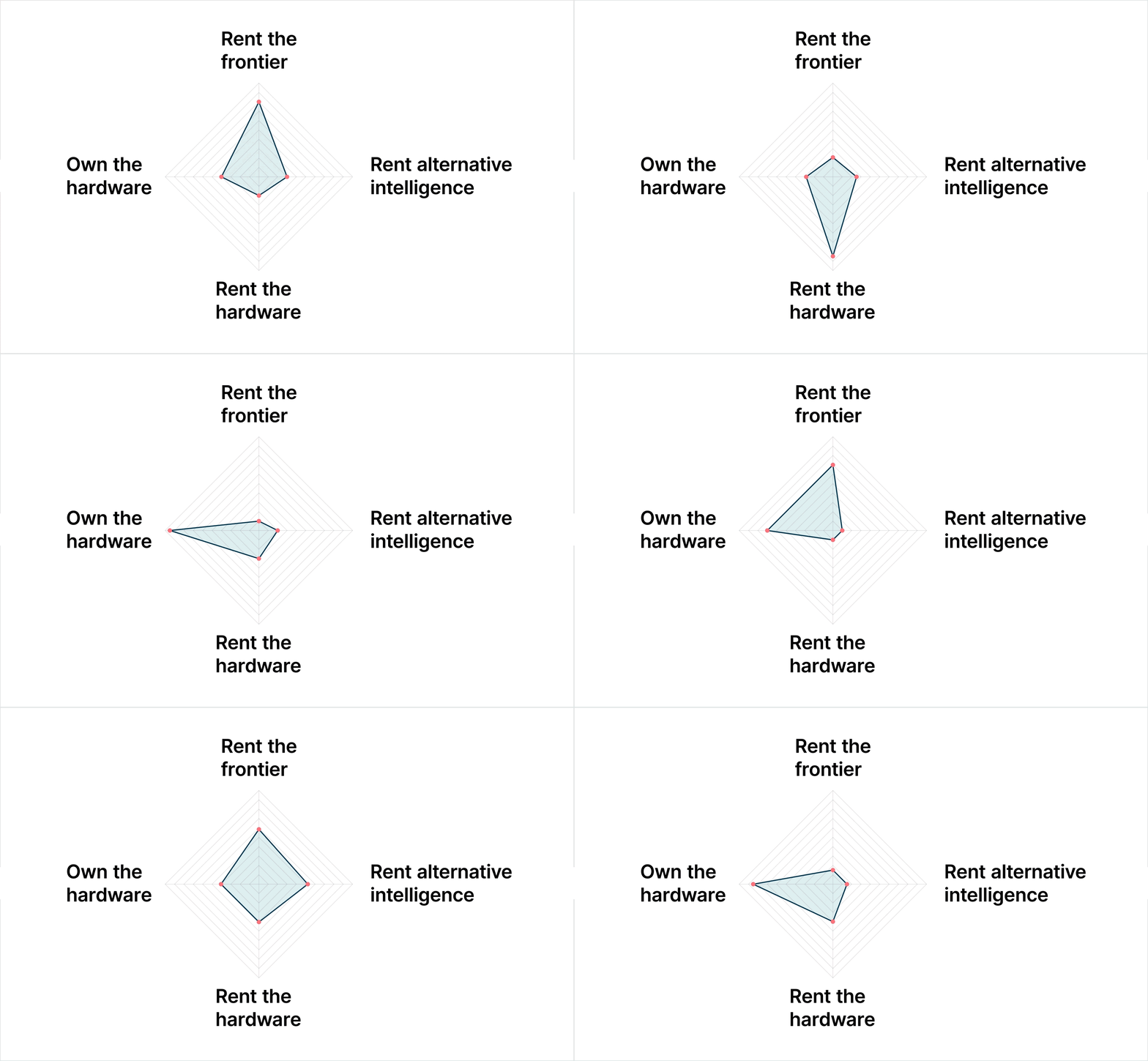
Most enterprises are already running a hybrid AI strategy, just not on purpose.
The unit of AI strategy is the workload portfolio, not the model. Most portfolios formed by default: one frontier provider for every task, because that's what got the first pilot live, and nobody has revisited the choice since. A hybrid AI strategy is the deliberate alternative of matching each workload to the sourcing model it actually needs, and building the operating discipline to keep making that call correctly as conditions change.
Thoughtworks AI Factory gives you the framework to decide, the architecture that makes switching cheap, and the proof points necessary to move forward with confidence.
The challenge
The window to build a deliberate strategy is closing faster than planning cycles move.
How we help clients
Assess
We map what you already run: the models, vendors and infrastructure behind your AI, and where each decision was made by design or by default. You leave with a clear picture of the hybrid you have today.
Strategy and roadmap
We work with your leadership team to decide, workload by workload, what to rent, what to run on models you control, and where dedicated infrastructure pays off. The roadmap sets out the steps to get there, with owners, costs and timing.
Thin-slice proof of concept
We prove the approach on one real workload and measure the result against your baseline. You see what changes in cost, quality and control before you commit more widely.
Ongoing service
Sourcing decisions need revisiting as models, prices and regulations change. We leave behind a managed service that keeps your strategy current. It can take the form of a subscription, a platform and tooling, dedicated people, or a combination.

Read our latest research
By Thoughtworks AI LabsChoosing and changing models requires evidence of how they behave under real conditions. Thoughtworks AI Labs investigates model evaluation, interpretability, robustness and control. Its researchers publish findings and, where available, code and datasets so others can examine the methods and build on the results.
Our work includes 1,000+ experiments on how changes in a query affect retrieval-augmented generation, including publications across NeurIPS, ICLR, AAAI, ACL, EMNLP, and IEEE.
FAQ
-
-
The best model for a workload changes, faster and faster every day. New models launch, prices fall, and open-weight models close the gap on tasks that once needed a frontier model. A single-vendor setup locks in today's choice, so you keep paying a premium for work that no longer needs it. It also concentrates risk: one vendor's price change, outage, policy shift or product move affects every workload you run.
-
The answer depends on the capabilities required. Rent where the market is commoditizing and the work gives you no edge. Own where the work draws on your proprietary data, carries regulatory or brand exposure, shapes what makes you different, or is the most economic. Most enterprises end up with a mix, set one capability at a time. The goal is to own your intelligence where it matters most, and to make that choice deliberately instead of by default.
-
Score each workload on actual data and a few questions. Can the data leave your boundary? Does frontier-level reasoning measurably improve the outcome? Is the volume high enough that unit cost dominates? Does the task need deep customization on your data? Workloads that need the strongest reasoning stay on frontier models. High-volume, stable tasks are usually candidates for open-weight models. Many enterprises run both inside the same workflow, using each where it performs best.
-
Set the standard before you test through continuous evaluation. For each workload, build a small test set from real production traffic and agree on the quality, cost and latency you will accept. Run a candidate model alongside the current one on live traffic, score the results against that standard, and move traffic in stages with a way back at every step. If a candidate meets the standard, you switch. If it falls short, you stay. Re-test when a new model launches, a price changes or quality drifts.
-
You stop paying frontier prices for work that doesn't need frontier capability. A hybrid strategy moves suitable workloads to lower-cost models, keeps premium models for complex, compliant tasks, and tracks cost per completed outcome instead of cost per token. Because you can move workloads as prices fall, you also capture the market's downward trend instead of staying on yesterday's rate. Our Token Economics page covers this in detail.
-
No. Purchasing hardware is one option among several. You can rent frontier models by the token, use open-weight models through a hosted provider, rent dedicated GPU capacity, or own the hardware. Most organizations use several of these at once, matched to the workload. Owning hardware makes sense when volume is high and steady enough to keep it busy, and/or when data cannot leave your boundary. Running that hardware well takes specialist operations skills, which is a reason to size the decision carefully.
-
Prove the strategy through one workload that has real and growing spend, or a data-control requirement. Establish a baseline for what it costs and how well it performs today. Then run a time-boxed proof of value that tests cheaper or better-fitting alternatives against that baseline, with quality safeguards in place. A first result on a single workload takes weeks, not quarters. Once you can show the number, extend the same method to the next workload. Get in touch to talk through which workload to pick.