














Diversity, equity and inclusion
How Women in Tech Are Forging Ahead


Think of scientists, list as many as you can in your mind. Now, remove the men from the list. Remove Marie Curie. Anyone left? For most, the list goes blank because there are simply not enough visible role models. This isn't because women haven’t been important figures in science, it is because they have been systematically hidden from how science is reported, celebrated and so makes its way into our collective memory. Let’s go over some of the reasons for this phenomenon.
This historical vacuum is the result of the Matilda Effect, a systematic prejudice where the discoveries and innovations of female researchers are overlooked, often resulting in the credit for their work being redirected to their male peers.
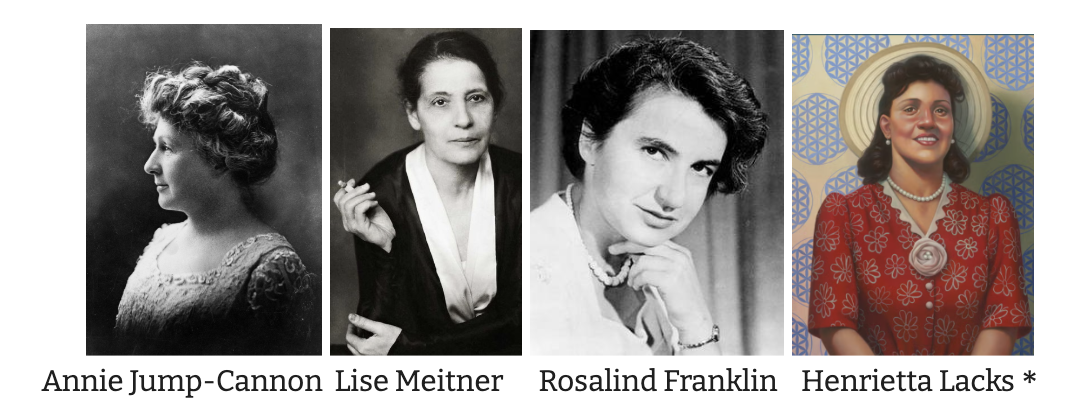
*Henrietta Lacks (HeLa): The Mother of Modern Medicine by Kadir Nelson, oil on linen, 2017
Take these remarkable women for example. Annie Jump-Cannon was an American astronomer who created the Harvard Spectral Classification system which is used to classify stars according to their emitted spectra. Her work was initially credited largely to the Harvard College Observatory institutionally and its director, Edward C. Pickering.
Lise Meitner was an Austrian physicist who should be recognized as the mother of nuclear fission, technology she researched with Otto-Hahn who won the Nobel Prize in 1944 without her. To add insult to injury, he then gets his own award (Otto Hahn Prize for Chemistry and Physics) which was awarded to Lise in 1955. Yes, that really happened!
Rosalind Franklin is arguably the most famous example of the Matilda Effect. Rosalind was an English X Ray crystallographer who took the famous first picture of DNA that allowed for the identification of its double helix shape. Her picture was stolen and published by a rival pair of researchers who then went on to win a Nobel Prize for it. Even though the injustices she suffered have been denounced and she is now largely credited for the discovery, Rosalind died long before she received any recognition.
Last but not least, Henrietta Lacks is proof that you don’t even need to be a scientist for science to try to forget your name. Henrietta was a woman of color and a tobacco farmer in the United States. In 1951 she went to John Hopkins hospital complaining of a “knot in her womb,” only to discover she had a very aggressive type of cervical cancer that would take her in less than a year. While in treatment, one of the doctors took a sample of her tumor and discovered the cells were immortal: They kept reproducing and not aging outside the body. Without Henrietta’s knowledge, these cells were harvested and used far and wide for clinical studies in human cells all over the world. From the polio vaccine, to HIV and cancer research and immunotherapy, her cells enabled a long list of medical discoveries that paved the way for new treatments for a plethora of health conditions. Even today, copies of the original sample are sold and used all over the world: HeLa cells. Not only were they taken without her consent, but her family had no idea the sample was cultured and sold for some 20 years after Henrietta’s death.
Another reason why women might not consider careers in STEM is gender bias, the discouragement begins long before the lab. Gender bias begins to affect self-perception as early as age six, when girls become less likely than boys to view their own gender as "really, really smart".
Pop culture and parenting reinforce these barriers:
Instructional vs. emotional: Parents tend to provide boys with "instructional" feedback linked to skill development, while providing girls with more "emotional" feedback.
Imagine a child falling in a playground while playing. For a boy, a parent is more likely to focus on the "how-to" of the recovery: "You're alright. Next time, keep your hands on the blue ones, they're easier to grip. Try it again." The fall is treated as a technical error in a mission. For a girl, the focus often shifts immediately to the "who" and the "feel": "Oh! Are you okay? That was a big scare, wasn't it? Come here, let’s make sure you're not hurt." The fall is treated as a personal, emotional event requiring comfort.
The toy gap: "Masculine" toys often promote spatial and math skills, while "feminine" toys prioritize appearance, influencing early learning and interests.
Think of building blocks, marbles and chemistry sets when compared to dolls, kitchen sets and secret diaries.
Narrative sidelining: In media, female characters often function as "mirrors" to define masculinity rather than having independent arcs.
Think of Mal, Di Caprio’s character wife in Inception, she’s not a part of the story outside of an embodiment of his guilt. Trinity in The Matrix is another example of this, while she’s a legendary hacker and a formidable warrior her primary narrative function is tied to a prophecy: she is told she will fall in love with "The One."
Character archetypes: There is a high prevalence of "Artificial Women" or gynoids in fiction categorized by the "male gaze".
Ava (Ex Machina) is a bespoke gynoid whose physical form is a weaponized reflection of the protagonist’s subconscious sexual preferences, designed specifically to exploit his empathy. Joi (Blade Runner 2049) represents the digital evolution of this trope, acting as a frictionless, holographic commodity that toggles her personality and appearance to suit a user’s shifting moods. Together, they illustrate the "male gaze" taken to its literal extreme: women stripped of independent interiority to become customizable utilities for male validation.
For the women who do make it into the field, the hurdles do not disappear. They face a systemic "leaky pipeline" driven by structural inequality:
The motherhood penalty: Mothers in STEM experience a 24% reduction in annual publication productivity compared to fathers in the first five years of parenthood.
Childcare infrastructure: Women in STEM are significantly more likely to be out of the labor force when childcare is unavailable, despite working more hours when they are active.
Domestic task imbalance: Even now, in 2026, women disproportionately shoulder the majority of mental load and unpaid care, creating a "double burden" that forces a higher probability of exiting the field.
Microaggressions: Eighty-nine percent of women report daily subtle slights. Underrepresented Minority (URM) women are 50% more likely to experience this, triggering even higher attrition.
These slights are often direct: "You made it to the lab, good for you. Now you can start by washing the things in the sink". Or, "You're teaching a workshop on electronics for women? Are you going to give them pink cables?".
Breaking these barriers requires active intervention.
Recognize and work on stereotypes: Actively challenge the internal and external gender biases that dictate what’s “for girls” and “for boys” and who "belongs" in science.
Provide opportunities: Ensure that women are given the same high-impact projects and leadership roles as their male colleagues.
Hold people accountable: If someone speaks over a colleague or makes remarks that are out of place, call it out.
Science is not "something girls don't do". It is something they have always done — it is time we stopped removing them from the list.
Disclaimer: The statements and opinions expressed in this article are those of the author(s) and do not necessarily reflect the positions of Thoughtworks.