














AI and ML
Quantifying AI adoption: From initial challenges to doubling speed


AI can write code in seconds. It can turn an idea into a prototype, generate tests, refactor code and help teams move from requirements to working software faster than ever before.
As a result, people are questioning the relevance of Agile.
Influencers across the tech industry are even declaring that "Agile is dead".
We need to ask a different question: What happens to Agile when the ability to build software gets dramatically faster? Agile becomes more important, and more alive, than ever.
In its literal sense, agile means the ability to move or think quickly, easily and with flexibility.
The industry debate often confuses the bureaucracy of process (sticky notes, story estimation, fixed sprint boundaries) with the core capability of agility.
AI changes the constraint. When implementation becomes cheaper and faster, the constraint starts to shift. The challenge is no longer just how quickly we can build, but how quickly we can learn, make decisions and respond to what we learn.
Speed alone doesn’t solve problems such as unclear priorities, slow decision-making, weak feedback loops or poor collaboration. AI can amplify both agility and dysfunction.
That makes agility more valuable, but it also changes what teams need to optimize for: not simply how much software they can produce, but how quickly they can turn an idea into an experiment, learn from it and decide what to do next.
As detailed in our Looking Glass report, AI-first software delivery represents an end-to-end shift across requirements, design, development, testing, deployment and maintenance.
This creates a new challenge: organizational friction.
If engineering can build in hours but decision-making takes months, the approval becomes the new bottleneck.
If teams can gather customer feedback quickly but product roadmaps remain rigid, faster delivery changes very little.
Organizational agility therefore becomes more than the ability of individual teams to work iteratively. It becomes the ability of the organization to make decisions, allocate resources, respond to evidence and change direction.
The goal isn't to remove governance or make every decision instantaneous. It is to make sure that governance matches the level of risk, rather than applying the same process to every change.
The bottleneck may no longer be how quickly we can build. It may be how quickly the organization can decide what to build next.
AI raises the stakes for overall organizational agility.
At Thoughtworks, Agile software development is built around small increments, close contact with business stakeholders and rapid feedback loops. AI can accelerate feedback loops across the delivery chain:
Instant discovery: A product manager can explore an idea with a customer and create a working prototype during the actual conversation using AI design tools.
Rapid implementation: A developer can move from prototype toward production implementation much faster with AI assistance, while relying on engineering practices and automated checks to validate the result.
Immediate evals: Automated tests and compiler checks evaluate behavior almost instantly.
Parallel exploration: Teams can evaluate multiple solution paths instead of committing to one approach prematurely.
For some classes of work, the distance between idea, experiment and feedback can shrink dramatically. The opportunity isn’t simply to deliver faster. It is to use that shorter feedback loop to learn faster.
This is where the conversation around AI and Agile often gets stuck. We focus heavily on AI increasing developer productivity, and it does. But productivity is only half the story.
If AI helps us build a feature in two days instead of two weeks, we face a strategic choice:
We can use the extra capacity to build more.
Or we can use it to learn more.
Building more should mean building more of what creates value, not simply producing more features because AI makes them easier to create. Learning more means testing assumptions about users and what actually works. Operationally, that can mean:
Testing more hypotheses.
Exposing work to customers sooner.
Killing weak ideas earlier.
Testing several competing approaches.
Collecting production evidence before scaling investment.
AI gives us more capacity. Agility tells us how to use that capacity.
The goal of Agile is not to maximize the volume of work completed, but to shorten the time between making an assumption and learning whether it was right. By reducing the time it takes to build, AI creates an opportunity to shorten that learning cycle as well.
When AI makes software easier and faster to create, teams can make smaller bets: smaller changes, experiments, releases and assumptions to validate.
That makes small-batch discipline more important, not less. Easier generation can tempt teams to produce more change than they can effectively review, understand or validate. Smaller batches make it easier to gather evidence while limiting technical and cognitive risk.
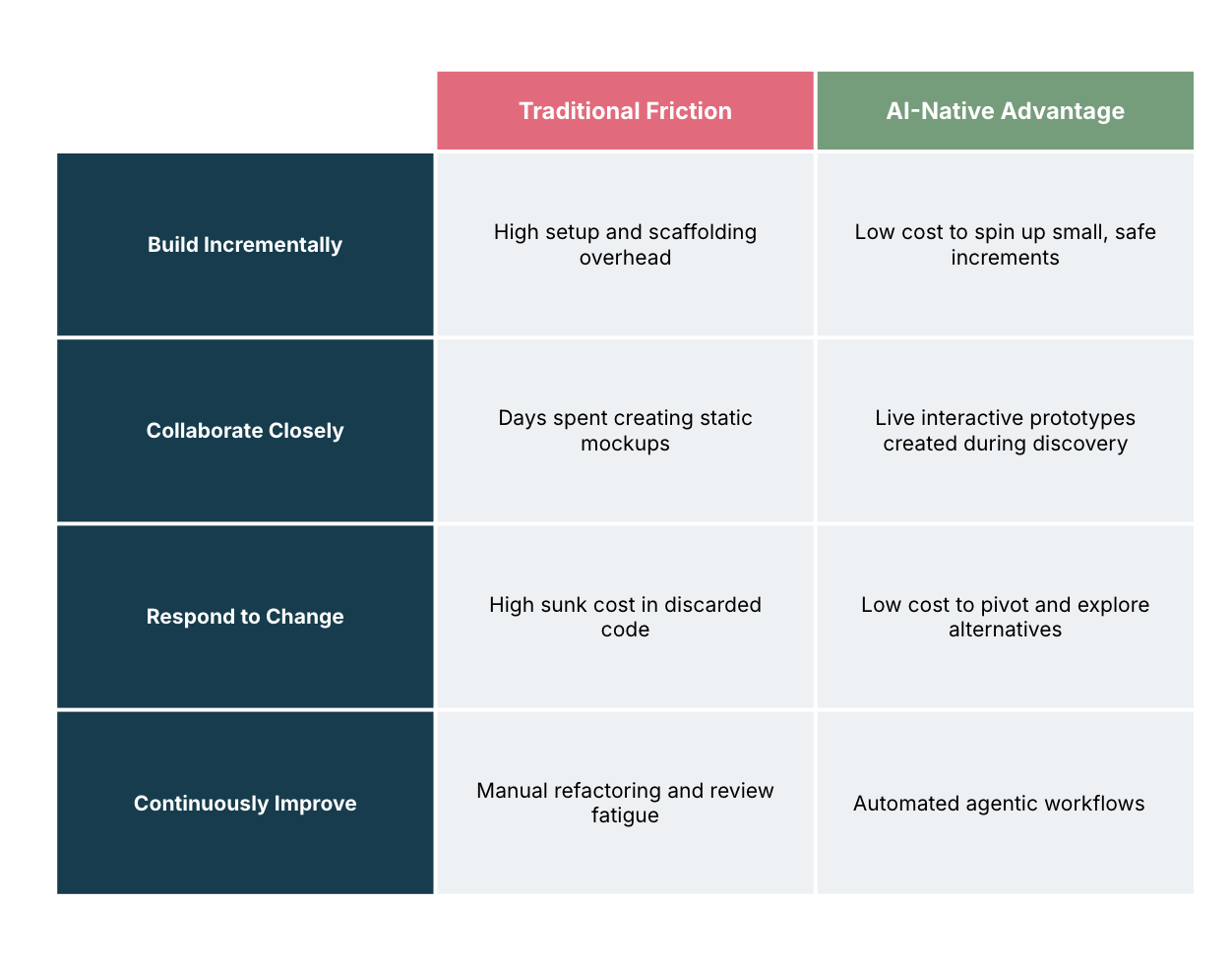
This shift does not mean every team must adopt a rigid "AI Scrum" or force sprints into one-week boundaries.
Instead, Scrum, Kanban, SAFe and other agile frameworks can adapt to an AI-enabled way of working. As they do, some Agile practices may become less important in their traditional form, while others become more important.
Backlog preparation
Routine documentation
Status reporting
Detailed estimation
Customer collaboration and discovery
Prioritization
Small batches and feedback
Quality and validation
Different frameworks will adapt in different ways, but the underlying shift is the same: some administrative practices can become lighter, while discovery, feedback, quality and decision-making become more important. That adaptability is itself an Agile principle.
Faster feedback from AI doesn't mean human feedback becomes less important. It changes where human feedback is most valuable.
Thoughtworks' Technology Radar highlights the emergence of feedback sensors for coding agents. By connecting AI coding agents directly to compilers, linters, structural tests and evaluation suites, agents receive feedback and self-correct during the coding process:

As machines take on more implementation details, human responsibilities shift.
Software roles are evolving beyond traditional syntax writing toward judgment, intent, architecture, validation and deciding what feedback matters.
When machines become better at producing options, humans must become better at choosing between them.
This doesn’t make human feedback a final approval step at the end of development. It makes human judgment part of a broader feedback system, helping teams define what good looks like, interpret evidence and decide what to do next.
AI can generate more options. Agile helps teams learn which options are worth pursuing.
AI does not make Agile obsolete. It changes what we can do with it.
For decades, Agile helped teams manage uncertainty by shortening feedback loops. Now that AI reduces the cost and time of creating software, we can make those loops tighter than ever before.
We can prototype faster, experiment faster, test faster, release smaller increments faster, learn faster and adapt faster.
The opportunity is not simply to build more software. It is to use that increased capacity to create more value, reduce uncertainty and make better decisions.
The ultimate competitive advantage may come from being able to think, learn and move with flexibility as the pace of technology increases.
AI helps us build faster. Agile helps us make the most of that speed.
Disclaimer: The statements and opinions expressed in this article are those of the author(s) and do not necessarily reflect the positions of Thoughtworks.