










Platforms
Navigating the messy middle: A guide to real product organization transformation


Commercialized products and platforms often over-simplify user expectations in order to deliver a product that is good fit for the majority target user group solving for a generic set of use cases. Consequently, the marketplace is flooded with off-the-shelf digital products that enterprises and users adopt and use almost immediately as compared to custom made software solutions. This works well until its effectiveness is tested in an environment where user needs are fundamentally diverse.
India is a sharp illustration of this challenge because it operates almost as two parallel realities — India and Bharat. The former refers to the urban, global-facing, English-speaking population, while the latter is more local, traditional and non-English-speaking, typically somewhat disconnected from the global economy. Each has its own behaviours, aspirations and level of digital maturity which only amplifies variability and diversity.
We faced this challenge in a project context, through a concrete problem statement: “How might we design a solution that is sensitive to existing diversity while still achieving a modern, unified enterprise platform for a leading Indian recruitment company? (For instance, the recruitment process for white collar worker like a Java architect is fundamentally different than a gig worker for food delivery platform like Uber Eats) ”
We further attempted to generalize our learnings to allow for repeatability, in terms of a framework that outlines a deterministic process to design for a fundamentally diverse environment, abstracted beyond a specific industry or geography.
The chart below illustrates the challenge of India’s diversity through a set of parameters relevant to the hiring industry context that we worked on.
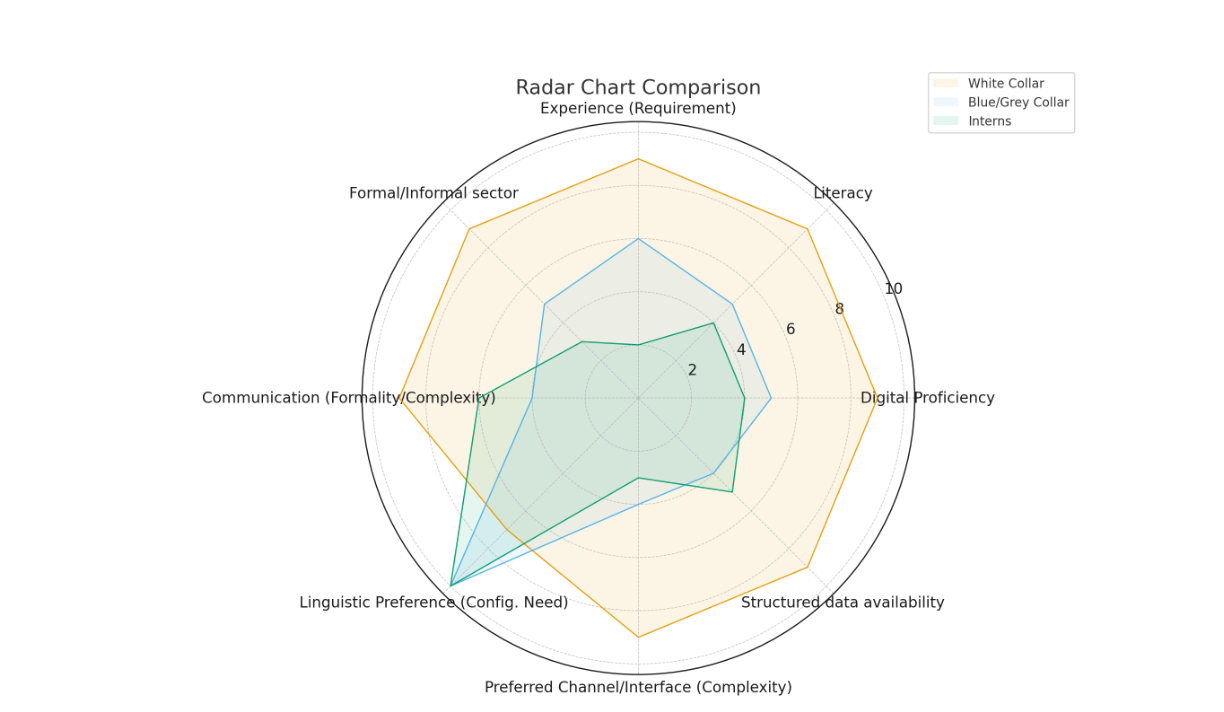
Whether you’re building a healthcare app, a retail store or a government program, the challenge is always the same: efficiency vs. empathy. On one side, you need standardized rules so the system can grow and stay organized. On the other side, you need personalized features so the system actually works for real people in their local context. This is a perpetual tension, on one hand building a "skeleton" that is strong enough to scale, but "muscles" that are flexible enough to adapt to the unique needs of the user.
Ethnographic diversity (e.g., India/Bharat):
How might we design one platform that successfully caters to distinct and diverse user sensibilities and behaviors without fragmenting the experience?
The product scale paradox:
How might we balance between the need for standardization for scalability with the need for localization for segmental requirements?
Transformation planning:
How do we thin-slice this transformation to ensure that value is delivered and received incrementally, without the risk of a "big-bang" failure?
While there is a plethora of AI tools readily available in the market, the answer isn’t a monolithic system or a complex mosaic of disparate and asynchronous point solutions.
From first principles thinking, we framed the idea of an optimally unified platform (OUP): a stable common set of capabilities across the core value stream, integrated with additional capability modules that are pulled into play depending on the specific needs presented by a scenario. Such an approach is meant to deliver value, upgrade independently and perform measurably.
Let us assume we want to build a platform for the recruitment industry for 3 different business verticals catering to 3 different employment segments with very different hiring processes. How do we define the common solution that works for all in such an environment? Do we try to solve every segment’s problem at one go or is there another way?
The goal of this OUP framework is to start simple, from a priority business with a set of needs that apply across verticals (despite their differences) and add specific features that are unique to this primary vertical. Then the platform goes through a series of versions where the common features are incrementally customised as more businesses or user types are onboarded and their specific needs are uncovered through continuous user research and discovery. This requires planning at the outset to embrace the complexity and scale of the future, by provisioning it in the architecture and functional structure at the outset.
This allows for a seamless way to manage the chaos coming from conflicting requirements from different business verticals or user groups, in a systematic and harmonious process.
We’re moving beyond the traditional MVP approach by weaving in more empathy than just adding features and also being more systematic about it. Instead of guessing which requirements matter most, we use continuous research to resolve conflicting needs with real-world data. This allows us to build a platform incrementally, that stays flexible for unique users while remaining stable and scalable at its core.
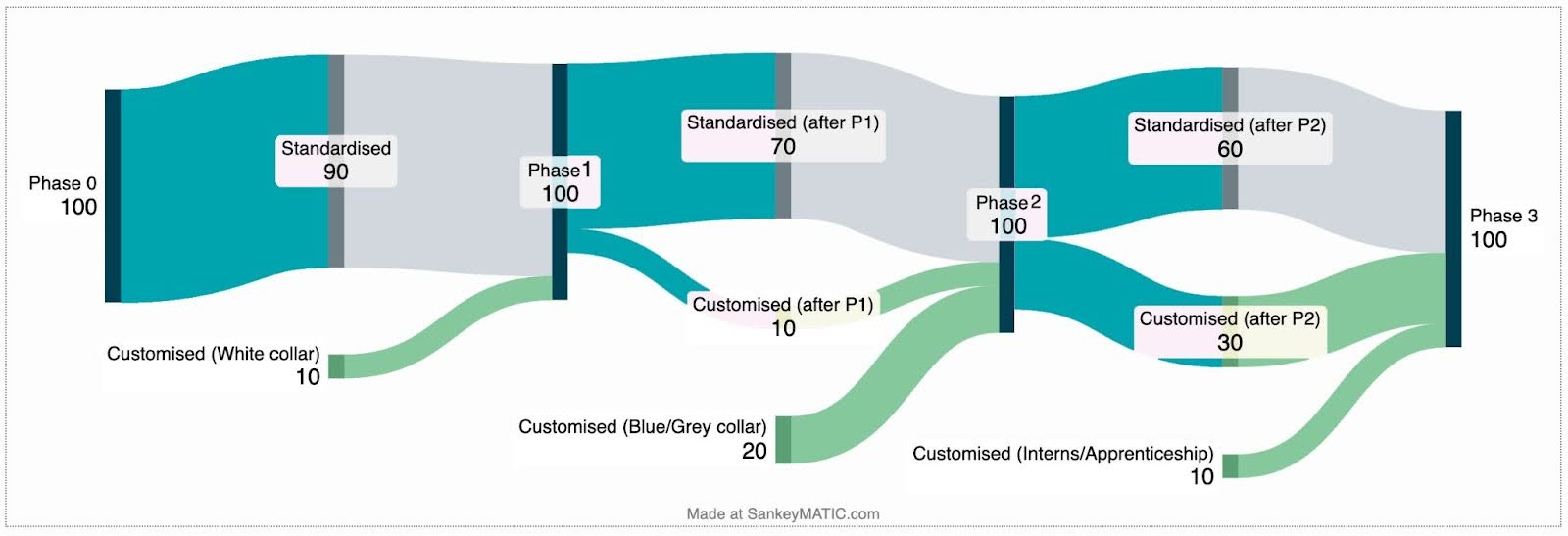
The progressive shaping process to build a MUP with ‘Continuous Discovery’ informing the level of Customisation on the platform evolution journey
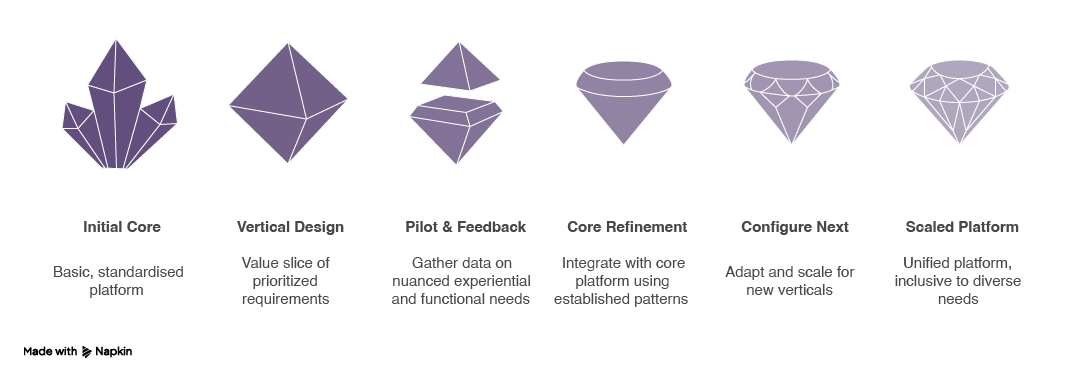
Evolution phases | Goal (balancing act) | Description | How we applied OUP for our hiring platform solution |
|---|---|---|---|
| Initial core: Define core homogeneity | Identify universal needs | Define the non-negotiable, common foundation required by all verticals (or business domains). This is the stable core that prevents fragmentation. E.g. For a Hiring platform a common core need can be Demand to Supply matching via Search (common core across business verticals), but the actual hiring process may require a variant feature of online scheduling and interview versus automated shortlisting for gig workers. | MUP Core V1.0 definition: Structured Data Model, Core platform services (across verticals) and Foundational AI/Search capabilities. |
Design thin slice: vertical A | Initial Customization via Configuration | Build the first specific user journey for one vertical/domain (e.g., 'white collar’), focusing on the most critical workflow. | Vertical A thin slice - White collar segment: |
Pilot and capture feedback | Measure harmonization vs. customization | Release the thin slice to a pilot group within vertical A. Collect structured feedback focused on relevance, usability and unmet needs. | Validated experience: Feedback logs and a clear classification of necessary platform adjustments as received from white collar hiring group |
Iterative core refinement: - Vertical A | Elevate universal patterns | Based on the feedback from the pilot, check if any 'customization' for vertical A is actually a universal pattern needed by other verticals. If so, move it into the MUP Core. | MUP Core V1.1: Mapping other BU (blue/Grey collar verticals) requirements to released features (white collar) and standardizing common workflows. |
Configure for next vertical: Vertical B | Adaptive customization & divergence | Introduce the next vertical/domain, leveraging the now-enhanced OUP Core and the learnings from vertical A, customising for vertical B as needed based on user research on vertical B | Vertical B thin slice: Continuous discovery extended to vertical B (blue/grey collar) shapes custom flows/features integrated to platform for next release. |
Scale & govern: Extension to vertical C and so on | Ensure unity across diversity | Roll out the refined platform horizontally, ensuring new verticals follow the same 'Configuration-First' approach. Establish governance to prevent ad-hoc custom development. | MUP governance model: Clear guidelines, architectural oversight and a roadmap for continuous core enrichment based on cross-vertical usage with additional vertical feature integrations (e.g. - Interns/Apprenticeship) |
The outcomes achieved through this approach are:
For the enterprise: Faster response to market shifts, lower cost of change, shared reusable services and consistent compliance and insight across regions or markets.
For the user: Experiences that feel personal—fostering language compatibility, supporting channel choice and guided journeys—thereby increasing trust, engagement and conversions.
Quantifiable results from the pilot project demonstrated a significant lift in match quality and achieved 100% internal user adoption during the organization's transformative shift to its new AI-enabled recruitment platform. Expectation is a 20–40% improvement in shortlist relevance and a 15–30% reduction in time-to-hire within the first year of implementation.
In retrospect, designing for diversity requires embracing its inherent differences instead of retro-fitting ready solutions. The optimally unified platform (OUP) approach helped us do exactly that in a predictable process.
Disclaimer: The statements and opinions expressed in this article are those of the author(s) and do not necessarily reflect the positions of Thoughtworks.