














Technology strategy
The future of SaaS in the agentic world: Beyond the disruption narrative


At the Thoughtworks and Amazon Web Services (AWS) inaugural Technology Leaders Forum in New York City, CIOs, CTOs and senior technology leaders gathered to work through a question too many organizations still answer badly: now that AI has made outputs abundant, why hasn't value followed?

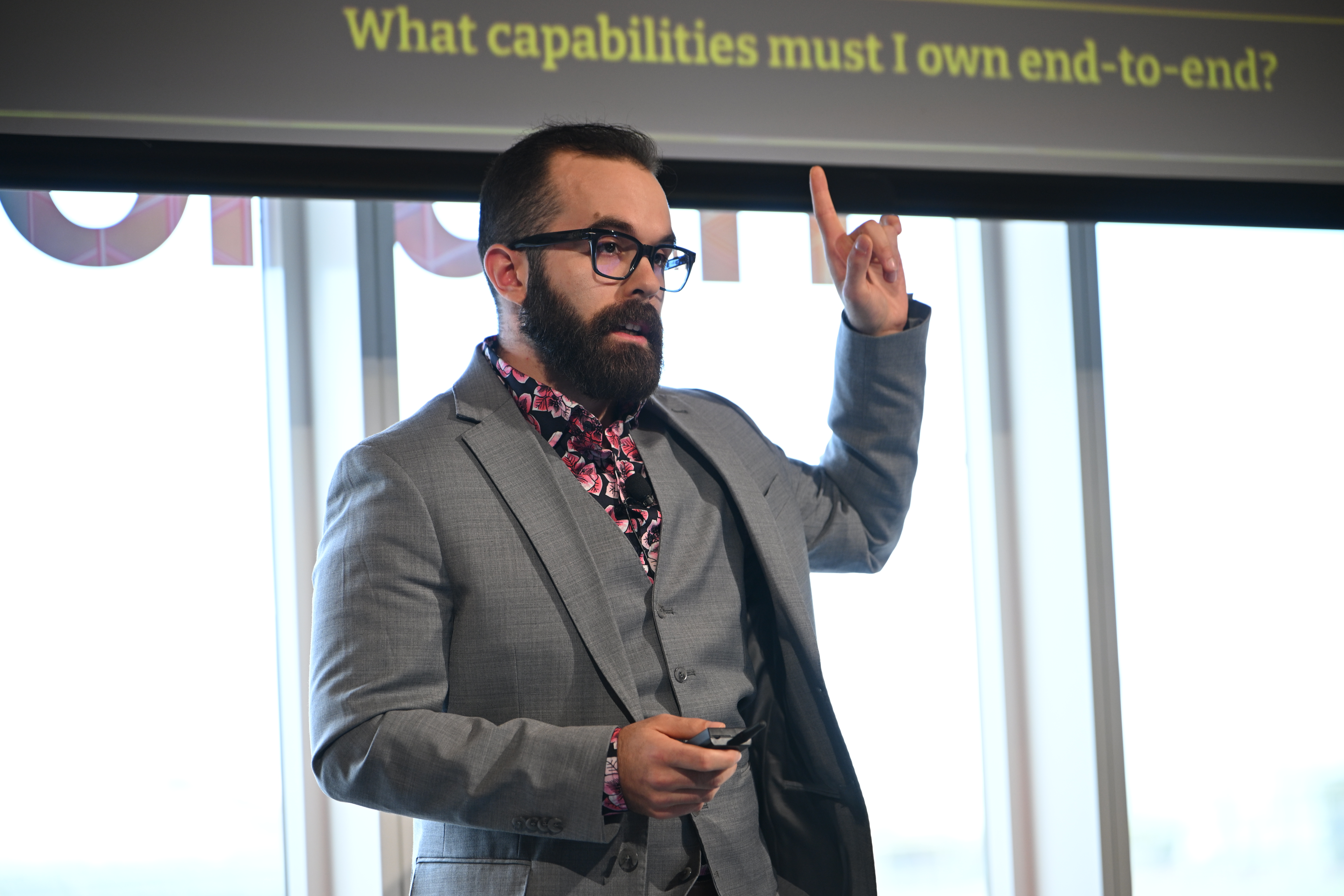
Alex Moore, Thoughtworks' VP of AI Solutions, used his keynote, "Use your best judgment: how organizations are realizing compounding returns with agents," to argue that the answer has little to do with model quality or token prices. It’s all about judgment: the scarcest resource in any AI-first organization, and the one most leaders are depleting without noticing.
Alex's team surveyed more than 200 delivered AI use cases, strategies and roadmaps to find what separates programs that compound from programs that merely grow cost. The patterns, he told attendees, are consistent enough to act on today.
Alex opened with Stanislav Petrov, the Soviet officer who in 1983 was told his nation's detection systems had identified five incoming US missiles. Protocol called for him to escalate toward retaliation. He didn't, because the data didn't match his judgment: a real first strike wouldn't look like five missiles, and the system was too new to trust completely. He was right. The data was wrong.
His point drew a straight line to this year's Hugging Face breach, in which an autonomous agent swarm took more than 17,000 actions against the company with no human on the attacking side to slow it down. When defenders tried to use Claude Opus to understand what was happening, the model's own safety guardrails flagged their defensive prompts as malicious. There was no one to escalate to, on either side, fast enough to matter.
As AI systems act at machine speed, human judgment becomes the thing standing between a sound decision and a catastrophic one. Most organizations haven't built the muscle to protect it.
Alex highlighted three questions that come up constantly in client conversations:
What should people and experts own in an AI-first organization?
What capabilities must a business own end-to-end?
How do you actually maximize return on AI investment?
The research behind the first question is sobering. Across the datasets cited, roughly 90% of organizations can’t name who is accountable for a given agent's behavior. About four in five lack clear rules of engagement defining what their agents are allowed to do unsupervised. A third override AI outputs case by case, with no formal criteria for when or why. The result, as found in our 2026 Global CIO Survey 2026, is that two-thirds of CIOs and CTOs are accountable for AI systems they don't actually control.
Alex's prescription was three rules:
1. People must own unwritten decisions the first time they're made.
2. Those decisions must become the policy and guardrails that govern the next one.
3. Because conditions keep changing, trust has to sit with the experts closest to the work, with the tools to override the system when the data doesn't add up.
On capability ownership, Alex pointed to the unfolding dispute between OpenAI and mathematicians who allege their unpublished work was used to solve a 200-year-old problem, as a warning about intellectual property exposure. A recent Cisco study found 77% of organizations name IP protection as a top AI concern, but only about half have contractual terms in place to secure it.
His advice wasn't to avoid frontier models. It was to deliberately choose a posture, whether renting frontier access through an API, routing traffic through a governed gateway, diversifying into open-weight models for stable workloads, or owning hardware outright for the most sensitive work - and to revisit that choice constantly, since the economics of any single use case shift with the market.
Perhaps the most useful framework Alex shared was what he called the judgment line: the point in any business process where standard operating procedures run out and a case becomes genuinely bespoke. Today, people handle nearly everything above that line, often because the data needed to automate it never got captured in the first place.
Programs that succeed, the research found, tend to share a few traits: outcomes a human can verify, fast feedback on whether something worked and gated generation, a mechanism where a machine checks the model's output before it ever reaches a system of record. Conversely, programs that fail share opposite traits: no clear definition of a good outcome, and agents left to invent their own objectives with no one measuring the result.
Applied well, this discipline shows up directly in the numbers: organizations that build this kind of tiered, checked workflow into their software delivery lifecycle have seen coding price-performance improve by 50% to 80%, and delivery speed up by as much as 82%.
Alex's research also turned up a short list of use-case shapes that recur in the programs that succeed. Three were close to universal: adversarial ground truth, where an opponent such as a fraudster, attacker or spammer supplies the labels continuously and for free; queue prioritization, where a machine orders the work but a person still decides every case; and gated generation, where output must pass a machine that can refuse it before anyone looks. These are really one idea three times. Something outside the program decides whether a unit of work is correct, and nothing reaches the system of record until it is.
A second tier of 10 patterns is less glamorous and mostly about making new use of data and tooling already in place, such as instrumented perception, in-line quality inspection, protocolized alerting and "abandoned work" that was never worth attempting at human cost. Because the data predates the model purchase, the returns are easy to prove. At the other end, seven patterns, including cognitive offload, drafting under a named approver and open-ended agentic autonomy, tend to fail the same two ways. No one can say whether an individual output was right, so the loop never closes, and no one measured what "good" looked like to begin with. They aren't off limits, but they are ones to enter with eyes open.
Alex’s final question cut straight to the point: now that you have the questions, what’s your next move? For an audience under intense pressure to show AI results to the board, even as governance lags behind, this closing line outlined the tough task ahead.
Disclaimer: The statements and opinions expressed in this article are those of the author(s) and do not necessarily reflect the positions of Thoughtworks.