














Token economics is the discipline of understanding what a piece of AI work actually costs, in the tokens a model reads and writes, and deciding deliberately which tasks should run on rented models and which should run on infrastructure you control. It connects a technical unit (the token) to a financial one (your AI budget).


Turn your AI spend into a number you can plan on.
AI is the only line in your budget that grows when the business succeeds, and nobody can tell you by how much. Thoughtworks AI Factory helps you match workloads to the right models, move the mission-critical workloads onto infrastructure you control, and a variable, vendor-set bill becomes a cost you can forecast and justify with ROI.
The challenge
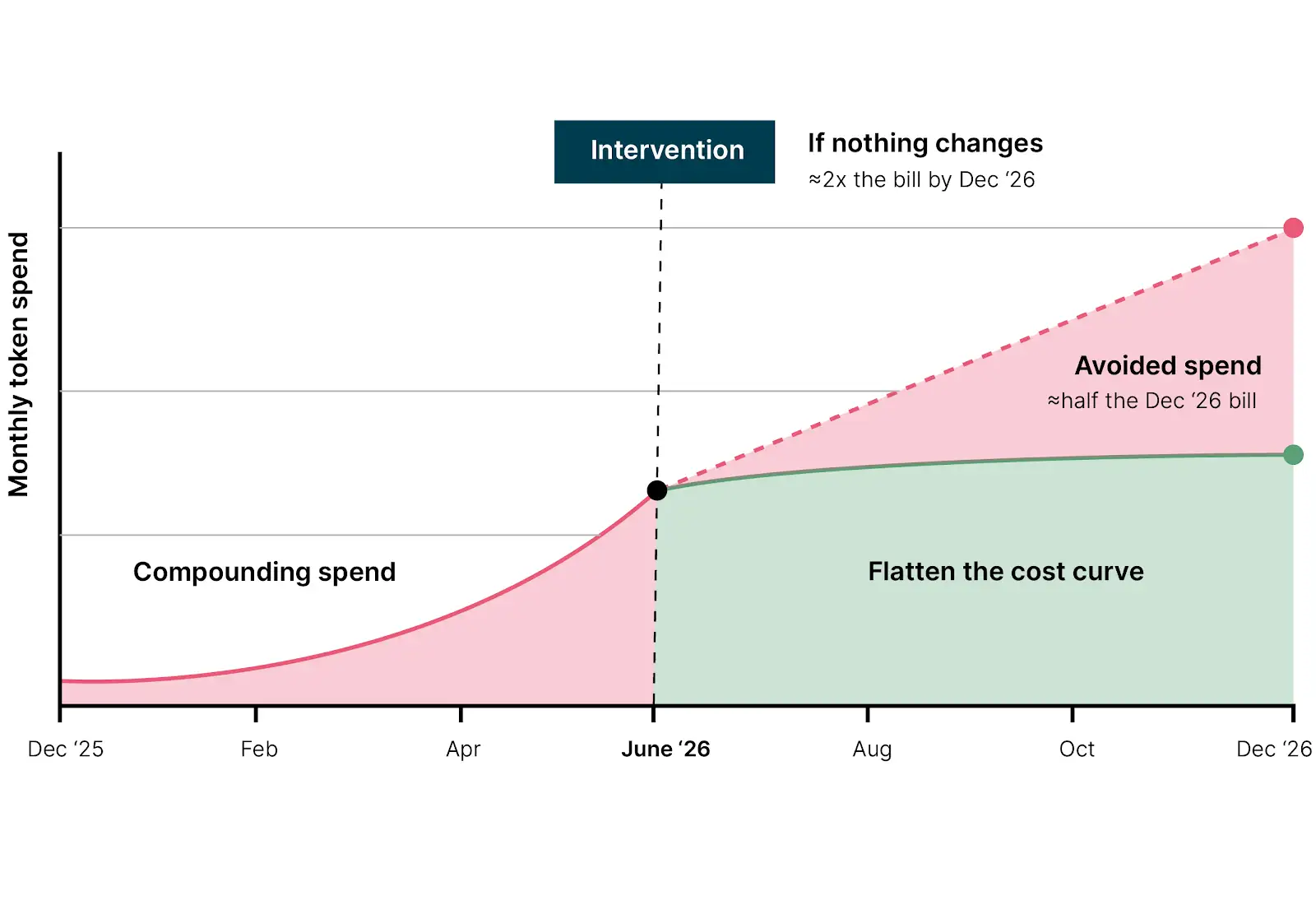
Token spend doesn't grow in a straight line
Once teams start relying on AI day to day, usage compounds month over month, and left unmanaged, that curve grows expotentially. Do nothing, and the run rate can double again within a year.
The spend itself isn't the problem. Spend without a plan is. Once you know which tasks need your most expensive models and which don't, you can route work deliberately instead of paying premium rates for everything by default. The bill still grows as you do more with AI. It just grows on your terms.
If you're reading this, you're probably living one of three moments right now:
How we help clients
Assess
We show you where your token spend goes: which models serve which workloads, what each costs per outcome, and where you are paying frontier prices for work that doesn’t need them. You leave with a clear picture of your spend.
Strategy and roadmap
We decide with your team which workloads should move to other models and which should stay where they are, and set cost and quality targets for each. The roadmap sets out the sequence, with owners and expected savings.
Thin-slice proof of concept
We prove the approach on one workload with material spend. We measure cost and quality against your own baseline, so you see the result before you commit more widely.
Ongoing service
Prices and models keep changing, so the right answer for a workload doesn’t stay right. We leave behind a managed service that keeps your cost per outcome falling as the market moves. It can take the form of a subscription, a platform and tooling, dedicated people, or a combination.
Read our latest research
By Thoughtworks AI LabsChoosing and changing models requires evidence of how they behave under real conditions. Thoughtworks AI Labs investigates model evaluation, interpretability, robustness and control. Its researchers publish findings and, where available, code and datasets so others can examine the methods and build on the results.
Our work includes 1,000+ experiments on how changes in a query affect retrieval-augmented generation, including publications across NeurIPS, ICLR, AAAI, ACL, EMNLP, and IEEE.
FAQ
-
-
Once a workload is high-volume and stable, the closed-API premium you're paying for often stops being justified. A misallocation audit, profiling spend by workload, is the fastest way to find out.
-
There is no single number — it varies widely by workload mix and how far along the AI journey a company is. We’ve seen the tipping point is typically between a quarter and a half a million dollars US for a single workload per year. For many organizations, they crossed that line on dozens of workloads over a year ago.
-
Our engagements typically target 30%+ reduction in coding AI spend, measured as cost per completed task with quality safeguards held against a baseline.
-
Token cost optimization is the fastest, most contained entry point, it fixes what a workload runs on today. AI Factory is the fuller operating model: gateway, governed multi-model serving, and the infrastructure to own more of your intelligence as volume grows.