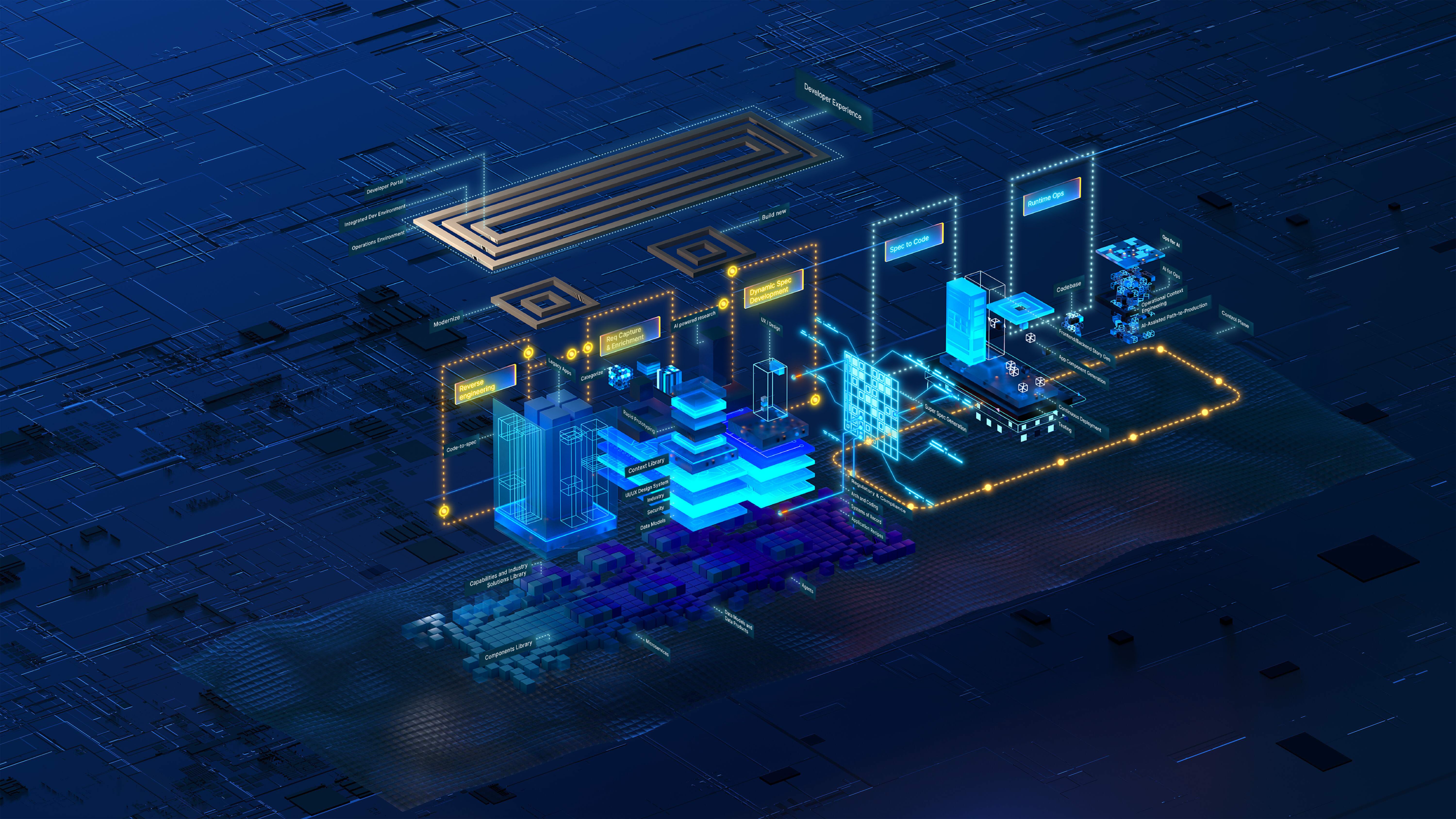
Developer Experience
A unified command center for developers, architects and operators — providing centralized access, visibility and control across the platform.
Developer Portal for Agentic Development Workflows
A central access point for agentic development workflows, specifications and generated artifacts.
Integrated Development Environment for Specification-driven Build
An integrated environment used to execute specification-driven development and testing workflows.
Operations Environment for Continuous System Evolution
An environment used to operate deployed systems and support ongoing evolution over time.
The AI/works Developer Portal transforms AI-generated code from isolated experiments into enterprise-wide capabilities. At its core are Golden Paths, pre-approved templates that encode your architectural standards, security practices, and compliance requirements into every project from day one. Workflows are the automation backbone. Every reverse-engineering and forward-engineering event triggers a defined pipeline. Security scans, architecture validation, and quality gates are consistently executed without manual intervention. The portal also exposes capabilities, industry-specific solutions, and microservices through a refined capability store. The result is compounding velocity. Each golden path created and each workflow refined becomes an organizational asset that multiplies across every team. AI/works transforms the developer portal into an engine that scales potential into enterprise-wide delivery.
Requirements Capture and Enrichment
Converts business needs into actionable specifications using coordinated AI agents — producing working prototypes in hours or days
Requirement Normalization and Categorization
Structures requirements so they can be enriched and executed by the platform.
AI-powered Research for Specification Enrichment
Uses AI-powered research to enrich requirements with relevant context.
UX Design Choices Embedded in Specification
Captures the leading, industry-relevant UX design systems.
Rapid Prototyping and Validation
Validates requirements and design intent during specification development.
Reverse Engineering
High precision, multi-language Reverse Engineering capability to provide a crystal-clear understanding of what the legacy system actually does.
Legacy Application Ingestion
Supports legacy applications as inputs into agentic modernization workflows.
Code-to-spec Reverse Engineering
Reverse engineers existing codebases to extract business logic and convert it into machine-readable specification.
AI/works begins by ingesting and comprehending your legacy codebase, stripping away decades of technical debt to reveal the core business logic. The platform's reverse engineering capability ingests the raw code and builds a comprehensive knowledge graph. It isn't just about the syntax. It maps entity relationships and dependencies. Once the graph is clustered, our agents analyze each capability in detail, separating what the code does from how it was originally written. The result is clarity. The platform generates as-is specifications containing functional flows, technical summaries, and architectural views. These documents let your business and tech teams validate the current state before we write a single line of new code.
Capability and Industry Solutions Library
Pre-engineered components, industry patterns, and agents — battle-tested, integration-ready and proven in real-world deployments. Reusable intellectual property delivering validated capabilities and industry solutions.
Pre-validated Capabilities and Industry Solutions
Reuses validated capabilities and industry solutions during specification development.
Components Library
Reusable technical building blocks of microservices, data models/products and agents. The library expands continuously with each project, compounding value and accelerating delivery over time.
Microservices Components
Reusable microservice components for application construction.
Data Models and Data Products
Reusable data models and data products.
Agent Components
Reusable agent components used during construction and runtime.
Context Library
A continuously updated, comprehensive, repository system-of-record specs, regulatory requirements,and UI/UX design systems — serving as the organization’s institutional memory, preventing teams from reinvention and ensuring consistency across projects.
UX and UI Design System Enforcement
Applies leading UX and UI design systems during specification development.
Industry and Application Specifications
Applies industry specifications and application-level constraints.
Regulatory and Compliance Specifications
Ensures regulatory and compliance requirements are applied continuously.
Architecture and Coding Standards
Applies Thoughtworks architecture and coding standards by default.
Security Threats and Conformance Measures
Integrates security threat considerations and conformance measures into specifications.
Data Model Specifications
Defines how data models are structured and used across the system.
Application Construction Recipes
Provides reusable construction guidance that informs how systems are built.
Dynamic Spec Development
The platform’s intelligence layer, generating the Super Spec — a comprehensive, AI-generated specification that can be refreshed as requirements change.
Dynamic Specification Development
Converges inputs from reverse engineering, requirements, context and libraries into a living specification.
Super Spec Generation
Generates a precise, machine-readable Super Spec that defines what to build and how to build it.
The Dynamic Spec Development process begins by defining the application you intend to build. Whether you are starting a greenfield project or modernizing a legacy app, simply select your target. Our intelligent parser doesn't just read your files, it understands the engineering intent behind every requirement. The platform then orchestrates your entire workspace – organizing requirements, extracting workflows, and identifying core capabilities with precision. The result is a comprehensive analysis of your project's DNA. In the design stage, the platform automatically generates a high-level system flow, mapping out API gateways, authentication services, and database schemas. Take full control of your stack, whether it's TypeScript and React for the front end, or Java and Spring Boot for the back end, AI/works ensures your architecture is modern, scalable, and robust. The platform extracts and suggests critical NFRs such as data integrity and API standards to ensure enterprise-grade compliance. It also generates a complete frontend wireframe flow from dashboards to loan application forms, ensuring a seamless user journey. Quality is built in. Our spec assistant uses AI to identify gaps like missing business use cases, and offers one-click fixes to ensure your documentation is comprehensive. Bridge the gap between design and logic. Easily link backend services such as notification systems or user management directly to your wireframes for a truly integrated specification. The platform then generates the precise specifications for every backend service required. Review your entire unified specification at a glance, covering both the frontend and backend. You have the ability to make modifications and updates at every stage of the dynamic spec generation process. Ready to build? Click “Initialize Agents” to hand off the spec to our autonomous Spec-to-code engine.
Spec to Code
The platform's code generation engine that transform Super Spec into production-ready applications. Delivers end-to-end technology construction by generating and deploying high-fidelity, fully tested code.
Front-end and Back-end Story Generation
Generates implementation stories directly from the Super Spec.
Application Component Generation
Generates application components from specification rather than manual coding.
Testing and Verification
Automatically generates and executes tests to verify correctness.
Continuous Deployment
Deploys generated code into target environments.
The Spec-to-code engine is the central command center for code and application generation. It uses specialized agents to help architect and build systems more efficiently. Here, we trigger the backend build. Multiple agents work in parallel to set up the microservices, automating the boilerplate so the team can get straight to the features that matter. Respective agents begin by ingesting the business requirements and mapping the necessary workflow. They handle the heavy lifting of drafting API specs and technical documentation. You can follow the logic in real time by logging every step from ledger ingestion to YAML generation. The system ensures the output is both predictable and easy to verify. Automation works best with clear oversight. The Spec to Code engine allows you to monitor agent status in real time and adjust workflows as needed. If your requirements change, you can stop a process and reroute the agent immediately. Keeping the human in the loop at every step. With the backend logic set, the frontend development agent begins its work. It references the initial user stories and design storyboards to ensure the interface reflects the intended user flow. The agent generates the essential components: business logic, API mappings and validation rules. The agent finishes the process by generating the necessary components, hooks and services. It focuses on creating a functional workspace, moving from your initial requirements to a structured code base. The output is organized into standard directories for assets, components, and utilities. This gives you a pre-configured foundation to start from, significantly reducing the initial setup time. Streamline your development cycle by moving from concept to application in significantly less time. Our spec-to-code engine helps you accelerate your roadmap and handle the repetitive tasks of early-stage builds.
Runtime Operations
AI-driven operations environment for continuous monitoring and maintenance. It detects change, updates the Super Spec, and regenerates impacted code to keep systems modern by default.
AI-Assisted Path-to-Production
Embed production-grade safeguards before AI-generated code release.
AI for Ops
Reduce operational toil, improve resilience, and manage tech debt.
Ops for AI
Ensure Runtime Ops AI agents and workflows remain traceable, controlled, auditable, and optimized.
Operation Context Engineering
Build operational context into AI agents, decisions, and workflows.
The runtime ops agent library holds specialized agents built to support post release operations. For each agent, you'll find everything required for adoption, from architecture and business value to system connectors. When ready, simply move to configuration, plug in your credentials, deploy, and start iterating. It's plug and play. Here, an engineer interacts with the alert agent directly in Slack, asking it to triage a live alert. The agent performs an AI assisted investigation and root cause analysis. It correlates signals, identifies the most likely cause, and generates a recommended fix. It also suggests improvements to help prevent recurrence. Each recommendation includes a confidence score, giving the team clear guidance on how strongly the system supports its analysis. Alert triaging, reimagined, faster resolution, greater reliability.
Control Plane
Centralized management of the platform’s AI infrastructure, delivering end-to-end governance, security, quality and cost control.
Unified Agent Co-ordination
Coordinates and manages AI agents across the entire software delivery lifecycle.
Cost and Usage Governance
Tracks AI usage in real time, linking token consumption to cost and enabling teams to set budgets and monitor spend.
Auditability and Traceability
Logs every AI action and human decision, creating a complete audit trail.
Policy Guardrails and Risk Controls
Applies centralized governance policies to detect and prevent risks, ensuring AI workflows comply with enterprise standards.
The real challenge in deploying AI agents lies in managing them effectively throughout the entire lifecycle. The AI/works Unified Control Plane is the orchestration layer built for these challenges. To scale responsibly, we need visibility. That visibility starts with cost. Our control plane introduces rigorous AI governance into your life cycle. We don't just track token usage. We map usage directly to cost and business value. We help you set strict budget caps at both the team and individual level. To avoid suprises, the control plane logs every human decision and AI action. You'll know exactly who approved what and which agent assisted. This offers a full audit trail and proof of compliance, giving you complete visibility into every AI action. True control is about standardized governance policies defined centrally and applied everywhere. These aren't just static rules. They are active guardrails. For example, if a user accidentally enters personally identifiable information like a social security number, the control plane automatically intercepts and redacts it so that it isn't stored anywhere in the system. We stop risk before it reaches production. We also create a traceable graph, providing you a complete lineage from the initial discovery activity through to build and run. This links every artifact to its parent and child elements. In the age of AI, speed is easy, but trust is hard. The control plane bridges that gap.
 Back
Back